There's a 28-minute audio summary of this file generated by Gemini Notebook here: https://
The earliest reference I found to the story that the SV40 virus was weaponized by beaming it with a linear particle accelerator was in Ed Haslam's 1995 book "Mary, Ferrie & The Monkey Virus". In the book Haslam claimed that he heard about the linear particle accelerator from his physics teacher in high school:
I had fairly good personal information that there was at least one linear accelerator in New Orleans in the 1960s: The Jesuit priest who taught physics in 1968 confided to our class that there was a linear accelerator being used 'for research' at a medical facility in New Orleans. And I think that it is reasonable to suggest that a doctor with Mary Sherman's reputation for researching treatments for bone cancers may have had access to it. But the question is: Did she?
In the original 1995 book, Haslam merely speculated that Mary Sherman might have had access to a linear particle accelerator, but he didn't yet claim to know where the accelerator was located. He wrote:
Did Mary Sherman have access to high energy radiation equipment? We should note what equipment was being put into medical facilities at the time. In 1959 Time magazine ran a cover article called "The New War on Cancer via Virus Research & Chemotherapy." In it, we read "Almost daily, ways are found to give bigger radiation doses more safely to hard-to-reach parts of the body." Their list of techniques included radioisotopes (cobalt-60, iridium 192, and yttrium 90), higher-powered X-ray machines and linear particle accelerators.[34] Was there a linear particle accelerator at one of the facilities where Mary Sherman worked? And if so, did she have access to it?
The real problem here is that the smallest viruses like SIV (and now HIV) are so small that they are even hard to kill with ionizing radiation.[35]
So what happens if you hit one, but don't kill it? What happens if you wound it with a stream of sub-atomic particles ripping through its strands of genetic information, mangling its molecules and scrambling its sequence? If you do, and if it is still capable of breeding, you now have a mutant. A new virus. One that behaves differently from the one you just mangled. It may be more virulent; it may be less. It may even behave differently from all other known viruses, since they evolved naturally and this new virus did not. This is the real danger. The moment you place a test tube full of viruses in front of a linear-particle accelerator, you enter a brave new world. And you become part of the biological history of our planet.
Was Mary Sherman using a linear particle accelerator to kill or weaken monkey viruses as part of a desperate attempt to develop an anti-cancer vaccine? Was she testing the results of those experiments in live animals in Ferrie's underground medical laboratory? Is this how good science goes bad?
Then he pointed out that Mary Sherman's autopsy report said that only a burned stump was left of her right arm, and a piece of her right rib cage was missing, and he speculated that the injuries couldn't have resulted from an ordinary fire. And then he wrote:
Finally it all came together for me. A scenario that explained all of the mysterious elements of the case in a logical manner. Here is how I would explain the events related to Mary's death.
On Monday Mary was going to work in a laboratory. Due to the unusual nature of this work, the normal day time traffic of doctors, patients, and staff would not be welcome. This work had to be done at night. Since she would be working late that night, she took Monday afternoon off to go to the dentist and to run an errand. In the morning she would be going to the Crippled Children's Hospital across the lake. The children were always happy to see her, even though they were the ones who suffered. She wanted to look happy when she saw them. It was one of the private joys of a childless widow. She laid out her festive black and white polka dot dress for her visit to see the children in the morning, not for a trip to the lab that evening. Then she washed her hair early, around 4:00 P.M., because she would not have time to do it later. She told her housekeeper, who was curious as to why she was washing her hair in the afternoon, that she was expecting visitors from out of town. A white lie, as it's called. It would not be proper to say that she was going to work on a secret medical project at the lab. After her housekeeper left, she slipped into some functional clothes and headed for the lab. There maybe she would finally find the elusive cancer remedy which she sought. Maybe tonight she would finally be able to neutralize the infinitesimal culprit that killed both children and adults so slowly and so painfully. Maybe this would be the step that made her dream of a cancer vaccine possible. The new machine had great potential. And it had been put in her hands. She was now standing on the leading edge of science. Her week of training in Boston would pay off now. She went to the lab with high hopes.
That night there was a terrible accident in the lab. It all happened in a brilliant flash of light. She had just completed irradiating a vile of blood and was going to remove the test tube from its holder. Without warning an electrical arc of unbelievable magnitude leapt from the machine and struck Mary in the arm. A virtual fire ball of overcharged particles flowed from the multi-million watt machine. A boulder of pure electricity struck her, beyond comprehension in its power. In an instant the massive electrical force lunged through her body, its intense heat and voltage literally blew her arm off and demolished the right side of her body instantaneously. Her body was destroyed almost beyond recognition by a blast of electromagnetic energy that lasted barely a fraction of a second. A flashbulb of violence. She never knew what hit her.
[And so on...]
So Haslam came up with an elaborate hypothetical scenario of how Mary Sherman died, and he even placed his story about the scenario within a blockquote. He made up fictional dates for his scenario, and he even came up with fictional feelings the characters in his scenario experienced. But he presented little evidence that his scenario had actually occurred.
Then he proceeded to write about "his guess" of what "probably" happened: "What happened in the lab that night? My guess is that Dr. Sherman was conducting leading-edge cancer experiments which were being kept extremely secret. This is why the work was being done at night. These experiments probably involved the use of a linear accelerator to kill or mutate known carcinogenic monkey viruses for the purpose of developing an anti-cancer vaccine. The results of these viral experiments were probably being tested in live animals in the underground medical laboratory which David Ferrie ran. Simply said, the risk of exposing an operation of these dimensions mandated Dr. Sherman's euthanasic termination and the subsequent obstruction of justice. But who sent the investigation on a wild goose chase, looking for a psychopathic lesbian butcher that never existed?"
In the 2007 book "Dr. Mary's Monkey", Ed Haslam introduced 4 new eyewitnesses to his story who were not featured in the 1995 book, who were Dr. X, Mr. Y, Mr. Z, and Judyth Vary Baker. All of them now corroborated his earlier hypothesis about the linear particle accelerator.
Supposedly Dr. X was a doctor who operated the linear particle accelerator in the New Orleans hospital, Mr. Y was the sales director of the company that manufactured the accelerator, and Mr. Z was the building manager of the building that housed the accelerator.
Haslam wrote:
Six months passed with little change. Then the phone rang. It was a cold winter night in January 1996. The voice was warm and familiar. It was a medical doctor who had quietly fed me information over the past several years. His kiss-and-tell stories about radioactive medicine and medical politics had encouraged me at a time when little else did. I will call him Dr. X, for reasons that will become obvious shortly. We had spoken often, but not in recent months. During those earlier phone calls, he frequently talked about his long career and detailed many of the people and places he knew along the way. Of particular interest to me was his experience with linear particle accelerators.
As a young surgeon in the early 1960s, Dr. X had worked at a well-known cancer clinic on the East Coast. Operating on cancer patients was his business. Day after day he removed tumors and repaired organs with varying degrees of success. The daily grind was an excruciating battle between life and death. As times changed, new technology brought new hope. Chemotherapy and radiation therapy offered alternatives to radical surgery, and brought new promises to both doctors and cancer patients.
Radioactive substances, such as Cobalt-60, were injected into patients in hope of destroying their tumors. It was a desperate hope. The side effects were often terrible. None of the medical staff liked the idea of injecting patients with radioactive substances strong enough to destroy living tissue. Nor did they like the idea of standing by watching countless patients die. They all hoped that things would get better.
Considering these circumstances, it was not surprising that Dr. X and his colleagues welcomed the introduction of the linear particle accelerator as a new, improved means of destroying cancer tumors. The accelerator's main advantage was that the direction of the radioactive beam could be controlled, aimed precisely at the tumor, rather than emitting radiation in all directions and into the surrounding tissue as Cobalt had done. Fewer healthy cells would be destroyed, and less radiation would penetrate the bloodstream. It was an improvement at least, and it offered new hope. The hospital spent millions of dollars on this new technology and renovated a building to house the huge machine, which Dr. X came to use on a regular basis.
In this setting Dr. X came to know the people who designed and built his linear particle accelerator. One was Mr. Y, the manufacturer's Director of Sales, who had sold the machine and who serviced the account. Mr. Y spent so much time at Dr. X's hospital that he rented an apartment nearby. Dr. X and Mr. Y became friends, as well as professional colleagues. At one point Dr. X sublet a room in Mr. Y's apartment, so for a time they were roommates.
Mr. Y was a colorful character, a Peter Paul and Mary vintage nonconformist with a Ph.D. in physics from Harvard. During the time Dr. X knew him, Mr. Y dated a beautiful French woman who danced with the Rockettes at Radio City Music Hall. According to Dr. X, Mr. Y's success was based both upon his brilliant mind and his father's close association with Harvard University's Board of Directors.[2] Dr. X gave me all the relevant details which I have stored safely.
Haslam wrote that the "hospital spent millions of dollars on this new technology", even though a 5 MeV LINAC only cost 150,000 USD in 1965. [https://
Even though Haslam was supposedly trying to protect Mr. Y's identity, Haslam gave out fairly unique identifying information about Mr. Y, because there are probably not too many people who have the combination of attributes that they were the director of sales of a company that manufactured linear particle accelerators, that they dated a French woman who danced with the Rockettes, and that their father had a close association with the Harvard board of directors. The last two details were not even relevant to the story.
But anyway, Haslam continued:
That January night, Dr. X's voice was more excited than usual. He began by telling me about his recent trip to Europe, and then he updated me on a research project that he had been working on. Finally, he turned the conversation to Mr. Y.
By this time, Mr. Y and his linear particle accelerators were a familiar subject to me. He had built about 10 accelerators around the world. Each one was uniquely designed for a special application. From Israel to South Africa to New Orleans, Mr. Y shepherded the design, sales and installation of some of the world's most mysterious machines. Dr. X had reminded me on several occasions that Mr. Y had known Dr. Ochsner.
This had been dangerous ground for me, and I had no intention of being manipulated into any accusations about Dr. Ochsner or Ochsner Clinic. Recall that my physics teacher at Jesuit had told our class in 1968 that the linear particle accelerator in New Orleans was not at Ochsner Clinic.[3] So I treated all these comments with caution.
Meanwhile, I had listened carefully for details which I might be able to confirm from another source. The problem was that there weren't many. Dr. X, however, kept encouraging me to look for evidence myself, evidence like a paper trail on the accelerator. At first he talked about licenses and permits. Since I considered this to be a covert operation, looking for an overt paper trail sounded like a giant waste of time.
Then Dr. X had reminded me that it would be difficult to hide a huge machine which required a three-story building and 5,000,000 volts of electricity. Perhaps there were records left in the files of the electric company. While this may have seemed like a reasonable route for a team of professional investigators, it sounded like a wild-goose chase down an obscured paper trail for an independent researcher like myself. And no one would leave a linear particle accelerator lying around.
But he had persisted. There must have been some kind of evidence left, even if the accelerator itself had been removed. Perhaps there was physical evidence, like special wiring needed for the massive amounts of electricity. I told him I needed more information about the site itself. Perhaps then, I could figure out where the machine had been located. The problem had been that Dr. X had not talked to Mr. Y in years. The last he had heard, Mr. Y had burned out on the stress and secrecy of exporting nuclear machinery and had got out of the business altogether. Dr. X hadn't even been sure that he could find Mr. Y anymore.
Now, that had changed.
Dr. X said that he had stopped on the East Coast to attend a medical meeting on his return from Europe. On the spur of the moment, he decided to try and locate Mr. Y. After several phone calls from his hotel room, he located his old roommate and invited him out for a drink. They met at a local restaurant and reminisced about old times. Eventually Dr. X got his friend to talk about the accelerators he had built. Finally Mr. Y talked about New Orleans.
Here is a summary of what Dr. X said he had been told about the linear particle accelerator project Mr. Y supervised in New Orleans:
The project was extremely secret. Mr. Y had to sign a secrecy contract with the government before taking on the project, and he could not disclose the exact location of the accelerator.
The design of the accelerator was unusual. Normally an accelerator intended for medical use had clinical access features, like ramps for wheel chairs or beds for patients to lie down on. Here there were none. In fact, the intended use was in some form of laboratory experiments which required that the radioactive beam be split into equal portions for identical doses of radiation.
The overall design resembled an octopus. The accelerator's particle gun was located on the top floor of the building. The beam pointed down, toward the ground, and struck a pyramid-shaped metal structure on the bottom floor. The pyramid divided the main beam into several smaller beams of equal intensity, and deflected them into series of containment chambers which encircled the pyramid. The targets were placed in the containment chambers, which were specially designed to hold heat and radiation. The metal pyramid was made out of platinum.
The financing was unusual. Since linear particle accelerators cost millions of dollars, the machines were usually purchased on long-term contracts which were paid off over many years. But this case was different, the entire amount (approximately $10,000,000) was paid in advance.
The method of payment was unusual. Mr. Y received five or six checks in varying amounts within one week. Each check came from a different company and was drawn from a different bank. (So much for the paper trail.)
Mr. Y went to New Orleans frequently during the construction of the machine, but once it was completed, he did not go back to the site for a long time. Suddenly there was a problem. He was sent to New Orleans to survey the situation. When he got there, something was obviously wrong. The accelerator building was guarded by soldiers with machine guns.
Inside the building there were thousands of mice in cages. They were doing some kind of vaccine experiments. Dr. Ochsner was in charge. Mr. Y described him as tense and extremely suspicious.
Mr. Y was particularly annoyed to discover, upon his return home, that military intelligence had been investigating his girlfriend while he was away tending to the accelerator.
What a bombshell! This was the worst-case scenario. At first, I hardly knew how to react. Needless to say, I had serious questions about the reliability of the information. Was this true? Or disinformation? Was I being handed the most important information of my investigation? Or was I being set up? Had I been given easily-verifiable information for over a year, only to be handed a red herring at the last minute? Or was I being lied to by someone with a hidden agenda?
Next Haslam zeroed in on the US Public Health Service Hospital as a likely location of the particle acceleration based on a kind of lame chain of reasoning, which was that Mr. Y said that the site where the accelerator was located was guarded by soldiers with machine guns, so Haslam reasoned that the accelerator cannot have been located at a hospital where the soldiers would have drawn too much attention, but a building at the Public Health Service Hospital was surrounded by tall walls that could have hidden the soldiers from sight.
He wrote: "Mr. Y went to New Orleans frequently during the construction of the machine, but once it was completed, he did not go back to the site for a long time. Suddenly there was a problem. He was sent to New Orleans to survey the situation. When he got there, something was obviously wrong. The accelerator building was guarded by soldiers with machine guns." And he wrote: "As I compared my location list with Mr. Y's story, the focus became obvious: the machine guns. There were very few places where soldiers with machine guns could wander about without making the patients extremely nervous. To do so would attract attention and thereby compromise secrecy. I quickly eliminated high-traffic facilities, like Charity Hospital and Ochsner Clinic, from my list." Then he wrote:
I started looking around and noticed a group of old buildings across the street. They were surrounded by an unusually high brick wall. I studied the scene carefully. Several buildings were visible. All had pitched roofs and had been built of brick in the federal style of architecture common to the years before World War I. Fungus grew on the portions of the wall shaded by the ancient oak trees. I realized at the time that I had never seen anyone go in or out of this facility. In fact, it appeared to be abandoned, all of which made it seem rather mysterious. The windows of the building closest to the wall looked to be boarded up from the inside. The general appearance was very governmental, and very spooky. I wondered what it was.
Finally, I asked my mother. She said that it was the back entrance of the U.S. Public Health Service Hospital, and that I should be quiet and listen to the speeches. I had obliged, as best I could, but actually was busy pondering what a great location the U.S. Public Health Service Hospital would be for covert operations. Trucks full of whatever could drive in through the wooden gates on one side of the campus, and cars could enter from the other. Once the gates were closed, no one on the outside would have any idea what was happening inside.
Whoa! Covert operations!... Machine guns! I snapped out of my reverie of recollections. The U.S. Public Health Service Hospital was operated by the U.S. military. Here was a place that could have had soldiers with machine guns. And who would go into a quarantine station unless they had to! What a great place to set up a secret laboratory!
It seems highly unlikely that Haslam would've randomly thought that a hospital building would've been a great place for covert operations, because the building was surrounded by a tall wall and it looked "very governmental, and very spooky".
Next Haslam introduced another anonymous source called "Mr Z.", who was supposedly a retired building manager of the hospital:
The campus had about ten buildings, one massive building which was the hospital itself, and nine or ten smaller buildings, some of which were residential in design. Mr. Z's first task was to plan for the renovation, so he had to thoroughly inspect all the buildings and inventory the situation. Mr. Z noted that all of the buildings, except one, were in comparable condition, with old desks and file cabinets full of papers scattered throughout the buildings. It was what one might expect to find in old government buildings whose funding had been gradually phased out. The only exception was a three-story building toward the back of the campus. It was completely empty. There was not a single desk, file cabinet, or piece of paper in the entire building. It had been swept clean. Everything had been carried off, except two pieces of medical equipment: a large microscope and a tissue slicer used for making microscope slides. It had obviously been some type of laboratory.
Mr. Z had been trained as an engineer, and had worked with electrical systems in large buildings his entire career. He knew what to expect. He remembered the building with the microscope because the electrical wiring was very strange. In fact, he had never seen such heavy wiring in a building before. It had obviously been for extremely high-voltage electrical equipment, more powerful than any he had ever encountered. The equipment had been removed, but the wiring was still there. Mr. Z also noted that some of the rooms had very unusual features. One room had metal walls which were grounded by heavy cables. He described the other room as a circular shaped "operating room" on the ground floor. It was surrounded by a group of small airtight rooms which were completely lined with one-inch thick asbestos sheets on the doors, walls and ceiling.
So as in the case of other key pieces of evidence Haslam presented in his book, he again relies on unverifiable anecdotal information, which he does not back up with any documentary sources or physical evidence. Haslam claims to have received several key pieces of anecdotal evidence from sources that are either anonymous or dead, so outside investigators cannot question the sources about whether Haslam is telling the truth or not.
During an interview in 2019, Ed Haslam said that the company that made the supposed linear particle accelerator in New Orleans was High Voltage Engineering Corporation (HVEG) from Boston. [https://
Haslam said that Mr. Y was the "Director of Sales" of the company. An article from 1965 said that the E. Alfred Burrill had been the "Vice-President" of HVEC since 1957 and the "Marketing Director" since 1960. [https://
An article from 1951 said that "High Voltage Engineering Corporation manufactures electrostatic generators above the million-volt range for cancer therapy, industrial radiography, nuclear particle acceleration, food and drug sterilization." [https://
Grok said:
No, there is no documented evidence that a linear particle accelerator (linac) has been used specifically to accelerate the mutation rate in a virus study. Linacs have supported virus research through structural imaging (via X-ray production) and inactivation/sterilization experiments, but not targeted mutagenesis of viruses.
Radiation can induce mutations in viruses by damaging their nucleic acids, but linacs are rarely chosen for this purpose due to their high cost, large size, and complexity. Easier and more common methods exist:
UV radiation is the simplest and most accessible way to accelerate viral mutation rates. It causes specific DNA/RNA lesions (like thymine dimers) that lead to errors during replication if not repaired. Labs routinely use UV lamps for this in virology experiments.
Gamma rays from cobalt-60 sources or low-energy X-rays from standard lab irradiators are widely used for radiation-induced mutagenesis in microbes and viruses. They are compact, well-controlled, and far less expensive than a linac.
Electron beam irradiation from dedicated (often smaller) accelerators has been applied in some inactivation or plant mutagenesis studies, but again, not routinely for viruses.
Heavy-ion beams from specialized accelerators can produce higher mutation frequencies and broader spectra than low-LET radiation like X-rays or electrons, but these are also not linacs and remain specialized tools. For most virus mutation studies, chemical mutagens (e.g., nitrous acid) or error-prone replication systems are even simpler alternatives to any radiation.
In short, while linac-generated radiation could theoretically induce viral mutations, it offers no practical advantage and is far more cumbersome than standard UV, gamma, or X-ray sources.
As support for his hypothesis that SV40 may have been mutated through the use of ionizing radiation, Haslam quoted a book titled "Zoonoses of Primates" from 1966, which said: "There is, therefore, a serious danger that viruses from such closely related groups as simian primates could show an altered pathogenesis in man, of which malignancy could be a feature. The dangers of such happening are enhanced by man's exposure in crowded cities to oncogenic agents and increased radiation hazards." However the author seems to have said that human exposure to carcinogens (oncogenic agents) and radiation made humans more susceptible to developing cancer, and not that carcinogens or radiation would've induced dangerous mutations in viruses.
In the 2007 book Haslam wrote:
This particular point was dramatically demonstrated by a man named Jack Nygard, an engineer at a company in Boston which manufactured linear accelerators.[18] Nygard developed ingenious new commercial applications for linear accelerators, from preserving bananas to cross-bonding wood. By shooting particles laterally through plastic-laminated wood, Nygard created a new structural matrix inside the wood. The result was an ultra-hard super-wood that would never warp. It was the perfect low-maintenance solution for the bowling industry. Nygard turned entrepreneur and set up shop in the heart of the lumber industry near Seattle, Washington, where he began producing his super-wood on a commercial scale. His success continued until the day the technician running his accelerator did not notice that Jack had stepped into the wood-processing area. When the technician flipped the switch on the 5,000,000 volt machine, it was the last anyone ever saw of Jack Nygard.[19] The beam of electro-magnetic radiation burned him to the point of disintegration. They swept up his ashes. (Or so the story goes.)
Footnotes 18 and 19 both said only "Roberts interview." The footnote before them said: "Dr. John Roberts, surgeon and president of the Medical Legal Foundation, interviewed by author, October 3, 1994. Roberts was one of the doctors who used linear particle accelerators to destroy cancer tissue, preferring it to Cobalt-60 because it could be controlled more precisely, minimizing destruction of healthy tissue."
The passage was otherwise nearly identical in the 1995 book, but the sentence "(Or so the story goes.)" was missing. So it seems like in the 2007 book Haslam included an additional caveat that the story might not be reliable. Another difference between the two editions was that the footnote in the 1995 edition said "Roberts was one of the doctors who used linear particle accelerators at Sloan Kettering to destroy cancer tissue", but the words "at Sloan Kettering" were omitted from the 2007 edition.
A newspaper article from 1968 said: [https://
John Nygaard, well-known physicist and electrical engineer, was killed yesterday when he touched a high-voltage power line at the Applied Radiation Corp. plant in Walnut Creek.
Nygaard, of 1172 Saranap boulevard, Walnut Creek, was dead on arrival at John Muir Hospital. He was 47 years old.
Nygaard was a pioneer in development of the linear accelerator used in cancer research and treatment. Applied Radiation Corp. is one of only two plants in the country currently building such machines and Nygaard headed the advance research and development division of the company for about two months.
Officials of the plant, at 2404 North Main street, said he was discovered unconscious near a 450-volt power line. They added he apparently fell into the line, but the cause of the accident was unknown.
The article didn't say anything about his body having disintegrated, and Walnut Creek is in San Francisco and not Seattle.
Another obituary of Nygard said that he was the "manager of advanced development at Applied Radiation Corporation" in San Francisco. [https://
Grok said:
Patents: John C. Nygard was a real inventor with ~17 patents, mostly related to high-voltage equipment, waveguides, microwave linear electron accelerators, scanning systems, and power supplies while at High Voltage Engineering Corp. (Lexington/Waltham, MA area). None of the patents describe wood treatment, wood crosslinking, particle irradiation of wood, or "super-wood." His work focused on accelerator technology itself, not downstream industrial applications like wood processing. [https://
patents. ]google. com/ patent/ US2816231A Wood Irradiation Technology in General: Electron beam (EB) or gamma irradiation for treating wood did exist in the 1950s-1970s era. Researchers explored:
Radiation-induced crosslinking or polymerization of monomers impregnated into wood (creating wood-plastic composites).
Improving dimensional stability, hardness, or decay resistance.
These were experimental or niche applications (e.g., for flooring, tool handles, or specialty items), often funded by the Atomic Energy Commission. However, they typically involved impregnating wood with chemicals first, then irradiating - not simply "shooting particles laterally through plastic-laminated wood" to create a super structural matrix.
Commercial success was limited. Most radiation-cured wood products stayed small-scale due to cost, penetration issues, and competition from cheaper chemical treatments. No mainstream records link this to bowling lanes or a Seattle-based venture. [https://
radtech. ]org/ magazinearchives/ Publications/ RadTechReport/ jun- 2014/ Enhanced% 20Wood% 20Durability% 20from% 20Radiation- Cured% 20Penetrants. No Corroboration for Nygard's Role: Extensive searches for "Jack Nygard" or "John C. Nygard" + wood, super-wood, bowling, crosslinking, irradiation, or Seattle lumber yield zero contemporary news articles, technical papers, company records, or industry mentions. The story appears only in Haslam's book (sourced solely from the 1994 John Roberts interview).
Preserving Bananas: Radiation for food preservation (including fruits) was researched in that era, but again, no link to Nygard.
Seattle Move and Commercial Production: No public records (business filings, news, patents filed from Washington, or industry directories) show Nygard setting up a super-wood company near Seattle. His SSDI death record lists California, though the accident was reportedly in the Seattle area.
Haslam claims that both Mary Sherman and Jack Nygard were killed by a 5 megavolt linear accelerator. It might be more accurate to refer to 5 megaelectronvolts than 5 megavolts, because Grok said:
A linear accelerator in this context is correctly described in MeV (mega-electronvolts), not megavolts. When older popular writing, such as in Haslam's book, refers to a "5,000,000 volt" or "5 million volt" linear accelerator, it is using a loose and somewhat outdated shorthand. This phrasing originally came from early electrostatic accelerators like Van de Graaff generators, where the voltage was used directly to describe the machine.
In modern technical usage for linear accelerators, the energy of the accelerated electrons is specified in MeV, which measures their actual kinetic energy. A "5 MV linac" typically means the machine accelerates electrons to approximately 5 MeV. Today, photon (X-ray) beams produced by linacs are labeled in MV, while electron beams are labeled directly in MeV.
When the story claims Nygard was killed by a "5,000,000 volt machine," it almost certainly refers to what is properly called a 5 MeV linear electron accelerator. Such machines were realistic and common during Nygard's era in the 1950s and 1960s. High Voltage Engineering Corporation and other companies built compact microwave linacs in the 4-10 MeV range for both medical and industrial applications, including material processing and experimental wood-plastic composites. Medical linacs of that period also commonly operated in the 4-6 MeV range.
Haslam's source for the story about Nygard was John Roberts, who seems to have been a conspiracy theorist who claimed that AIDS was caused by polio vaccines, because an article from 1996 said: "In February 1994 I received a call from John Roberts, who said he was working for a foundation in San Francisco that had been working on blood and blood-product-related legal aspects of AIDS for nine years [42]. He said he was supporting a massive lawsuit against the Federal Drug Administration and others for giving children AIDS via polio vaccines, and claimed to have informants in the Wistar Institute and elsewhere." [https://
A newspaper article from 1993 said that the parents of an 11-year-old with AIDS were "working with the Medical Legal Foundation in San Francisco to pursue a possible link to the vaccine", and the parents suspected the AIDS may have been caused by an "oral polio vaccine made with ... monkey cells that were contaminated with HIV". [https://
In his original 1995 book, Haslam presented no solid evidence that Mary Sherman was working on SV40 or even any monkey virus. ChatGPT said:
The book does not present direct, concrete documentary evidence that Mary Sherman was specifically working on SV40. Instead, it builds an indirect, circumstantial argument, and even acknowledges significant gaps. The "evidence" is therefore inferential rather than explicit.
First, the author ties Sherman to cancer research involving monkey viruses in general, not SV40 specifically. She is described as running a cancer laboratory, working in pathology, and operating in an environment where monkey virus research - especially cancer-causing viruses - was active and well known. This establishes that she had the expertise and institutional access to work with such agents, including viruses like SV40, but it does not prove she did so.
Second, the argument relies heavily on Jim Garrison's Playboy interview, which is described as the only document referencing the alleged Ferrie-Sherman cancer experiments. The text explicitly states that this interview is essentially the sole documentary basis for claiming Sherman's involvement in an underground lab conducting cancer-related work. This is critical: the claim rests on a single, second-hand assertion rather than laboratory records, publications, or physical evidence.
Third, the book introduces contextual scientific background about SV40 and contaminated polio vaccines to suggest a plausible research focus. It notes that SV40 was a known cancer-causing monkey virus present in vaccines and central to debates about viral oncology. By placing Sherman within a network of researchers connected to institutions like NIH and NCI, the author implies she could have been involved in efforts related to these viruses, possibly even vaccine-related research. However, this remains speculative linkage rather than proof.
Finally, the author openly concedes the lack of hard evidence, emphasizing missing testimony, unavailable documents, and uncooperative key witnesses. For example, attempts to obtain confirmation from Garrison's chief investigator failed, leaving the central claim unverified.
Haslam claimed that when he was 10 years old, his father who worked with Mary Sherman at Tulane University said: "They're researching monkey viruses down at the med school. Some of the more deadly ones are coming in from Africa." Tulane University does in fact have a primate research center, which has performed research on viruses like SIV, SARS, Zika, and simian varicella virus. [https://
Haslam discussed the overall history of research on monkey viruses, and he discussed SV40 contamination in polio vaccines, and he wrote about how several viruses that caused cancer in humans were specifically simian viruses. And he pointed out how Alton Ochsner killed his grandson by injecting him a polio vaccine that contained a live polio virus, so Haslam speculated that Ocscner might have been interested in studying polio vaccines as a result of the incident. Then he jumped to the hypothesis that the cancer-causing virus mentioned in the Playboy article would've specifically been SV40.
The prisoner who was infected with Sherman's virus is supposed to have died 28 days after the infection. But SV40 doesn't even cause particularly fast-acting cancer. When I asked if a weaponized or mutated form of SV40 could cause a very fast-acting cancer, ChatGPT said:
SV40 (Simian virus 40) is well studied in virology and cancer biology. It can transform cells by interfering with tumor-suppressor proteins (notably p53 and Rb), which is why it has been widely used in laboratory models of oncogenesis. But that transformation is only an initiating step. Cancer development generally requires multiple additional changes - genetic instability, evasion of apoptosis, angiogenesis, immune escape - before a tumor grows large enough to cause symptoms.
Even in aggressive malignancies, the timeline is constrained by cell division kinetics. A single transformed cell must undergo many rounds of replication (often tens of doublings) to form a detectable mass. That process typically takes months to years, not days or weeks. Some cancers (like certain leukemias or lymphomas) can appear to progress rapidly, but even those arise from a buildup of prior cellular changes rather than an immediate, explosive onset after a single exposure.
Engineering a virus to accelerate oncogenesis would face several bottlenecks:
Latency of tumor formation: Viral oncogenes can push cells toward uncontrolled growth, but they do not instantly produce a tumor burden large enough to cause acute illness.
Host immune response: A highly immunogenic or cytotoxic virus would likely be cleared or would kill cells before sustained tumor growth occurs.
Biological trade-offs: Mechanisms that make a virus more acutely destructive tend to reduce its ability to establish the kind of persistent, subtle infection typically associated with cancer-causing viruses.
In practice, viruses linked to human cancers (e.g., papillomaviruses, Epstein-Barr virus) are associated with chronic or latent infections and long latency periods before malignancy appears. SV40, in particular, has not been established as a cause of rapid-onset cancers in humans.
So while you can hypothesize about modifying viral properties, the idea of an SV40-derived agent causing near-immediate, "fast-acting" cancer runs against fundamental constraints in tumor biology.
In the 2007 version of his book, Haslam relied on statements by Judyth Vary Baker as additional evidence that Sherman's lab was exposing viruses to radiation. He wrote that "part of Judyth's daily operational cycle was to bring 'the extracts' of her cancer-causing virus research from Ferrie's apartment to Mary Sherman's apartment". However he wrote that one of the questions which neither he or Baker could answer was "Which monkey viruses did the project's radiation genetically alter? Was SIV one of them?"
He also wrote:
If "the project" in New Orleans was intentionally exposing SV-40 to radiation, they may have exposed SIV to radiation at the same time. Simply stated, HIV-1 is a mutated form of SIV.
Did the mutation which changed SIV into HIV-1 occur when SV-40 was exposed to radiation? Was this the moment of conception of AIDS? Could this artificially-induced mutation explain why HIV-1 is mutating so rapidly? Why it is behaving so "unnaturally"?
In the book "Me and Lee", Judyth Vary Baker wrote that she was hired by Mary Sherman who "needed a lab assistant familiar with handling the carcinogenic SV-40 virus and fast-growing cancers". She also wrote:
Originally, these viruses came from monkeys, but they had been enhanced with radiation. The virus we were most concerned with was SV40, the infamous carcinogenic virus that had contaminated the polio vaccines of the 1950s. But the science of the day was not terribly precise, and cross-infection between species was common in the monkey labs. So it was impossible to know if we were working with SV40 only, or a collection of viruses.
We assumed there were probably other viruses traveling with it, but whether it was SV40 or SV37 or SIV did not really matter to us. What mattered was whether it produced cancer quickly. For our project, these cancer-causing viruses had been transferred to mice because they were more economical than monkeys, and the viruses thrived just as easily, which is why mice are so widely used in medical research.
Grok said: "Mouse cells are considered non-permissive for SV40 replication. The virus can enter the cells, express early genes (especially the large T antigen), and transform them in cell culture, but it does not complete a full replication cycle to produce new infectious virus particles." Grok also said that "wild-type SIV (Simian Immunodeficiency Virus) does not productively infect normal (non-humanized) mice, and it does not cause cancer in them", and that "mouse cells lack the proper receptors (such as CD4 and the correct co-receptors) and intracellular factors needed for efficient SIV entry and replication". And of course humanized mice were not yet available in the 1960s.
In an email in 2000, Baker wrote: "In reality, Dr. Sherman and other Ochsner-sponsored associates such as myself had found the precursor to AIDS. SV-40 and other viruses had been altered, probably using a linear accelerator (location unknown) in order to produce a virus that was to be used to knock out the immune system– the true precursor of today's AIDS." [https://
However in her 2009 book, Baker now indicated she knew where the particle accelerator was located: "Once Dr. Sherman had determined which samples showed the most promise, she would take them to yet another lab in uptown New Orleans, where the carcinogenic viruses would be exposed to high-voltage radiation, in hopes of mutating them."
It seems weird that even though the linear particle accelerator played a central role in Haslam's book, I found only a single direct reference to a linear particle accelerator in Baker's book, which was in a footnote where she wrote that Mary Sherman visited London in 1963, and that "London is a short train ride from Oxford, England where a Linear Particle Accelerator just like the one she used in New Orleans was located (see Dr. Mary's Monkey)". So Baker now again stated it as a fact that Sherman used a linear particle accelerator in New Orleans.
In a 2003 documentary about her story, Baker said: "This test had to be done within 72 hours. And on August 31, 1963, Lee Oswald drove me up to Jackson. I was wearing my little white outfit so I looked like a nurse type. I was taken by the orderly up through a freight elevator and then into this area. This person I was taken to see, who was one of the prisoners who had been injected, was in a bed by himself, and I noticed it once that he was thrashing about and he didn't even know where he was. He was quite ill already. This is only within 72 hours of being injected with this material and having been subjected to these high doses of x-ray." [https://
In her book Baker wrote: "I found it very interesting that Ruby died 28 days after being diagnosed with cancer, just as the prisoner in Jackson had done, and that shortly before he died, Ruby told family and friends, 'I have been injected with cancer cells.'" So she may have come up with the detail that the prisoner died in 28 days because of Ruby's story. Ruby was admitted to hospital on December 9th 1966 with what was initially thought to be pneumonia, but he was then diagnosed with lung cancer, and he was announced to have cancer in a newspaper article dated December 10th, which was only 24 days before his death. [https://
In her 2010 book Baker wrote that the prisoner at the Jackson mental hospital was injected on August 29th, and that Oswald received a phone call on September 23th telling him that "the prisoner had died", but there's 25 days between the two dates and not 28 days.
In the 2007 book Haslam wrote:
A woman had been introduced to me (and my girlfriend Barbara) as "Judyth Vary Baker" at a party near Tulane's campus in uptown New Orleans in October 1972. The exact location was on Pitt St. near the corner of Dufossat St., behind the Ladder Library on St. Charles Avenue. It is important to point out that our invitation to this party was the result of an argument that I had had several days earlier concerning David Ferrie's underground medical laboratory, and whether viruses could actually cause cancer in humans. My opponent was the Latin American graduate student, mentioned in Chapter 4, who had previously made comments to Barbara about Dr. Ochsner's connections to Nazi scientists in South America.
At Barbara's suggestion, we had gone as a group to a cafeteria on Tulane's campus for coffee. Several other graduate students joined us there. What began as a polite discussion about local lore and Jim Garrison's investigation into the JFK assassination descended into an argument about the scientific accuracy of my comments about cancer-causing viruses. A particularly volatile point was the fact that I said that this fellow's hero, Dr. Ochsner, had said that "sex could cause cancer." Several days later Barbara complained to me that since that conversation in the cafeteria, none of her fellow graduate students had spoken to her: "You have to make up your mind whether you are going to be the recognized expert on the Garrison investigation, or whether you want to be my boyfriend."
I assured her that I was more interested in being with her than in discussing the JFK assassination, and agreed not to discuss it around her friends. Several days after that watershed conversation, Barbara announced that my "performance in the cafeteria" had gotten us invited to a party. Barbara was anxious to attend the party in hopes of regaining her social standing among her graduate school colleagues. She invited me to accompany her to the party, on the condition that I could "control myself." Therefore, when the hostess of this party told Barbara that she had been a friend of Lee Harvey Oswald when he lived in New Orleans and invited me to discuss the Garrison investigation with her, I asked Barbara if we could leave. Barbara agreed, and we immediately left the party.
Two weeks later, this "Judyth Vary Baker" contacted Barbara, and invited us (as a couple) to dinner at her home (without any other guests). I reminded Barbara that this woman had said that she had been a friend of Lee Harvey Oswald, and I said that I did not want to go to any dinner with her. Barbara declined the invitation.
When 60M said they were investigating "Judy Vary Baker, I thought this was the same person. She was not. Was I being set up to discredit the real Judy Vary Baker should she ever emerge from hiding? Or was I given her name so that I would recognize it when she did? I don't know. For a more detailed account of this incident, see my video interview by Jim Marrs posted on www.DrMarysMonkey.com.
When it became clear that the woman introduced to me by 60M was not the same person I had met in 1972, I realized that I now had two separate women claiming to be "Judyth Vary Baker", who both claimed to have known "Lee Oswald." Simply stated, one had to be an impostor. With the information available to me at that time, I could not tell 60M which one was the impostor. I hoped that they would be able to tell me.
What are the odds that Haslam's girlfriend happened to live in David Ferrie's mouse lab, and even though Haslam did not yet even know at the time that the apartment had previously served as Ferrie's lab, he had an argument with someone about the topic of Ferrie's lab and cancer viruses, which led to Haslam being invited to a party that was attended by an impostor who claimed that she was Judyth Vary Baker?
In the book "Me and Lee", Baker wrote: "When I first talked to Edward T. Haslam he told me he had met a woman in New Orleans in 1972 who said her name was Judyth Vary Baker, and that she had been a close friend of Lee Oswald. Whoever this woman was, it was not me. Once we met, and he saw I was not the same woman, Haslam accepted that someone had gone to the trouble of presenting him with a double in an attempt to mislead him and discredit me." Supposedly at the time Haslam was not even researching Sherman's story, so why would someone have been sent to mislead Haslam? Maybe Haslam incorporated the detail of his debate about the mouse lab into his story in order to explain why the impostor would have been interested in him.
In the afterword to the book "Me and Lee", Jim Marrs wrote: "For those who continue to question her legitimacy, one can only ask: who was the Judyth Vary Baker claiming knowledge of Oswald who met author Ed Haslam in 1972 in New Orleans? (See Dr. Mary's Monkey for details) It was clearly not the same Judyth Baker of today.[2] Someone was impersonating Judyth, who had left New Orleans nine years previously, which lends great support to the idea that a very dangerous secret was being preserved through cover-up and misdirection at a high level." Footnote 2 says: "In 1995, I read an obscure and self-published book by an unknown author named Edward T. Haslam, the son of a New Orleans doctor, who decided to investigate the murder of Dr. Mary Sherman, a physician who had worked with his father at Tulane Medical School. Haslam had also mentioned Ochsner, Sherman, Ferrie, Oswald and a plot to kill Castro. I called Haslam, and asked him if he had ever heard of Judyth Vary Baker. He had. At the time I also questioned his claims regarding the polio vaccine contaminated by a monkey virus. Today that scandal has been confirmed and reported by mainstream news outlets. I met with Haslam in Dallas on two separate occasions (2002 and 2003) to interview him on camera about Judyth. Haslam said that in 1972, as a college student at Tulane in New Orleans, he had met a woman who said her name was Judyth Vary Baker, and she had been a close, personal friend of Lee Harvey Oswald. She also had questioned Haslam closely about any information he might have concerning the JFK assassination. The problem was that, years later, when Haslam was introduced to the real Judyth Vary Baker by 60 Minutes, he realized the first had to have been an impostor, since Judyth did not live in (or visit) New Orleans at the time. So who knew about JVB's connection to Oswald in 1972, and why would they go to such lengths to impersonate her? Haslam did not have an answer, but he was determined to find out more about the curious woman."
Haslam's website has a link to his 2003 interview with Jim Marrs, but I didn't find the 2002 interview anywhere. [http://
It seems likely that Haslam came up with the impostor as an excuse for why he had earlier claimed that he met Baker in 1972. But who did he have to come up with the excuse for? In the scenario that Jim Marrs was controlled opposition and he was in on the scam by Haslam and Baker, then Haslam wouldn't have needed to come up with the excuse to convince Marrs, in case Haslam mentioned the meeting with Baker only in a private conversation with Marrs. But it's possible that Haslam mentioned the meeting in the 2002 videotape or some other place.
Haslam's 1995 book had no reference to the impostor Judy, the party in 1972, or the argument with the Latin American student.
In 2026 there were 21 BitChute videos that matched Ed Haslam's name, but 13 of them were posted by John O'Loughlin, who recorded an audio narration of Haslam's book. O'Loughlin also recorded an audio narration of the TrineDay author Adam Finnegan's book, who has interviewed both Haslam and Baker.
In 2019 Haslam did a two-part interview with John O'Loughlin in person.
In part 1 Haslam said: "And one way to mutate a virus very quickly is with radiation - gamma-ray radiation - you stick it in front of a linear particle accelerator and flip it on, you're going to mutate the viruses that are in the test tubes. Now, SV40 is a pretty large virus in comparison to SIV, alright. Now, they're trying to mutate SV40. Why? They're trying to make a vaccine to stop the cancer-causing virus in the polio vaccine. That's their initial goal. It is risky, but it is noble. So, the point is, if you shoot radiation, gamma-ray radiation, which is the stuff above X-ray, it's a really powerful stuff, into a test tube that's got SIV and SV40 in it, all right? What happens if you wound those guys and don't kill them? What happens if you wound SIV and scramble its DNA or RNA - it doesn't have any DNA, it's an RNA virus, ok - but if you scramble its genetic structure with the radiation, you have just created a new virus that never existed before. And if that gets into the human population, you got a really big problem. And I find that to be - I listed all of the possible causes of AIDS that were listed in literature, all that stuff - and the one I just explained to you is my contribution to the list. And I think it makes really solid scientific sense. And the scientist that I have talked to said, 'Yeah, that's how it works.' Okay? But none of them want to go near a microphone." [https://
In part 2 Haslam said: "I think, frankly - my take on it is that what they don't want to tell us is that tens of millions of dollars of CIA-laundered money was used to pay for a medical Manhattan project, which used a linear particle accelerator to mutate cancer-causing monkey viruses, because the government had authorized the release of 200 million doses of the polio vaccine that were contaminated with cancer-causing viruses. And then they tried to turn it into a biological weapon to kill Fidel Castro, right?" [https://
Then at time 33:36 Haslam said: "I came to learn about Judyth's story. I saw the detail, I saw the documentation. I took her book to my publisher and asked him to publish it. And he said, 'Sure, I'll publish it, if you edit it.' So I wound up being the senior editor on the project, taking her raw manuscript and turning it into a book, ok. So because of that, I'm extremely knowledgeable of the book and have a great deal of equity in it." I didn't see Haslam being credited as an editor anywhere in Baker's book.
At time 35:36 Haslam said: "I've met with her and Oliver Stone about three weeks ago, for two and a half hours. Oliver read her book. He was blown away by it. He was very interested in it. He had lots of good stuff to say about it. And, so, with that kind of interest and support, with basically me on one side and Oliver on the other - I'll send you the photo - I think Judyth Vary Baker is a real voice in this choir." The afterword to Baker's book and the foreword to Haslam's book was written by Jim Marrs, who received a payment around 200,000 USD from the Israeli arms dealer Arnon Milchan for movie rights to his book, which served as a foundation for Oliver Stone's film about JFK.
In 2007 a New Orleans newspaper published a letter from Alton Ochsner's son John Ochsner, who wrote: [https://
The article also contained numerous erroneous statements. To mention a few, Mary Sherman never performed experimental work with monkeys or any other animals. She was an orthopedic surgeon at the Ochsner Clinic and a pathologist, not at Tulane as the book suggested. Her laboratory prepared slides from bones and their pathology, from which doctors could study. Dr. Gordon McFarland, who works at the Ochsner Clinic, was Dr. Sherman's associate and close friend. He took over her laboratory after her death and assures me that there was no animal experimentation - ever - in the laboratory.
The article also claims a laboratory accident with use of a linear particle accelerator at the U.S. Public Health Hospital caused the death of Dr. Sherman. The U.S. Public Health Hospital in New Orleans never had a linear particle accelerator. This can be easily documented. The author is so uninformed that he states that terms such as "carcinogenic" and "cancer causing chemicals" were not a part of the American vocabulary at that time, which is ridiculous.
During the period of time in the 1960s when the story allegedly took place, I saw my father every day. I can assure you he did no experimental work during that time.
Sherman did also work at Tulane, because for example a page about her on the website of the American Orthopaedic Association said: "She joined the faculty of Tulane University as an Associate Professor of Orthopaedic Surgery, where she participated in orthopaedic resident education, and in 1956 became a partner at Ochsner, where she directed the Bone Pathology Laboratory." [https://
In 2025 Jikkyleaks quoted a video where Suzanne Humphries talked about Haslam's story, and he wrote: [https://
The problem with this interview is the poisoning of the [really bad] original SV40 polio story with the extra "they put it through a linac" rubbish.
Here is the original story from the monkey's mouth - Sabin and Boulger.
That they used passaged GoF viruses for vaccinating children is horrific.
But - was the "linear accelerator" add-on a ruse to bury the horrific, awful story of Sabin creating a "vaccine" through multiple passages of virus through monkey cells containing SV40 contaminants?
Jikky wrote that Ed Haslam "is extremely credible", but next he said: "As for the LINAC, that's the sideshow. They weren't using it to create supercharged viruses and you definitely won't fit a LINAC into an apartment. What was happening around that time was Dulbecco's work which was using UV/x-ray induced genome damage to induce recombination in phages." [https://
Kevin McKernan replied: "It doesnt really matter if they put it through a LINAC or EMS mutagenesis. This was done before Fred Sanger invented sequencing so it was blind mutagenesis but with a GOF intention." [https://
Baker replied to Jikky: "The LINAC was used on 100's of mice at once, selected for fastest-growing tumors by weight. Best-surviving tumors were deemed more radiation-resistant & their cell lines were selected for more passages. Using ordinary x-ray machines = paperwork & exposing the scale of the project". [https://
Jikky replied to her: "I'd like to see the paper, but I couldn't find a pubmed presence for you and I couldn't find any reference to viral GoF using LINACs". [https://
After Baker ended up blocking Jikky, Jikky wrote: "She chose to block me instead. I hadn't posted anything about Judyth in my original post and it was falsely claimed that I was attacking her, which is not true. We were mutual follows. I simply asked for the evidence behind the LINAC story as presented by Suzanne." [https://
One of the biggest jokes in the thread was that Kevin McKernan said that Baker has "deep domain expertise", and he came to Baker's defense. [https://
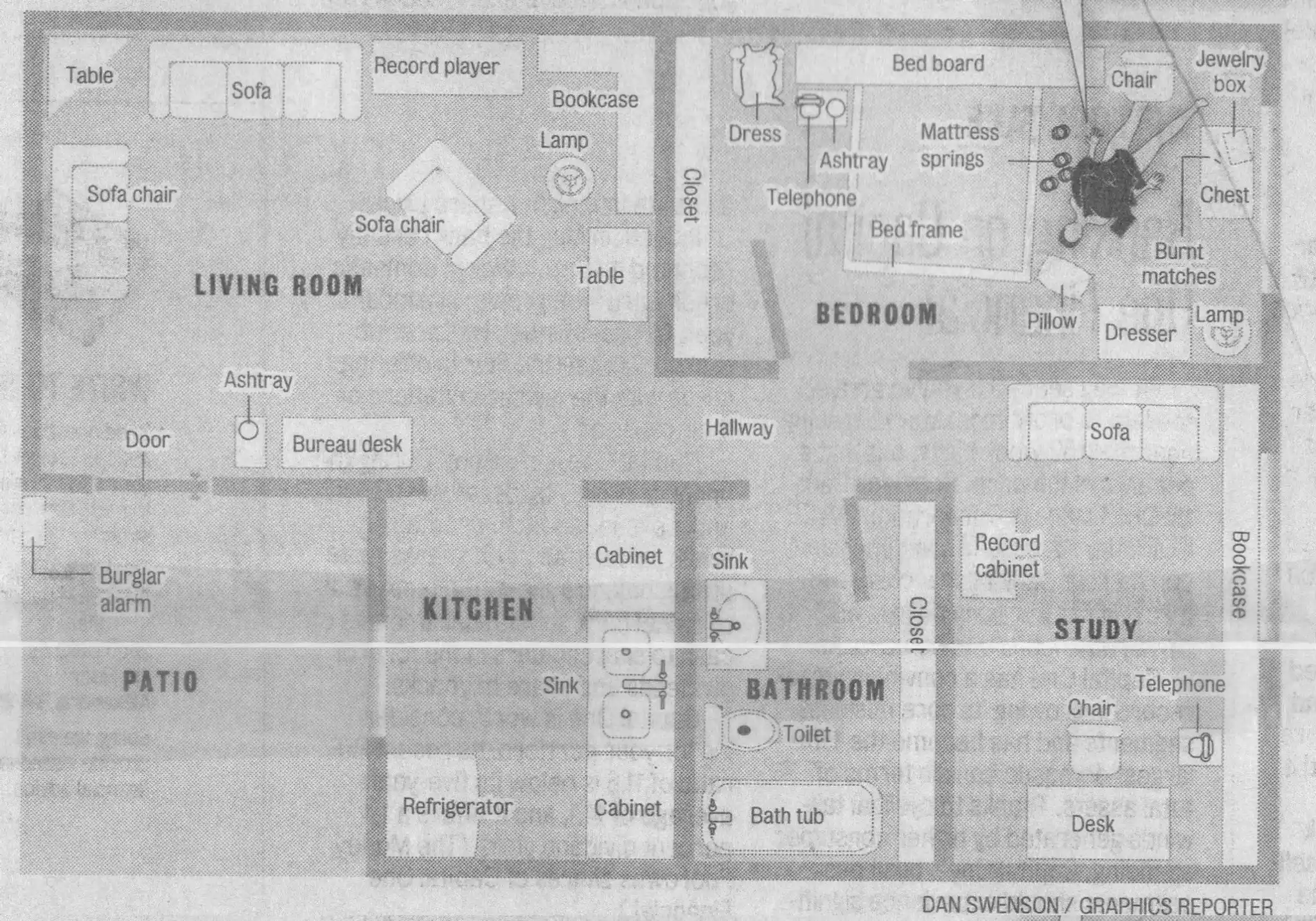
In 1965 about a year after Mary Sherman's death, the New Orleans newspaper Times-Picayune published an article about the homicide investigation. [https://
One of the questions was: "Was there any evidence of forcible entry? What evidance?" To which Giarrusso answered: "No evidence of forcible entry. The locking arm on the sliding glass door was broken. Crime Lab reports lock could have been broken up to 72 hours old, indicating a possibility that the victim did not know the mechanism was broken." But isn't the broken arm of the sliding glass door evidence of possible forcible entry? I didn't find Haslam mentioning anything about the broken arm of the sliding glass door, but he only quoted the precinct report as saying "The officers could find no signs of the door leading to the apartment patio or sliding glass door having been forced open." A layout of Sherman's apartment indicates that the door that opened to the patio was the front door of the apartment, and there was no second back door to the apartment. [i/
Another question was: "Just about three (3) weeks ago, occupants of this same Dr. Sherman's apartment were robbed, and detectives reported that the thief or thieves had entered with a key. Have you pursued this as a possible link to the Dr. Sherman case?" To which the answer was: "The apartment of a woman was reported burglarized at 10 p. m. June 4, 1965, to district officers who indicated in their report that they could not detect any sign of forced entry; however, an examination by Lt. Edward Larson, commanding officer of the homicide division, revealed that this door bore evidence of pry marks which would indicate forcible entry." The article said: "One occupant said the former Sherman apartment was robbed several weeks ago of money, liquor and a wig." The apartment was on the first floor in a city that was already about 40% black in 1964.
Another question was: "About three (3) years ago, there was a murder in this immediate vicinity - this case was not solved either. Please comment on this. Are you hunting any possible connection?" To which the answer was: "It is assumed that the murder of Mrs. Erin McKenzie, WF [white female] 62 years, 3303 Carondelet St., which occurred April 9, 1962, is the unsolved homicide referred to. This is an unsolved murder-rape which occurred at the victim's residence. This case as well as all other cases in the unsolved category are actively pursued when leads are developed or obtained and are constantly reviewed when personnel are available for this purpose. No unsolved case, whether homicide or otherwise, is permitted to lie dormant when information or leads are developed or are available." I didn't find Haslam mentioning Erin McKenzie anywhere. Her residence was only about 160 meters away from Mary Sherman's home. [https://
Another question was: "How do you account for the fact that the car was taken from the apartment, yet driven only nine blocks and then abandoned with the keys tossed out, matter? (This question was based on the initial report about where the keys were found.) Were the keys known to have been the victim's? Possibly a duplicate?" To which the answer was: "To answer these questions would be theorizing andor understanding the mind of the perpetrator. There is no explaining the actions of any human being. It is surmised that the perpetrator used the vehicle to flee the scene of the crime, knowing that the vehicle would be missed, abandoned it for another mode of travel to escape detection. Having set fire to the apartment, the perpetrator certainly knew that the crime would be discovered if the blaze was extinguished in time; therefore, would not want to remain with the vehicle which would link him to the offense." I didn't find Haslam saying anything about the stolen car.
In 1966 about two years after Mary Sherman's murder, a woman was found murdered in her own apartment about 1 km away from Mary Sherman's home. [https://
Miss Herard, an attractive 40-year-old librarian was found beaten, smothered, and apparently raped in her bedroom. Police said the murder occurred shortly after midnight while the victim's mother slept less than 40 feet away.
[...]
The brutal slaying Thursday of Miss Rosemary Herard points up once again similar gruesome murders of women in the uptown area since 1961. Miss Herard, an attractive 40-year-old librarian was found beaten, smothered, and apparently raped in her bedroom. Police said the murder occurred shortly after midnight while the victim's mother slept less than 40 feet away. Miss Cindy DeRedil, niece of the victim, said there had been two attempts to enter the house by burglars in the past two weeks. Both attempts were made at a window in Miss DeRedil's bedroom.
[...]
Co-workers of Miss Herard at the New Orleans Public Library noted her great interest in cultural affairs.
"She always kept to herself and never gave much indication of her feelings," one library employee said.
This comment echoes those made by friends of Dr. Mary Stults Sherman who was found stabbed to death and her body set afire July 21, 1964. Friends of Dr. Sherman noted her great interest in books and described her as having a quiet social life. They said she also kept her personal affairs relegated Investigators at Miss Herard's residence, 4421 Danneel, noted that her bedroom was in a state of disarray and it was difficult to determine if there had been a struggle. Again, as in the Sherman case, they said they were without a clue.
They said they were unable to locate any fingerprints and had no other leads to the identity of the murderer. Police maintain that the house was in such a disarray that it was difficult to uncover any leads. The victim is said to have collected rags, newspapers, and nearly everything.
The murder of Dr. Sherman occurred at 3101 St. Charles ave. Her maid reported that she had been victimized several times by burglars in recent years and that six months prior to the slaying her apartment had been looted. Other residents of the fashionable uptown apartment building also reported recent burglary attempts. Police said there was no sign of forcible entry, however. They said an attempt to open a jewelry box had been made.
Within the same vicinity at 3303 Carondelet, 62-year-old Mrs. Erin McKenzie was found stabbed to death in her bloodsoaked bed in April, 1962. She was a widow who also lived alone.
At the time, police believed the intruder gained entrance through a bedroom window which housed an air-conditioner. This murder-rape is still unsolved.
Mrs. McKenzie's neighbors in the apartment building said several burglaries and attempted burglaries had taken place. However, Mrs. McKenzie's assailant left about $50 in small bills in a dresser drawer. The murder of Mrs. McKenzie came only a month and three days after 85-year-old Miss Ida Fettis was found strangled to death in her residence at No. 43 Fontainebleau Dr. Another single woman who lived alone, Miss Fettis was found dead on the living room floor of her home, her feet bound with a piece of cloth. Dresser drawers and cabinets were left in a state of disarray. But, again there was no sign of forced entry.
Miss Fettis lived more in the area where 18-year-old Donna Trussell was found hacked to death in January of 1961. The murder of Miss Trussell occurred about 10:40 a. m. in the victim's bedroom at 1616 S. Gayoso [about 3 km from Mary Sherman's home]. However, here two witnesses saw the assailant flee. Miss Trussell had, like some of the other victims, evidenced an interest in the arts and had been active in local theater work until about two years before her murder. More recently she had been studying modeling and acting in New York.
Mrs. Lillian Harris, of nearby 3905 Louisiana ave. pkwy. [about 1 km away from Mary Sherman's home], was found dead in her bedroom November 6, 1964. She had been shot in the head with a small caliber bullet, badly beaten about the head and face, and raped. Her hands were bound and she was bound about the neck.
[...]
On November 21, 1964, Frank Charles Williams, a Negro ex-convict admitted the rape-slayings of Mrs. Harris and Miss Trussell, police said. The 24 year-old Negro, who resided at 3611½ Holly Grove, admitted the killing of Mrs. Harris in the presence of an aunt, according to police. Police said he was picked up and later admitted both crimes.
They said Williams was placed on probation on June 5, 1961 and was to remain on probation until June 5, 1965. They said that on July 23, 1962, Williams was sentenced to serve four years in the Angola penitentiary on a burglary charge. However, a check by The Times-Picayune disclosed that Williams had not been sent to Angola and had not been paroled. Williams was on the street and not in the penitentiary.
On November 26, the Orleans Parish Grand Jury indicted Williams for the two murders. On August 4, 1965, Williams was given lunacy tests.
Milton E. Brener, attorney for Williams, said Thursday that a motion will be heard Sept. 8 to suppress the use of confession. A warden at Parish Prison confirmed that Williams is incarcerated there.
But, the murderers of Miss Herard, Dr. Sherman, Mrs. McKenzie, and Miss Fettis, are still at large. These cases have striking similarities. All involved single women. Three of the victims lived alone at the time of their murders, and all had no spouse, Two were interested in the arts. Burglaries had recently been attempted in the area where three of the victims lived. Yet, they remain unsolved. No clues, say police.
ChatGPT didn't find evidence that the cases of Erin McKenzie, Rosemary Herard, or Ida Fettis were ever solved.
An MD from New Orleans who wrote a review of Haslam's book wrote: "I called Dr. Samuels, who remembers the autopsy and discounts an offsite thermal injury. 'She had severe right-sided burns with exposure of her liver. There was no soot in her lungs meaning that she was dead before any fire. I have seen similar thermal burns in autopsies of bodies found on burning beds,' Samuels says." [https://
Grok said:
Yes, a smoldering mattress fire (especially one deliberately set with piled clothing and possibly an accelerant) can cause exactly the kind of localized, severe damage described: complete destruction of the right arm and right side of the torso (from waist/hip to shoulder), with soft tissues burned away to expose organs like the liver, intestines, and lung.
Forensic pathologists who have reviewed the actual crime-scene photos, autopsy details, and police reports from Mary Sherman's 1964 death confirm this is consistent with ordinary fire damage - not something that required a lab accident, radiation, or impossible temperatures. Here's why it fits the evidence in the precinct report and newspaper accounts you quoted:Smoldering fires in bedding/mattresses burn slowly but persistently. A smoldering innerspring mattress fire can last for hours, stripping away padding and fabric ("denuding" the springs) while producing intense, localized heat right where the body is in contact. The reports explicitly note the fire smoldered long enough to do exactly that and to burn away the flesh of one arm.
The "wick effect" (or candle effect) explains the extreme, one-sided destruction. Human body fat melts and becomes fuel; clothing or bedding acts as a wick. This allows a low-intensity, smoldering fire to consume soft tissue and even char bone over time, while leaving other areas (left side, legs, head hair) relatively untouched. The right side was the area in direct, prolonged contact with the burning mattress and piled underclothing.
Accelerant + mattress placement accounts for the unevenness and intensity. Experts note the pattern (right arm and torso "disintegrated," organs exposed, but minimal spread to the rest of the room or body) is typical when someone pours an accelerant on one area, lights the mattress or clothing, and places the burning mattress over or under the body. One pathologist stated: the burned mattress "accounts for the severe fire burns to the right side of her body." Another added that acid or lye couldn't produce this - only heat from fire could. [https://
www. ]nola. com/ news/ crime_ police/ in- the- death- of- doctor- mary- sherman- strange- myths- pale- next- to- stranger- facts/ article_ 7022729c- 95bf- 5fc7- b9ab- 8000e1336f6a. html Temperature and time are sufficient. Burning away soft tissue and charring bone doesn't require crematorium-level sustained heat (1,600-2,000°F for hours). In a prolonged, fat-fueled smoldering fire with bedding as fuel, extremities and torso sections can be destroyed in roughly 50-90 minutes, matching the timeline of a smoldering mattress fire that didn't fully engulf the apartment. [https://
www. ]sciencedirect. com/ science/ article/ pii/ S0379073898000760 The official cause of death was stab wounds (including a fatal heart wound) with the burns occurring afterward, almost certainly to obscure evidence. The fire was deliberately set post-mortem. Claims that the damage was "impossible" for a mattress fire (popular in some conspiracy accounts involving a particle accelerator) have been directly refuted by multiple experienced forensic pathologists who examined the case materials.
John McAdams was the moderator of the alt.assassination.jfk Usenet group, which hosted an extensive debate about Judyth Vary Baker. He wrote: [https://
Judyth's treatment of scientific issues is pretty slipshod. For example, in one e-mail she asked rhetorically "I would like to see a list of people involved in this case who died of lung cancer, especially if they did not smoke, such as Jack Ruby. And how many heart attacks (sodium morphate)." She further explained to researcher Gary Buell that:
Gary, David Ferrie told me about it. I actually believed at that time that there was nothing Dave did not know. In medical matters like this he described this as a method he could use to commit suicide and people would think it was a heart attack. There would be no way to discern it wasn't a natural death.
Buell investigated this, and found that there is no such thing as "sodium morphate." But if there is no such poison that can induce a heart attack, where did Judyth get this? Her apparent source is a crackpot conspiracy essay that appeared in 1975 titled "The Skeleton Key to the Gemstone File." That document states that sodium morphate is "a favorite Mafia poison for centuries. Smells like apple pie, and is sometimes served up in one, as to J. Edgar Hoover. Sometimes in a pill or capsule. Symptoms: Lethargy, sleep, sometimes vomiting. Once ingested, there is a heart attack - and no trace is left in the body." Thus a poison Ferrie supposedly told Judyth about in 1963 is nowhere in the medical literature, not part of crackpot conspiracy literature until 1975, but all over the internet by the time Judyth was sending out her e-mails circa 2000.
[...]
Judyth does have several love letters that she says she wrote to Lee. Unfortunately, the name of the addressee has been torn off each of the letters, and Judyth's word is the only evidence they were actually written to Lee. Robert Baker's second wife, Rose Boory-Baker, provides a suggestion as to the real nature of the letters.
I have seen those letters. Judy wouldn't even have them if I had not sent them to her daughter years ago. She left those personal letters in Norway when she flew the coop. There is nothing in the letters between her and Bob that would give any type of evidence of which you are implying. Quite frankly, how in the heck are you going to present a love letter from Judy to "Lee" when she tore off the name. She wrote many love letters to Bob. Gosh, if I knew now what I knew then [sic], the box would have never been sent . . . .
If Judyth's pieces of "evidence" point to a pretty prosaic life, independent sources show her life to have been much more mundane than she portrays it. For example, her former husband remembers that, rather than being mysteriously "set up" with the job at Reily Coffee Company, she got it when she got tired of flipping hamburgers at a local burger joint.
After the summer in New Orleans, she and her husband were at the University of Florida in Gainesville. According to Robert Baker:
Back in Gainesville, we heard about the assassination during the school term - like everyone else I remember exactly where I was and what I was doing. Later in the day or the next day, she brought home a newspaper and was studying it closely and said, "I think I may have seen this guy. He was a stocker or something. I think I saw him in the back room." [capitalization corrected]
[...]
Judyth can't resist adding implausible scenes to her account. Consider, for example, how she supposedly met Lee Oswald.
It was through this amazing coincidence that Lee thought I knew so much.
He was standing behind me [at the post office] for general delivery, April 26, when I went to get a letter from the general delivery.
. . .
As I got the letter, I reached for it, and dropped the newspaper, and when Lee picked it up, without realizing it, I thanked him in Russian. I was always practicing Russian (which I'd been required to learn to level of conversational by my doctors, etc - and which is on record at Manatee (then Jr.) Community College-) - so now Lee heard me saying, "Karashaw, tavarish!" in Russian, and he answered me quickly, "That's not a very wise thing to do, to be speaking Russian in a place like this."
That did it, we began talking together.
Judyth supposedly learned Russian because the conspirators who were controlling her demanded that she do so, but she could never give a coherent account of why they would do that. But a worse problem stems from the fact that Judyth maintains that both she and Lee were being controlled, at the time they met, by the plotters. The mystery is why the plotters would not simply invite both to (say) the Café du Monde, sit them down and say "Judyth, this is Lee. Lee, meet Judyth." Why did they meet in a vastly improbable chance encounter? Or if the encounter was "set up" (as Judyth claims to suspect), why such an elaborate plot to have them meet? And why would Judyth speak Russian to a random stranger at the post office?
By 2003, when Judyth was interviewed for "The Men Who Killed Kennedy", the business about speaking Russian to Lee was missing, and instead Judyth explained that Lee was so "clean cut" that when he offered to walk her home she agreed.
[...]
Ferrie did apparently fancy himself a "cancer researcher" at one point, but lacked the knowledge and training to do any serious research. Even worse, his amateur "cancer experiments" ceased long before the summer of 1963, and Judyth's claim of lab mice in Ferrie's apartment at that time is flatly contradicted by several witnesses who knew Ferrie.
[...]
Further, Judyth's account of the mental patient got "enhanced" a bit when she talked to "The Men Who Killed Kennedy." In that documentary, she claimed the experiments were carried out on a group of prisoners from Angola Prison, an entire "convoy." A car containing David Ferrie, Lee Oswald, Clay Shaw, and an orderly entered the gates of the Jackson mental hospital immediately behind the prisoners.
And just as the plot against Castro got "adjusted" to include multiple doses of radiation rather than a virus to destroy the immune system, the 2003 account has an experimental subject in the Jackson hospital exposed to a "high dosage x-ray."
[...]
Thus we find, in Judyth's manuscript, a tearful exchange between her and Lee Oswald on the Wednesday before the assassination:
Because time was so short now, Lee told me there wouldn't be another call from him unless he reached Laredo.
"Lee," I said slowly, "you didn't say until. You said 'unless.'"
"I apologize," he answered. I heard him suck up his breath. We were both very close to tears. Outside, it was sunset.
"You'll go to Cancun," Lee said. "You'll stay in a fine hotel. I'll be there - if they -"
We were both speechless.
"You know," he said then, "if I don't make it out - you have to go on with everything."
"Oh, sure!" I said, bitterly. I told him that I would never allow anyone to replace him in my heart.
Thus Lee and Judyth were to meet in Cancun - or Judyth was to go there if Lee failed to escape - and stay in a "fine hotel."
Unfortunately, there were no fine hotels in Cancun in 1963. The popular vacation destination has been developed since, and the place was a series of deserted sand dunes in 1963.
[...]
When Team Judyth became aware of this problem, they did some quick footwork. First, they explained that it wasn't really Judyth who said that, but rather it was put in the manuscript by coauthor Howard Platzman. Judyth also claimed an interest in anthropology, and asserted that she was interested in Mayan ruins in the area. The first problem with this is that even an anthropological interest in this area isn't plausible.
The claim that the "Cancun" business was put in by Platzman was quickly replaced by the claim that Judyth's "first agent" had added a bunch of nonsensical material to the manuscript. Supposedly, the version of the final chapter that was leaked (and appears on this web site) was a "partially corrected" version that somehow still had Cancun left in.
The individuals to whom the chapter was sent were told nothing about it being "partially corrected." Indeed, it would be foolish to distribute a draft before corrections were complete.
Judyth also told David Lifton (in a phone conversation) and Mary Ferrell that she was to meet Lee in Cancun. Neither account includes "fine hotel," but neither does either mention Mayan ruins.
But the story gets more convoluted.
Talking on Black Op Radio, Judyth described her "first book."
I was terrified . . . I was scared . . . I wrote a bunch of nonsense because I didn't want to get sued. All I wanted to do was to get some publishers interested in my story and then I would give them the other book, which by the way a number of people saw my original book . . . it's not what was put out there to begin with, that was I guess you would call it a "teaser" I put that out there to try to get interest. . . . (click here to listen to the clip, and forward to about the 6:07 mark.)
How this "nonsense" version got replaced by a "good" version which was handed over to the agent to be edited back into a "nonsense" version which was then sent out before it was fully "corrected" is something of a mystery.
To further complicate matters, Judyth has admitted to lacing the manuscript with further disinformation. As she explained in an e-mail to Dave Reitzes:
The book has what I call "flags" in them [sic]. A couple of us have the true version, and the other version has some things in it that will keep it from getting pirated.
Judyth, in fact, claims to have put thirty untrue statements in the manuscript. Supposedly, if the manuscript is stolen, one or more of the "flags" will reveal who stole or leaked it.
Thus she has all kinds of excuses for why various versions of her story are filled with malarkey. It's because she was scared, or because her agent put it in there, or because it's a "flag" intended to frustrate piracy.
All these might seem to give her enough wiggle room to wiggle out of "fine hotel in Cancun." But the comments at the head of the chapter say nothing about it being "partially corrected," and indeed state "the next section will deal with the last two telephone calls====thanks.j." This appears for all the world to be Judyth's introduction to material she has written. Even worse, Judyth herself e-mailed the draft with "Cancun" and "fine hotel" to several people, including her "coauthor" Howard Platzman.
[...]
So "Cancun" together with "fine hotel" was in a version that Judyth explicitly said she wrote, and which she e-mailed to several people.
Not surprisingly, her most recent account entirely omits Cancun and "Mayan ruins." In "The Men Who Killed Kennedy" she claims that she and Lee were to escape to Mérida, a town on the Yucatan Peninsula (a two-hundred-mile drive from present-day Cancun) because it was a place "that had CIA contacts located there."
[...]
Then there is this, from an e-mail written in September 2000, to explain the "disappearance" of other evidence.
About this time last year, my former landlord, a drug addict, stole my diary, some jewelry and other things. He stole valuables from the other two trailers he also owned, at the same time, and the police were on their way. So he built a bonfire - under my window - and burned the evidence - probably what happened to the diary that had four pages from 1963 in it - before he was taken off to jail anyway - and of course, seeking a more secure habitat, at the urging of my good friends, I moved into the most secure - and nicest - apartment complex available here, even though it's pricey for me. . .
So she would have a diary showing contemporaneous mention of her affair with Oswald and perhaps her role in the assassination plot, but the drug addict landlord of her trailer park home burned it.
Team Judyth has pointedly ignored questions about whether they ever sought a police report that could confirm this incident. Judyth gave a similar account to a researcher Louis Girdler, and According to Girdler:
I asked for the same thing when she told me her "apartment" was burgled. When I asked for a cc of the police report [which she would need for an insurance claim], she admitted that it was her neighbor's apartment that was broken into - but (she added quickly) her "window screen had been cut."
[...]
The final supposed act of "harassment" she has suffered is "firing from a teaching job as a result of a campaign organized by an FBI employee who didn't want their child taught by 'a friend of Lee Harvey Oswald.'" One has to wonder if it happened exactly that way, and in the wake of the airing of "The Men Who Killed Kennedy" a former student of hers came on the History Channel discussion board to give his version:
Let me just tell you that I am 18 and a senior in high school. Mrs. Baker, Judyth, was hired at my school last year as our english teacher. What a mistake it turned out to be. She never taught us, she just went on about her "stories" which we all claimed were lies and that she needed to be cooped up somewhere. She was crazy because every time she heard a "loud noise" she would act like she was having a seizure in the classroom. Our school realized the mistake and fired her after a month and a half. (Post by Paulio, dated 7:55PM PST Nov 19, 2003)
[...]
Judyth told Prof. Luis Urrea that as a child she was a close friend of Dr. Seuss, and used the word "nerd" (which she had invented) in his presence. He liked it, and used it in one of his books, making it a common word in the language.
In an email in 2000, Baker wrote: "The other books where Lee had written marginal comments was in bad shape, though. It had been badly chewed by puppies". [https://
Mary Ferrell was a respected researcher of the JFK assassination, who compiled a database of over 40,000 index cards relating to the JFK assassination. In 2001 she wrote a PDF file she emailed to John McAdams and other people, where she wrote: [https://
I have been uncertain as to her motives and preferred to believe that she was delusional and, although I believed she had actually known and probably worked for a short time with Lee Harvey Oswald, her "affair" with Lee Oswald was all something she dreamed up.
Judyth came to my home more than a year ago, late in the afternoon in November 2000.
[...]
Judyth said it had been planned that Alexander Rorke would pick up Lee Oswald in a plane in some part of the Yucatan, Mexico. She was so startled that she dropped a rolled-up newspaper that was under her arm and Lee Oswald stooped and retrieved it. When he handed it to her, she thanked him in Russian.
I asked her why she would use the Russian language to a man she didn't know standing in a line at the post office in Louisiana. She claimed that Dr. Oschner and his colleagues had insisted that she study Russian and become fluent in the language. She never gave a coherent answer about why she was instructed to learn Russian. She did ramble off several portions of sentences that did not make sense.
[...]
I questioned Judyth about her first meeting with Oswald and the exact date it occurred. She claimed it was within a day or two of his arrival in New Orleans in April 1963. She also claimed she accompanied him to visit his father's grave but never gave an exact location of the grave. (According to the Warren Commission's investigation, Lee visited his aunt, Mrs. Arthur A. P. Alice Barre, on St. Charles Avenue in New Orleans, to learn where his father was buried. Judyth did not answer me when I asked if she was with him when he visited his aunt.)
At one point, Judyth said, "I can tell you where Lee was on the two occasions when you don't know where he was." I asked her how she knew that there were two periods when I didn't know where he was. She stuttered a bit and finally said that Martin Shakleford had questioned her from my chronologies. However, she never gave any explanation of when those two periods were nor where she knew that Lee was during the two periods.
[...]
I want to make it clear that I have never believed Judyth's "story." I have believed that she knew Lee Harvey Oswald, either as a co-worker or as an employee she remembered after the assassination. I have NEVER believed the story of the mad, passionate love affair. I can account for almost every minute of Lee's time from the time he joined the Marine Corps until the day of his death. There was absolutely no time for nights of passionate love and Russian poetry reading. I do not believe that they had sex in the back of trucks in Adrian Alba's garage. At the very most, Judyth knew Lee a total of less than five months. She claims that she talked to Lee just two days before the assassination by way of a Mafia wire-service phone line. I do not believe this.
Judyth claims that Lee introduced her to David Ferrie. She claims that Ferrie introduced her to "Sparky" Rubenstein. She claims that Lee told her that Carlos Marcello called Jack Ruby when Lee was a child in Fort Worth and asked Ruby to keep an eye on Lee. She claims that she last saw Ruby in New Orleans in June 1963.
She claims that as soon as she arrived in New Orleans, in April 1963, Dr. Oschner got her an apartment where prostitutes were living and the place was immediately raided and everyone taken to jail except Judyth. She says Lee got her another apartment. They then lived close to each other and would ride the bus from Reily out to the end of the line and ride back so they could sit together.
[...]
Judyth tells a fantastic story about the man who wrote Andersonville - MacKinlay Kantor. She claims that she would walk with him through a garden, holding a tape recorder and Kantor would dictate into the recorder. She says that Kantor "fell in love" with her. She claims she was still a teenager when this happened.
She claims she wrote to Bertrand Russell about her reluctance to have sex with Lee because she and he were both married at the time. She says that Russell wrote to her that she must not let anything hold her back if they were in love. They must have sex. Joan Mellen was married to Ralph Schoenman for a number of years. Schoenman was the top aide to Bertrand Russell during the last years of Russell's life. Schoenman told Joan that during the period Judyth claims this happened Russell was not even able to read his own mail and he NEVER wrote such a letter.
There were only 5 hits on Google Search when I searched for a combination of the terms "MacKinlay Kantor" and "Judyth Vary Baker" in double quotes, but none of the results were related to the story Ferrell mentioned, because the PDF of her letter was not indexed by Google Search. So I don't know if Baker later stopped telling the story about Kantor. When Baker was a teenager, she lived in the city of Bradenton in Florida, which is about 20 km away from Sarasota where Kantor lived at the time, so I guess her story is at least geographically plausible. [https://
In an email in 2001 Baker wrote: "I DID INDEED MEET MACKINLAY KANTOR. I have a newspaper article proving he spoke to my high school class. I was the star writer and was introduced to him. He was very interested in my dog and horse stories. He had writren The Voice of Buf=gle Anne and read the entire book to our class in two hours. I was invited to his home. ASK HIS WIDOW HOW HE WROTE HIS STUFF. HE WA;LKED AROUND WITH HIS TAPE RECORDER AND SPOKE INTO IT. Twice i came over and held the tape recorder. You should know that i try to be friendly. I liked Kantor a great deal. He had very conservative friends in the military." [https://
Debra Conway had earlier supported Baker, and she recorded a video with Anna Lewis and Baker in 2000. But by 2001 Conway had turned against Baker, and she posted this email about Baker's response to the email by Mary Ferrell: "Having spoken to Mary both before and after she posted her email regarding Judyth Baker, I can tell you she is very sane, coherent, and has all her mental faculties. I resent Judyth's claims to Mary being unable to remember what she has been told or what she has said. I've been through this with Mary every step of the way and believe me, she not only has been totally truthful in her email, typical of Mary, she has been generous and sensitive to Judyth. She could have written much, much more. For Mary's sake, I'm glad this is over. She is too polite sometimes for her own good and allowed her kindness to Judyth to be misconstrued and manipulated." [https://
In December 2001 Mary Ferrell also sent an email to a redacted recipient where she wrote: [https://
I have now received two letters from Ed Haslam. I'm going to copy out one paragraph from the letter I received today.
"My personal puzzle about her remains. In 1972, in New Orleans, I was introduced to a woman named Judyth Vary Baker and was told that she was personal friend of Lee Harvey Oswald. At the time, I wanted nothing to do with anyone who claimed to be a friend of the accused assassin of the President, and therefore had no further contact with that woman. The problem is that it was not the same woman we now know as Judyth Vary Baker. Had I not had this experience personally, I would be less interested in her story. ..."
When I read this portion of Ed's letter to Debra Conway, said that Anna Lewis (the New Orleans Judyth and Lee) told Debra that she did know a woman named Judyth Baker who dated Lee and they did go to Thompson's Coffee Shop together (the four of them -David Lewis and Anna and Lee and Judyth) but Anna said that it was not the same Judyth Baker as the woman who now claims to be the one who dated Oswald.
As the old black people at home used to say, "Has we just run into a whole passel of lying bastards?" If not, what in the Hell is going on? One other thing Ed Haslam said in today's letter was that he had repeatedly asked Judyth if he could read her book and she refused to let him see it.
So Ed Haslam seems to have already come up with the story about the impostor Judyth Baker by December 2001. I suspect he had earlier claimed that he met the real Baker in 1972, but then he had to come up with the story about the impostor after he realized that Baker no longer lived in New Orleans in 1972. But I haven't yet found any source where Haslam said he met the real Baker.
In 2010 Ed Haslam and Judyth Baker were guests on Coast to Coast AM. [https://
At time 7:42 Haslam said: "Dr. Mary Sherman happened to be a good friend of my father's, and they were both professors at Tulane Medical School. I had even sat on Mary Sherman's lap as a child." I think in his book Haslam didn't describe his father as a "good friend" of Sherman.
At time 43:00, Baker said that after the JFK assassination, "The first thing I just made sure my name V-a-r-y did not get into the public, like I was warned it should not. So I didn't even go to my, like my grandparents' - I love my grandpa - I couldn't go to his funeral. My only sister - I couldn't go to her wedding - because the maiden name would have been in the paper that way. Uh, and that has even extended to the present. I was forced by death threats to apply for political asylum, as an asylum seeker - they take your passport and everything - my mother died, I couldn't even go to my own mom's funeral in 2007." It seems like a fake excuse that she couldn't go to her sister's wedding to avoid having her maiden name being visible in a newspaper. In 1990 and 1991, a newspaper from Florida published two guest column by Baker under the name "Judyth Vary Baker". [https://
At time 50:36, Baker said: "I wasn't very good in Russian. I think, uh, someone online said, well you know what you said, uh, tovarisch, or khorosho, and all that, what I was saying didn't make sense. You know, I wasn't interested in making sense. I was just saying trying to say 'Thank you, comrade' in a certain way, which, uh, one of my Russian professors had taught me. And apparently that wasn't correct, or whatever. But I just wanted to do it to - just because he was kind of cute, and, and, uh. I always use little phrases - I used tusen tack today, you know, a thousand thanks that's in Swedish, and also in Norwegian. I've always used foreign phrases to say thank you."
In her book she wrote: "'Karashaw, Tovarisch,' I said to him (Loosely, 'Thanks, Comrade' Russian). [...] I was shocked when the young man leaned close to me and said, in perfect Russian, 'It's not good to speak Russian in New Orleans.' 'But I like to speak Russian,' I protested in Russian, as politely as I could. As I turned to leave the building, the young man said, 'Please! Wait!' - once more in Russian."
But if she was so bad at Russian that she thought "khorosho" meant thank you, then how did she even know how to say "But I like to speak Russian"? Or how was she able to tell if Oswald spoke perfect Russian or not?
"Karashaw" is a highly unusual way to romanize the word "хорошо", and when I googled for "karashaw" russian, there were only two pages of results, most of which did not even feature the word "karashaw" in the sense of a failed romanization of the word "хорошо".
In a 2003 documentary, Baker said: "It was my job to work with 50 to 60 mice at a time. And these mice had large tumors that had developed. They were being brought in from another nearby locale, some other place. These animals had already been inoculated with cancer when they were weanling mice, very very tiny, and in a matter of a week or so, the cancer that they had developed at this time, the lumps and the tumors were as large as these little mice. So to the point where they could hardly drag these huge tumors along. And we would actually have to kill these mice, cut out the tumors, weigh the tumors, see which ones were the heaviest, because those were the fastest growing. We were interested in the weight and how fast these tumors grew. We were after a vicious cancer, a galloping cancer. And then all the tumor material that seemed to be most vigorous was then placed in a blender and blended together, so they could recycle and not lose that virus. And the other thing that we were doing was making tissue cell cultures from the most vigorous and deadly cancers." [https://
Grok said:
Tumors described as being as large as the mice themselves, developing in just a week or so from inoculation in weanling mice, are not biologically plausible. A typical laboratory mouse weighs only 15-25 grams. Even the most aggressive mouse tumor models do not produce masses approaching the animal's own body size in such a short time.
In reality, fast-growing transplantable tumors may become palpable within days, but reaching a burdensome size that seriously impairs movement usually takes several weeks, not one. Modern ethical standards limit tumor size to roughly 10% of the mouse's body weight, and even in the less-regulated 1960s, tumors equal in size to the mouse would have caused rapid death from mechanical interference, ulceration, or systemic failure long before that point.
While researchers did harvest, weigh, and passage vigorous tumors - sometimes blending material for serial transplantation - this work was performed on tumors far smaller than the animal itself. The described scenario of mice barely able to drag "huge tumors" the size of their own bodies greatly exaggerates what was realistically possible in cancer research, even with the fastest-growing models available at the time.
I found a collection of photos from Chinese studies of mice with very large tumors, which exceeded what was viewed as acceptable by Western ethical standards. [https://
During an interview with Danny Jones in 2025, Baker showed an old photo of a mouse that had a tumor bigger than the rest of the mouse, and she said "in 7 days it gets that size". [https://
During an interview with Jim Fetzer in 2010, Baker said: "Imagine if you have a mouse that is - that weighs, um, an ounce, say, and then it has a tumor that it develops in only seven days, and this tumor is as big as the mouse is. So for a 100 ounces of mouse, you have a 100 ounces of tumor, imagine. That's 100% ratio, you know, going on." [https://
A tumor growing to match the entire body weight of a roughly 1-ounce (28-gram) mouse in just one week would be extraordinarily unrealistic based on known biology and laboratory data on mouse tumor models. In cancer research, ethical guidelines for lab mice typically limit single tumors to about 1.5-2 cm in largest diameter, which equates to roughly 2-4 grams or less and often around 10% of body weight at most before euthanasia is required. A 28-gram tumor would be massive, comparable to or exceeding the mouse's own mass, and far beyond any observed or permitted growth. Such a burden would likely kill the animal long before reaching that size due to mechanical stress, ulceration, cachexia, or organ failure.
Tumor growth rates are also much slower in practice. Tumors often become palpable at only a few millimeters days to weeks after cell injection, with measurable growth continuing over additional weeks. Even fast-growing models might show detectable volumes within 4-7 days, and volume doubling times are typically on the order of days to a couple of weeks, but not an explosive increase from near-zero to 28 grams in a single week. Exponential growth does occur, yet starting from a tiny number of implanted cells, it takes far longer to reach even gram-scale masses. Studies routinely monitor growth curves over multiple weeks, with experimental endpoints reached well before extreme sizes.
Biological constraints further make this scenario impossible. Tumors require a blood supply through angiogenesis, along with sufficient nutrients and physical space. Extremely rapid growth would quickly outstrip these resources, leading to widespread necrosis, immune responses, or host death. Even in immunocompromised or specially bred mouse strains designed to allow faster tumor growth than in natural settings, nothing approaches this kind of explosive development. Spontaneous or induced tumors in mice also take much longer periods to form and enlarge. In short, while some laboratory tumors grow relatively fast compared to human ones and may become visible within 1-4 weeks, a full-ounce tumor in one week on a one-ounce mouse belongs firmly in science-fiction territory rather than real oncology.
For a long time I believe Anna Lewis was the only person who claimed to have seen Judyth Baker together with Lee Harvey Oswald.
John Simkin wrote: "There is at least one witness who confirms part of Judyth's account. Anna Lewis, the former wife of one David Lewis, confirms Judyth's claim that she and Lee went on several dates with Anna and David. This might seem like solid corroboration, but David Lewis was in New Orleans during the Garrison investigation, and was telling all kinds of stories - stories which even the Garrison people came to reject - about seeing Lee with Guy Banister, and with David Ferrie." [https://
During an interview with Debra Conway in 2000, Anna Lewis said: "In February of 62 I met Lee Harvey Oswald in the park." [https://
In 2019 Baker wrote on Facebook: "Her statement that she remembered first meeting Lee in either spring or fall 1962 is no longer very controversial, since records have been released that Lee Oswald visited New Orleans in fall of 1962 during a time period when after fighting with his wife, Marina, they separated, and during a period before he obtained a new job, his whereabouts for days at a time were unknown." [https://
I didn't find any place where David Lewis would've said he saw Baker together with Oswald.
At time 15:56 Anna Lewis said: "Guy Banister's secretary was found dead in a swamps on the outskirts of New Orleans. His pilot's plane crashed over the swamp. It had a bomb in it." In reality Banister's secretary Delphine Roberts only died in 2007. [https://
The JFK researcher Jim DiEugenio wrote this about the interview of Anna Lewis by Debra Conway: [https://
Debra Conway says this was even worse than that.
I think this was when that goof Platzman was promoting her. Debra said it was pretty clear that it was scripted, and every once in awhile Anna lost her lines.
The whole thing is that Baker had nothing to corroborate her story at first. But her so-called Team at that time, I think it was Shackleford and Platzman and one other person, went out and tried to find something - anything. So this embarrassment was one of the results.
If I recall, this was before Haslam changed his mind about her. Carol Hewett was surprised that he did that. Carol, a good lawyer, worked on her case for Sixth Minutes. She recommended against it. But then somehow, some way, Haslam changed his mind on her.
DiEugenio also wrote: [https://
They asked Debra to film this and she came away not buying the whole thing. Platzman wanted her to publish a book at the time. Conway refused.
Platzman sent me that manuscript back then also. I think he wanted me to excerpt it in Probe. I had the same reaction as Debra.
In 2010 Baker wrote that she now had a "New witness William 'Mac' McCullough, Mafia associate, who observed me with Lee and who verified that we were lovers in New Orleans. He knew information about Marcello that backs up what new things I have to say about David Ferrie and the Marcello relationship." [https://
In an article about the Reilly Coffee Company, C.A.A. Savastano wrote: [https://
Reilly Coffee Company had multiple locations, the plant and a sales branch office. While Oswald worked at the company production plant, Baker claimed to work on credit reports, payroll files, background checks, shipment examination, and was a floor secretary to Vice President of the Riley Coffee Company William Monaghan. To support her other claims of doctoring Oswald's time cards and having access to him she apparently believes she needs all those jobs. Baker then claims in her book "Me and Lee" that she and Oswald both met with William Monaghan at the Standard Coffee sales offices a block away from the Reilly Coffee plant building on their first day.
Regrettably, in a legal statement to the Federal Bureau of Investigation William Monaghan affirms he never knew Oswald personally.[vii] The person who likely would have met with Oswald was his direct supervisor Emmet Barbe or the man who employed him former Plant Manager Alfred Claude. It makes little sense to have an executive meet with a maintenance worker for introductions and it is because of Baker's other various stories this strange instance is offered. Thus, Baker has made another in a verifiable plethora of unlikely claims that evidence contends. If she were William Monaghan's secretary as claimed, she would have likely been located at the Standard Coffee offices of the William Reilly Company a block from the Reilly Coffee plant. This of course would preclude her ever working with Oswald, and that perhaps is why she claims to be the plant secretary.
Baker was seemingly not attentive to detail because among the nameless salespeople mentioned in her book, some whose resumes she claimed to review, was Oswald's cousin William S. Oswald.[viii] One would imagine anyone but the most inattentive person would not have realized this in months of employment. This may suggest Baker had no access to the employment files she claims or that she did work with an Oswald, just not the Oswald related to the JFK case.
No one present in the sales office confirms Baker's multiple claimed meetings of her, Oswald, and Monaghan, who himself prior attests legally to never knowing Oswald personally. Reilly's Assistant Vice President in Charge of Production John Clark stated his only interactions with Oswald were to reprimand him a few times. Clark states after an inquiry of all Reilly plant employees he learned of six people that could have encountered Oswald. He names employees Rose Schambra, Emmet Barbe, Charles Le Blanc, Arturo Rodriguez, Alfred Claude, and John Branyon.[ix] Notably Judyth Baker is never mentioned by any person working at the company despite they could easily confirm her claims if they were true.
Rose Schambra supervised three coffee packaging machines at the Reilly plant; each machine required greasing by a maintenance worker. Oswald under her supervision would maintain the machines and she commented that he seemed quiet and shy. Schambra offered that Oswald never seemed to converse with anyone.[x] She affirms having no contact with Oswald beyond work related conversation.
Maintenance Foreman Emmet Barbe was Lee Harvey Oswald's immediate superior and recalled that Oswald was quiet and never spoke unless someone else initiated conversation. He noticed that Oswald seemed averse to conversation and "...usually gave no recognition of persons around him and spoke only when spoken to." Barbe notes that Oswald never made any statements critical of America or President Kennedy.[xi]
Charles Le Blanc was a maintenance man at Reilly for over a decade who states he "broke Oswald in" for his oiler-machinist assistant job. Le Blanc deems Oswald a poor worker who often wandered off when he was required and Le Blanc would have to track Oswald down inside the plant. The only employee Le Blanc observed having contact with Oswald was maintenance worker Arturo Rodriguez and Oswald is not observed with a female employee besides Rose Schambra by anyone at Reilly.[xii]
Arturo Rodriguez reports that he instructed Oswald how to oil and clean the machines and observed, "...Oswald was not friendly with any of the employees and he described Oswald as a person who did not talk much, was very quiet and did not associate with any employees." Since Rodriguez was instructing Oswald and working in close proximity, he witnessed large portions of time and supports Oswald did not associate with other employees.[xiii] Repeated legal statements contend Baker's claims.
Former Reilly Coffee Company employee Alfred Claude hired Lee Harvey Oswald four weeks before leaving Reilly for another job. Oswald had found the job from an advertisement in a local paper and this would support the job was not a cover job as Judyth Baker asserts, but just another job in Oswald's long list of them. Claude noticed that Oswald did not associate with other employees even during coffee breaks and lunch. The only complaint Oswald gave was his placement on the late shift, Oswald complained he did not like to work on the late shift.[xiv] If the job were a cover for any clandestine operation, the later shift would seem optimal for being unobserved for long periods. Claude also noted that Oswald's work was poor and he nearly fired him on several occasions, but due to a lack of replacement workers, he did not. This would support again Reilly Coffee was just another job and no secret plan kept Oswald employed but luck and a lack of replacement workers. His complaints and repeated actions would support he did not place any great importance on his time at Reilly's which makes complete sense if one ignores the tales of Judyth Baker.
The final person with a verified association to Oswald at Reilly Coffee was former employee John Branyon and he reaffirms the statements of all other Reilly employees with noted access to Oswald. He states Oswald did poor work and that he criticized him on multiple occasions and Branyon informs officials that Oswald was a "lone wolf" who did not associate with other employees during coffee breaks or lunch. No other Reilly Coffee employees were observed associating with Lee Harvey Oswald based on the primary evidence. Every time Baker claims in her books to associate with Oswald apparently never happened.[xv]
There is no verifiable mention of Judyth Baker at the William B. Reilly Coffee Company in association with Lee Harvey Oswald; the evidence disproves her claims of various encounters with Oswald and Reilly Vice President William Monaghan. Not a single employee from the coffee plant or sales staff ever mentions Judyth Baker, including Oswald's second cousin. The evidence supports Oswald was never in the company of any woman at Reilly besides work related discussions with Rose Schambra.
In 2025 Baker tweeted: "I reported to Sixty Minutes, before I knew Haslam existed, which I can prove with emails, that 500 mice were being irradiated at the same time, the beams split to receive equal dosage. This could only be done with a LINAC. I knew it was on the USPHS campus but not where. Haslam was speculating. The LINAC came into use only after conventional deactivation methods failed and Ochsner openly decided to offer his talents, in a newspaper interview in 1961,to the US Government, urging the medical profession to fight Communism. Then deliberate efforts regarding enhancing SV40 as a bioweapon,beginning March 23, 1962,began." [https://
Grok said:
No, a LINAC was not the only method - nor the most practical one - for irradiating large numbers of mice simultaneously in 1963.
Gamma irradiators using cobalt-60 or cesium-137 were the standard tools for whole-body animal irradiation at that time. These sources provided uniform gamma rays and commonly used rotating holders or multi-compartment chambers to expose many mice at once with acceptable dose uniformity. Conventional orthovoltage X-ray machines (200-250 kVp) were also widely used and could easily irradiate multiple mice in a single large field.
LINACs did exist by 1963 and could produce high-energy X-rays suitable for such experiments. However, they were primarily clinical machines for human patients - expensive, complex, and rarely used for routine preclinical mouse studies. For total-body irradiation of animals, gamma sources and conventional X-ray units remained far more common and accessible.
Irradiating 500 mice in one simultaneous run would have been logistically challenging with any equipment and was typically done in smaller batches. The idea that this could only be achieved with a LINAC is incorrect.
And anyway, Ed Haslam gave the impression the linear accelerator was used to radiate viruses in cell culture, and not viruses inside infected animals. For example in his 2007 book he wrote: "So, minimally, any potential creator of this monkey virus mutation would have needed access to both the monkey viruses and a means of altering genetic chemistry, such as a powerful radiation machine. Once the virus was mutated, the next step would be to put the mutated virus into living animals to find out how it behaved."
In 2025 Baker said that when she was working with Sherman, "several times we had to kill 500 mice at a time, pull out these horrible notches". [https://
In 2003 when Baker was living in the Netherlands and working on the Lee Harvey Oswald museum in the Netherlands, a Dutch magazine published an article about her. [https://
The article said in Dutch: "There is, however, a well-known photo of Oswald - taken in New Orleans while he was handing out pro-Castro leaflets in the city's business district - showing an unrecognizable woman. Vary Baker believes that she is the woman in that photo, but cannot prove it." She seems to have later stopped saying she was featured in the photo, even though in 2010 she wrote: "Though have never been 100% certain the woman was me, I remember talking to the two girls shown in the footage under consideration. In any case, Lee simply happens to be nearby, and there is little, if any, interaction with the woman, beyond a smile in her direction as he approaches with flyers. I do not remember being filmed, but was warned that filming was taking place, and to leave at once, a warning which Lee gave to me. The fact is that Lee is coming closer to the woman in the footage under consideration, and it is possible that he was about to tell me to leave. The incident happened too many years ago for me to be more specific in these claims, as I have no proof that this woman is actually me, beyond my speculation that it may have been me, as I had two dresses similar or exactly the same as the dress worn by the lady in question, and have photos of one of those dresses showing its close similarity to the dress in the footage." [https://
The Dutch article also said: "In St. Petersburg, Florida, I met two Nobel Prize winners in physics, and eventually, during an international science fair - still in high school - I was introduced to the then already legendary physician Alton Ochsner, founder of the famous Ochsner Cancer Clinic in New Orleans. [...] After meeting Ochsner, I was asked if I wanted to serve my country. From that moment on, I became an asset to the CIA, although I did not immediately realize it. Additionally, at that time, I already knew many people from the anti-Castro Cuban community."
The article quoted her as saying that David Ferrie "had lost all his hair due to illness, so he walked around with a conspicuous toupee and glued-on eyebrows". In reality he had only lost some of his hair, even though it's possible the author who interviewed Baker would've misinterpreted what she said.
I think in her 2010 book she didn't say she was asked if she wanted to serve her country after meeting Ochsner at the Science Writers Conference, but she only wrote: "The three great men told Col. Doyle that I was invited to come to Roswell Park Memorial Institute in Buffalo, New York for a summer of fast-track training. The National Science Foundation would fund my work in Dr. Moore's own lab, where I would receive world class instruction ona project of my choice."
The article also quoted her as saying: "Lee was also involved in the research. He received a crash course on handling the transport of living cancer cells, which could be kept alive in a special chemical fluid. This technique involved working with SV-40, a material extracted from the kidneys of great apes [mensapen], which was also used in the development of the polio vaccine. The goal of the operation was to infect Castro with it. He was known as a cigar enthusiast, so no one would be surprised if he developed lung cancer." However SV40 was extracted from the kidneys of rhesus macaques, which are an Asian species of macaques, and SV40 is not native to any great apes. It's of course possible the author would've misunderstood or mistranslated what Baker said.
One of the forms of cancer that is now associated with SV40 is mesothelioma, and the most common form of mesothelial cancer is pleural cancer, which affects the mesothelium surrounding the lungs, but SV40 was not connected to mesothelioma until the 90s. [https://
SV40 had only been discovered in 1960 as a contaminant in early polio vaccines. By 1963, scientists knew it could cause tumors (mainly sarcomas) when injected into newborn hamsters and other rodents. Some animal studies noted tumors in various tissues, including occasional lung involvement in hamsters, but these were undifferentiated sarcomas or other experimental tumors - not primary lung carcinoma (such as adenocarcinoma or squamous cell lung cancer).There was no established or even hypothesized link between SV40 and human lung cancer at that time.
The first suggestions of SV40 in human tumors (primarily mesothelioma, brain tumors, and osteosarcomas) emerged in the early 1990s.
Mesothelioma (a cancer of the lung lining, sometimes loosely called a "lung cancer") was not linked to SV40 until the mid-1990s.
Primary lung cancer itself has never been strongly or consistently associated with SV40.
The reason why she claimed SV40 would cause lung cancer might be because Jack Ruby died from a clot in the lungs induced by lung cancer. The cause of death on his death certificate was listed as "Pulmonary emboli as immediate cause of death secondary to bronchiolar carcinoma of the lungs" (which is a primary lung cancer and not pleural cancer). [https://
Next the Dutch article quoted her as saying: "I had to get the material to Mexico City, where a Cuban contact, a medical student, would arrange for further transport. Staff from the hospital in Havana whom Castro visited - not doctors, but technical personnel from the radiology department - would then take care of the contamination."
If she was just a laboratory technician on the project, why did she have a need to know what personnel would be responsible for transmitting the virus to Cuba or infecting Castro? In her 2010 book she said she was training Oswald "on how to keep the bioweapon alive outside the lab, so it could be transported to Cuba via Mexico City". But still it would've seemed like a great liability to inform her about the technical personnel from the radiology department.
I believe in her 2010 book she didn't say a medical student would be responsible for transmitting the virus to Cuba, or that people from a radiology department would be responsible for infecting Castro.
Next the Dutch article quoted her as saying: "Lee and I had a plan to leave the US together. We were going to live in the Cayman Islands, where he had contacts." In the 2010 book she didn't mention having contacts on the Cayman Islands, but she wrote: "We would flee to the Cayman Islands, wait a year or so, then move on to fulfill our dream of exploring lost Mayan cities." But then why did Lee tell her to go to a fine hotel in Cancun in 1963, if they were only going to go to Chichen-Itza a year later?
Next the Dutch article quoted her as saying that after Oswald, Ruby, and Sherman died, "I was forced to stop my work as a researcher and, together with my husband, sought protection from the Mormons", as if the Mormons would've somehow protected her from being assassinated. But in her 2010 book she wrote: "As it happened, Mormon missionaries knocked on our door. 'Here's a coincidence,' I thought. I invited them in, and they soon persuaded me to join the Church of Jesus Christ of Latter-Day Saints. Suddenly, a very large circle of new friends entered our life."
Judyth Vary Baker claimed that her team created the turbo SV40 through serial passage in mice, where they injected mice with the virus, selected the mice with the largest tumors, and injected the virus from the tumors to subsequent mice.
However SV40 doesn't replicate in mice, so it wouldn't have been possible for the virus to evolve over time to a more cancer-causing form. At best it can induce cancer without replicating to produce a new generation.
Grok said:
No, SV40 (Simian Virus 40) does not replicate productively in mice or mouse cells.
SV40 is a polyomavirus that is permissive (supports full productive replication, including new virion production) in certain simian (monkey) cells, its natural host. It is generally non-permissive in rodent cells, including those from mice.
Key Details:
No productive replication: Multiple studies confirm that SV40 does not replicate its DNA or produce infectious progeny virus in mouse cells. Mouse cell extracts do not support SV40 origin-dependent DNA replication in vitro, unlike extracts from permissive human or monkey cells.
Transformation instead of replication: In non-permissive rodent cells (mice, hamsters, etc.), SV40 can enter cells, express early genes (like large T antigen), integrate its DNA into the host genome (or persist episomally to some extent), and cause cellular transformation or tumors. However, it does not complete the full lytic cycle.
In vivo evidence: When injected into mice, SV40 DNA can persist long-term (mostly in the cytoplasm, with some integration), and under certain conditions (e.g., specific mouse strains or immunosuppression), it can induce tumors. But there is no evidence of viral replication or spread as infectious particles.
This non-permissive behavior in rodents is why SV40 has been a classic model for studying viral oncogenesis and cell transformation without the complications of full viral replication. Transgenic mice expressing SV40 early genes are commonly used to model specific cancers precisely because the virus itself doesn't replicate in them.
Grok also said: "Serial passage relies on repeated cycles of infection → replication → production of progeny virus → harvest and re-infection of new hosts. Without productive replication, there is no meaningful viral evolution, adaptation, or selection for 'more cancer-causing' variants through passage in mice."
If the virus wouldn't have been able to produce more copies, it would've also become diluted over time, because when her team injected a mouse with SV40, not all of the SV40 would've ended up in the tumor where her team supposedly extracted the virus to inject the next batch of mice.
On pages 6-13, Baker said that during an art class on 8th grade, her school was for some unexplained reason visited by the president of the local chapter of ACS, who was a woman called Georgianna Watkins, who happened to see Baker's painting and asked if she would be willing to paint posters for ACS meetings. But Baker said that Watkins ended up becoming her mentor, and "taught me my first medical lingo, and I spent my spare time at her house reading about cancer". Then when Baker was 15 years old, she was invited by Watkins to the opening ceremony of a new critical care clinic, where the ACS president Alton Ochsner spoke about cigarettes causing lung cancer. Then Baker wrote: "If Ochsner's goal was to inspire, he succeeded. I, for one, was ready to join his cancer crusade. I resolved right there to graduate from fish to mice. I wanted to prove the connection between cigarettes and lung cancer through my own experiments. I told my dreams to Mrs. Watkins, and she said she would help me."
On pages 42-47, Baker wrote about how she wanted to attend the American Cancer Society's Science Writers Seminar in St. Petersburg in 1961, but her high school teacher told it would not be possible, because "The attendee list had been set for months, and only the most respected scientists and the top reporters from America's major media outlets were invited". But she wrote that she managed to crash the seminar anyway by showing her high school press pass. There she met with Harold Diehl, who was the senior vice president of ACS and led the anti-smoking campaing of ACS. He introduced her to the British Nobel laureate Robert Robinson, who was one of the leading chemists of the 20th century, and who apparently thought the seminar was important enough that he flew to the US to attend it. Then she went on to have lunch with Diehl and Robinson, and they called Alton Ochsner to inform him of Baker's research, so Ochsner ended up flying to St. Petersburg to meet Baker. After lunch Baker was introduced to two more Nobel laureates, and she was called a "medical Mozart" by people at the seminar, and they were impressed of her ability to induce cancer in mice in 7 days. After the seminar, the head of the Manhattan Project joined her entourage, and he drove to her school along with Alton Ochsner and Harold Diehl. Then Baker wrote that her entourage told her that "In their words, I had been 'playing with fire.' Radiation, to be more precise. They saw the dangers clearly. But I had only learned about the possibility of triggering cancer-causing viruses the day before!" So she seemed to suggest that exposing a virus to radiation would've somehow enhanced the cancer-causing potential of the virus.
A newspaper article from April 1961 said that Baker was actually invited as a guest writer to the seminar, so I don't know why she came up with the story in her book that she had to sneak in to the seminar because she didn't have an invite: [https://
Judy was a guest writer to the National Science Writers Seminar last month in St. Petersburg, at the invitation of the Florida division of the American Cancer Society. While there she was interviewed by John Carbonneau, chairman for the professional cance: education of St. Petersburg. She also met all the cancer research scientists at the seminar including Dr. and Mrs. Harold S. Diehl, senior vice president for research and medical affairs, and deputy executive vice president of the American Society, and Dr. Howard Moore, head of Roswell.
While the seminar was in progress, Dr. and Mrs. Diehl came to Manatee County to check on Judy's record at Manatee High School and were pleased with her background. Since the seminar Judy has been corresponding with many of the scientists who have helped her with her research. Dr. Moore has offered Judy $150 per month, plus her room and board and transportation to and from Buffalo.
An article in her high school newspaper in 1961 also said: "Judy was one of three Floridians at the Seminar, and the first high school student ever invited. Just 68 people were invited, Judy explained, and all except herself had doctor's degrees or better." [https://
However the article didn't say anything about Alton Ochsner or the head of the Manhattan Project, or that they would've been part of the entourage that visited her high school. And the article didn't say that Diehl went to the high school to observe her mouse research project, but that he "came to Manatee County to check on Judy's record at Manatee High School and were pleased with her background".
The newspaper article also said that Georgianna Watkins "told how Judy used cigarette stubs to induce cancer in the white mice and how she is now using radiation on the mice". But it didn't mention that Judy had developed some novel method to introduce cancer in the mice particularly fast. I didn't find Baker explaining anywhere in detail how specifically she was able to cause cancer in mice in 7 days, even though her ability to induce fast-acting cancers was supposedly the reason why she caught the attention of high-level scientists. Simply exposing the mice to cigarette stubs or cigarette smoke would've been easy for others to replicate.
Grok said that in a study in 2010, "A/J and Swiss SWR/J mice were whole-body exposed to diluted mainstream cigarette smoke (various concentrations of total particulate matter) for 5 months (6 h/day, 5 days/week), followed by a 4-month post-inhalation period. This resulted in a concentration-dependent increase in lung tumor multiplicity (up to 2-fold over controls). The particulate phase drove most of the tumorigenic effect. No strong increase was seen immediately at the end of exposure; the post-exposure period was key for tumor development." [https://
A user on the Education Forum wrote: "though the news article notes she was invited, Judyth insists she 'crashed' it on the first day and was invited to come back for the other days". [https://
A newspaper article from July 1961 said: "A group of 66 high school students and June graduates from five states and Canada started work at the cancer research institute under grants mainly supplied by the State of New York and the National Seience Foundation. [...] Officially titled the 'Summer Research Participation Program,' by its originator, Dr. Edwin A. Mirand, the summer study period provides outstanding science students with opportunities for original and sometimes rewarding research. [...] Dark-haired Judith Vary, 18 from Palmetto, Fla,, bubbled with the serious-sounding observation that the institute would 'certainly be intellectually stimulating.' She will study radio biology." [https://
Baker's supervisor Edwin Mirand coauthored a paper about SV40 published in 1963, which is a documented connection she has to SV40. [https://
On page 62 Baker wrote: "Ongoing was a project to develop a liquid medium to keep cancer cells alive - a difficult task at the time. I worked with Dr. Moore and associates that summer in helping develop the basis of what is now the famed RPMI medium, still used worldwide to grow cancer cells in test tubes." This seems plausible considering that she later published a study involving the optimization of an RPMI growth medium, even though it's possible that her work contributed little or nothing to the development of the standard RPMI 1640 growth medium.
On page 66 Baker wrote: "Dr. Moore and Dr. Diehl discussed my proposal [of applying to St. Francis] and evaluated how it might impact the funding they had envisioned for my research. After some deliberation, they suggested that I could spend a year or two at St. Francis, before moving on to the University of Chicago. After all, St. Francis did have a fine medical technology department. They could arrange for grants, they said, to support a laboratory there for my use, so I could continue in my present course of research. I had just begun working with monkey viruses and radiation, under Dr. Grace, and was anxious to merge that new knowledge with my present work - facilitating the most rapid growth possible of human-based melanomas, in variants of our new, ground-breaking RPMI mediums. Dr. Diehl suggested that I could compare the growth rates of human melanomas infected with SV40 with that of uninfected human melanomas to determine what would make these fast-growing cancers even more deadly." This seems plausible, because she published a study about working on an RPMI growth medium at St. Francis, even though I haven't seen documentation of any work she did with SV40.
On page 67 she wrote:
By the end of the summer training program, I had presented three papers to the program appointees and staff at Roswell Park.[8] Even Dr. Mirand begrudgingly complimented me on the quality of my final presentation at the last seminar session. "I don't know how you do it," he muttered.
As a result, I received several awards, including a grant from the National Science Foundation for my college tuition. Further, lab equipment and supplies would be sent to me, care of a lab in Fort Wayne, from the National Cancer Institute and the American Cancer Society. I would be getting a new strain of specially bred bacteria-free mice, tissue cultures with cancerous viruses like SV40, and cancerous tissues derived from human cells, like melanoma.[8] This is where Diehl and Ochsner wanted me to focus my research efforts. It would be quiet, low profile, with little red tape. Everything was set.
I don't believe that she actually was in contact with Ochsner, or that Ochsner would've been concerned with her "research efforts". Her connection to Roswell Park's summer program and Howard Moore are documented by reliable outside sources, but her connection to Ochsner is not.
A newspaper article from 1961 said: [https://
From Palmetto way comes news of Judy Vary, daughter of Mr. and Mrs. Donald W. Vary of Gulf to Bay estates. Judy was surprised recently at her home by 50 high school friends. She was home from Roswell Park Memorial Cancer Research Center in Buffalo, N.Y. Her time there was spent with white mice - every day, in fact. She did research work at the Center and worked under Dr. Howard Moore, the head of Roswell. They met last March when Judy was a guest writer at the National Science Writers Seminar in St. Petersburg.
Highlight of her surprise party was a large cake centered with - that's right - a white mouse. The evening also included swimming in the Varys' swimming pool and a chicken barbecue, Honored guests were Anne Estrup, Miss Bradenton and Carol Muir, Miss Cortez Plaza.
Judy left Friday for Fort Wayne, Ind., where she has a complete scholarship at St. Francis College.
On pages 70-72, Baker wrote:
So not only did I try to keep a low profile around the hospital, but the paper trail for my project had to be protected. All items for my laboratory projects were shipped to me in care of a doctor in town. The doctor was Ray W. Fuller, a young biochemist who had just received his PhD from Purdue.[10] Fuller was the first director of the Biochemistry Research Laboratory at the Fort Wayne State Development Center (a mental hospital), where he developed psychoactive drugs. Aware of the fragility of his new position, Fuller was anxious to please persons such as Dr. Diehl - the American Cancer Society's Vice President in charge of research, happily receiving shipments for me. In some cases, his lab actually did some of the initial processing of the cell cultures. After two years in Fort Wayne, Fuller officially joined the Eli Lilly company where he spent the next 33 years of his career. Today, Dr. Fuller is best known as coinventor of Prozac, the psychoactive drug that earns billions of dollars each year for Eli Lilly.[11]
I am not exactly sure how the chain of communication worked in Fort Wayne, but it appeared to involve Dr. Fuller, Eli Lilly, Roswell Park, and the American Cancer Society, all of whom were on our cancer team at the time. Bank-shooting deliveries through Dr. Fuller made it hard for anyone on the outside to trace the exact supply route to me. Since I was still a minor and was not supposed to be handling these types of materials without proper supervision, the paperwork said a qualified adult, Dr. Fuller, was my supervisor. The goal of my experiments was to see if the onset of melanoma was affected by the presence of SV40 (the monkey virus that had contaminated the polio vaccine). If I could learn under what circumstances the SV40 virus affected melanoma development - if indeed it did - perhaps I could then manipulate the virus to see what effect that had on melanoma development. At this time, I did not know that many thousands of people had actually been injected with the contaminated vaccine. The very thought of releasing that kind of loose cannon into masses of trusting people would have disgusted me. Aiming at the mechanics of the SV40 virus itself to make it fight cancer was a bold idea.[12] And if it worked, it would be what Dr. Ochsner called "Serendipity!" Cancer cells containing the SV40 virus arrived by early October 1961. They would be soon be followed by monkey kidney cells, through which the SV40 virus had spread like a fungus on old bread.
At the state hospital, Fuller's team processed my deliveries. They stabilized the tissue cell cultures in what today would be called a highly recommended precursor of RPMI 1640 (that's 1,640 variations of the medium that Dr. Moore and his assistants, such as myself, tested before the standard RPMI medium was perfected in 1967). When the cells were determined to be safely growing in the medium, it was sent to St. Joseph's Hospital - not far from St. Francis College - where I worked with the tissue cultures in their sparsely furnished oncology lab. I also brought cell cultures from that lab back to the St. Francis campus where my second lab was located. It was small and modest, but adequately equipped to nurture the cell cultures.
My initial task was to continue one of the three Roswell Park projects - growing hamster cell cultures in which a modified human melanoma had been established. I was testing a variety of RPMI mediums to determine which medium might speed up melanoma growth. Within two weeks, I revved the melanoma in those hamster cells into metabolic high gear. My reports were sent to Dr. Ochsner, who never acknowledged my communications directly, but I soon received his response - human melanoma cells from Buffalo.
I was told that these melanoma cells were from the cancer that had killed my then-hero, U.S. Navy Dr. Tom Dooley, Jan. 18, 1961. He'd written several popular books combining his strong religious and anti-Communist views with commentary about his work as a Catholic medical missionary in Laos and Southeast Asia. His dying statement struck me to the soul: "The cancer went no deeper than my flesh. There was no cancer in my spirit." Dr. Moore knew how much it meant to me to be able to work with this line of cells. They were ID coded because efforts were being made to make Tom Dooley a Saint in the Catholic Church, and the New York doctors who harvested Dooley's melanoma didn't want anybody 'worshipping' a cancer cell line. (It would be another two years before I learned that Tom Dooley was a CIA asset who had indulged in homosexual activities, from another famous Catholic who was also a homosexual: David W. Ferrie.)
I started growing these melanoma cancer cells in my lab and spent more and more hours there. I also continued to send Dr. Ochsner monthly reports throughout the fall, as he instructed, though he never responded with questions or comments about them.
LLMs didn't find evidence that RPMI developed a cancer cell line using cells from Tom Dooley. It seems like an unlikely coincidence that Baker would've worked on the cancer cells of one of her heroes, who happened to be both a Catholic and an anti-Communist intelligence asset, because at the time Baker studied in a Catholic college, and she claimed that soon afterwards she started working with anti-Communist intelligence groups in New Orleans.
A newspaper article from 1961 said that Baker "is doing special research on some of the aspects of melanoma, sometimes called, 'black death,' which caused the death of the late Dr. Tom Dooley". [https://
On pages 73-74 Baker wrote:
On October 19, 1961, I went to Terre Haute, Indiana, accompanied by several sisters from the Order of St. Francis. We travelled to Indiana State College for the fall meeting of the Indiana Academy of Science, One of these kindly and intelligent nuns was a doctor, and two were highly-trained medical technologists (or maybe it was the other way around). They came to co-sponsor my presentation because I was a minor. There I delivered a paper on melanogenesis (melanoma cancer growth) for peer review to the Committee on Bacteriology[14] and to members of the informal organization that had originally invited me - "The Indiana Biological Association." The title of the paper ("Studies on the Increase in Vitro of Mitotic Activity and Melanogenesis in the RPMI HA #5 (7113) Strain Melano") summarized both the work I'd done at Roswell Park with melanoma, and, as the abstract indicated, recent success in getting this human-derived melanoma, which had been grown in hamster "volunteers," to become more deadly.[15]
The paper was accepted and the abstract was published in the 1961 Proceedings of the Indiana Academy of Science on page 71. It was my first science paper to be accepted for publication in a peer-reviewed journal. For that, I was happy: a perfected version of the paper was scheduled to be sent to the Academy at the end of the month.[16] But bigger targets loomed.
The next step in my cancer research project was for me to try to transfer the SV40 monkey virus to human melanoma cells to see what the result of their interaction would be. The monkey kidney cells laden with SV40 would be arriving in about a week. Then there was a pause in my schedule, and I had a moment to ponder my family in Florida. What would my mother and father say?
The journal only published a short abstract of the paper that consisted of this text:
Studies on the Increase in vitro of Mitotic Activity and Melangenesis in the RPMI HA # 5 (7113) Strain Melano. JUDYTH VARY and SISTER M. CLARE FRANCIS, St. Francis College. - A 73rd generation un-pigmented melanoma, derived from a metastatic lesion in a human host and cultured in the Syrian hamster, was used in attempts to accelerate the proliferation of the melanoma in vitro, employing assays of the basic media #213 against controls of 213, Puck's, Shu, and ELH media. Several hundred variations of twelve amino acid concentrations, in correlation with fetal calf serum percentages of 2%, 5%, and 10% were tested. Although results are inconclusive at this date, indications suggest that specific concentrations of phenylalanine, alanine, and tryptophane influence from a slight to substantial extent the increase in mitotic activity of the melanoma. In some instances melanogenesis was increased to the point that some cells seemed to contain melanin in amounts noticeable under low microscopic powers. Tests with the dopa reaction revealed an increase in melanogenic activity in some cases.
The factors influencing accentuated mitosis and melonagenesis may provide a key in the control of this deadly cancer, since the absence or loss of such factors may reciprocally influence the proliferation and metastatic activity of this melanoma in an adverse manner. An area of future endeavor includes testing the influence of Ehrlich-derived ascites DNA; stock RNA; insulin; etc.
Baker included this caption for the abstract: "This abstract of an article was written by Judyth Vary under the direction of her supervisor of research at St. Francis College. It was published in the Indiana Academy of Science in 1962. It deals with preparations for the enhancement of melanoma cancer growth in a strain of modified hamster cells from Roswell Park (as the RP in the RPMI HA #5 indicates) at St. Francis College in 1961."
The study appears to have been real, and the abstract of the study is available from the website of the Indiana University. [https://
Grok said:
By 1961 standards, Judyth Vary's project on the RPMI HA #5 melanoma strain was not groundbreaking research. It represented an ambitious but fairly routine type of exploratory student work common in cancer research labs at the time.
Mammalian cell culture and media optimization were already well-established techniques by the late 1950s. Researchers routinely tested variations in amino acid concentrations, serum levels, and basal media formulations - such as those developed by Harry Eagle, Theodore Puck, and others - to improve growth of difficult cell lines. Systematic trials involving dozens or hundreds of nutrient combinations were a standard approach when adapting or enhancing established cell strains.
The abstract itself reports only preliminary "indications" and "suggestions" of effects from phenylalanine, alanine, and tryptophan, while openly stating that results were inconclusive. The suggested future tests (ascites DNA, RNA, insulin) reflect typical next-step speculation rather than novel discoveries. Work with hamster-adapted human melanoma lines and melanogenesis assays using the DOPA reaction was also an active but not revolutionary area in early 1960s oncology research.
In short, this was solid, labor-intensive lab work suitable for a directed student project under supervision. It was impressive for a college freshman with strong mentorship and access to a specialized setup, but it did not introduce new techniques, cell lines, or major mechanistic insights that advanced the broader field. Media optimization studies of this nature remained commonplace for many years afterward.
On page 76 she claimed that she was already working on SV40 in October 1961: "On October 28 I had received the SV40 virus-laden cells, and was looking forward to transiting the virus into hamster cells, then into live mice, to see what would happen. And my HA melanoma strain would hopefully soon be infected with the same mysterious virus."
Studies on SV40 became extremely common after the virus was discovered in late 1960, so it seems plausible that a year later Baker would've been working on SV40. But I haven't found documented evidence of any studies she did with SV40, and she may have come up with the story that she studied SV40 in order to explain why she would've been later recruited by Alton Ochsner.
On page 95, Baker wrote that even before Aschner had asked her to work with Sherman, he was already so familiar with Baker that he angrily criticized her for her life decisions as if he was her father:
Several hours later I received a call, not from Senator Smathers' office but from Dr. Ochsner himself. I was thrilled to hear his voice and figured he was calling to help me, but soon he had me cowering.
"What is the matter with you?" he thundered.
"First, you wanted to be a nun. The stupidest thing in the world!"
I humbly agreed. It had been stupid. But Ochsner wasn't finished.
"The next thing I know," he went on, "after all the pains we took to rescue you from your own parents, you get pregnant and have a miscarriage!"
I sadly admitted that this was so.
"Judy!" Ochsner roared, "Will you please make up your mind?"
I said that I was sorry and asked for his forgiveness. Mollified, Dr. Ochsner revealed that his star cancer specialist was interested in having me work in her lab as an intern for the summer. Would I like to come to New Orleans and work with Dr. Mary Sherman?
On page 115 Baker wrote that Oswald said: "'I won't forget your face, because you look like my wife. Are you married?' he asked." But Baker didn't look anything like Marina Oswald.
On page 125 Baker wrote: "Ferrie had lost almost all the hair on his body, and the little that was left on his head made him look like a clown.! He wore cheap wigs and put on fake eyebrows to keep dust and dander out of his eyes, which is necessary for flying or using a microscope, and he did both." However fake eyebrows would hardly help with preventing dust or dandruff from falling on his eyes. And even if the eyebrows would temporarily capture debris, wouldn't the debris later fall on the eyes?
On page 138 Baker wrote: "Ferrie's cancer experiments had begun years earlier in a lab he set up in a big house out by the airport. Ferrie sometimes used himself as a guinea pig, and told Lee that he blamed his embarrassing hair loss on the chemicals he was using in his experiments." However Ferrie's alopecia had already started by 1941 when he was in college in Ohio, and the experiments at the Vinet Avenue apartment took place around 1957. [https://
On page 164 Baker wrote that at a party in April 1963, "I heard David Ferrie say, 'That S.O.B. Kennedy needs to keep being careless and riding in open cars, so he can get his head shot off!' Then Ferrie started cursing President Kennedy for the Bay of Pigs deaths." So supposedly half a year before the assassination, Ferrie had the foresight to predict how JFK would die.
On page 205 Oswald referred to Robert Baker and said: "So, he's without a clue about everything that's happened?" Then Judyth wrote that she answered: "'Yes, and unless he asks directly,' I said firmly, 'I've decided never to volunteer a word about it. He's going to get a taste of the same medicine he gave me. He deserves it.'" So she seemed to have a convenient excuse for why her husband hadn't known about her secret activities in New Orleans at the time.
On pages 207-210 Baker wrote:
Dave explained that the makeshift lab in his apartment was actually part of a sophisticated network of laboratories strung across uptown New Orleans, each with different equipment and performing a different function, but all united by a common goal: to develop a cancer weapon and kill Fidel Castro.
[...]
The next lab was in Dr. Sherman's apartment, where she would examine the slides under a microscope. There, the world-famed oncologist and surgeon selected the most promising examples and took them to another lab on Prytania Street, where she used a more powerful microscope to examine the cells in exquisite detail.[2] I never went to the Prytania Street lab myself, but I was told that it had an electron microscope.
Once Dr. Sherman had determined which samples showed the most promise, she would take them to yet another lab in uptown New Orleans, where the carcinogenic viruses would be exposed to high-voltage radiation, in hopes of mutating them. You can't predict whether the genetic damage done to the virus will make it stronger or weaker, so it is an imprecise step. But once these newly enhanced viruses are allowed to "work," the question answers itself. The stronger ones quickly become cancerous, and the weaker ones do not.
On page 208 Baker wrote: "Several times each week, fifty or so live mice would be selected based upon the apparent size of their tumors. These mice had tumors so large that they were visible to the naked eye." However she no longer said the tumors were as big as the mice, like in the 2003 documentary.
Haslam didn't mention the laboratory in Sherman's apartment in his 1995 book, and in the 2007 book the laboratory was only mentioned in an appendix where he summarized Baker's story within a blockquote:
Judyth was grinding up tumors in Ferrie's apartment when she was supposed to be working at Reily's. Her supervisor at Reily (William I. Monaghan) covered for her by picking up her workload, and punching her time clock when she was not there. "The product" (tumor extracts) was then delivered to Dr. Mary Sherman's apartment, for analysis later the same day. (Mary Sherman lived near the corner of Louisiana Ave. and St. Charles Ave., a short bus ride down Louisiana Ave. from David Ferrie's apartment.) Sherman had a microscope and a device for holding test tubes that she jokingly called "Ferrie's wheel." Next, the extracts were "enhanced" by exposing them to more radiation at the U.S. Public Health Service Hospital. The roasted viruses were then re-injected into other mice (and monkeys) to see which viruses were "best" at producing deadly tumors. On occasions when Dr. Mary Sherman did not have time to return home to pick them up, Lee Oswald was asked to take the products of Judyth's experiments from Ferrie's apartment directly to her at the Children's Hospital.
Haslam's book similarly had no reference to Prytania Street or to a lab with an electron microscope.
Baker wrote that when she first moved to New Orleans, Oswald accidentally got her an apartment in a brothel. On page 235 she wrote the apartment was supposedly recommended to Oswald by Jack Ruby as a joke:
Sparky's face grew red as he came down hard. Lee said, "By the way, remember that place you recommended for girls new in town?"
"What place?" Sparky asked as he reloaded his pockets.
"Over on St. Charles, near Carrollton. The place where you said young girls and couples were always welcome."
"O God! That was a joke, Lee! You didn't take me seriously?"
"Yes, I did," Lee said, folding his arms. "And J, here, was kicked out of the place when they raided it on Friday night."
"Youre kidding!" Sparky laughed. Then he sat down on the couch next to Lee and me. "They raided it?"
Jim Garrison claimed that Oswald knew Ruby, but his claims were contested by other historians. Grok said:
Claims of a prior relationship between Oswald and Ruby gained prominence through New Orleans District Attorney Jim Garrison's investigation and prosecution of Clay Shaw in the late 1960s. Garrison alleged conspiratorial connections involving Shaw, Oswald, Ruby, and others, including assertions of meetings and money exchanges, as part of his broader conspiracy theory that contrasted with the Warren Commission's lone gunman findings. [https://
www. , https://cia. gov/ readingroom/ docs/ CIA- RDP75- 00149R000700040025- 7. www. ]nybooks. com/ articles/ 1967/ 09/ 14/ garrisons- case/ Dallas District Attorney Henry Wade, who prosecuted Jack Ruby, refused to call several witnesses who claimed to have seen Oswald and Ruby together because those individuals failed polygraph tests. Wade stated there had been no proof that Ruby and Oswald knew each other, and he declined to use such testimony at Ruby's trial. [https://
www. ]timesofisrael. com/ jack- ruby- killed- lee- harvey- oswald- on- live- tv- yet- his- trial- was- no- slam- dunk/ One notable example involved Carroll Jarnagin, who claimed to have overheard Oswald and Ruby discussing a plot at the Carousel Club in early October 1963, but he failed a polygraph examination administered by Dallas authorities on relevant questions. Such discredited accounts contributed to speculation but were not relied upon in official proceedings. [https://
www. ]bookforum. com/ print/ 1502/ a- new- study- on- jfk- s- assassination- rehashes- tired- conspiracy- theories- 2487 Ruby consistently denied knowing Oswald beforehand, and official investigations, including the Warren Commission, found no reliable evidence to the contrary despite extensive scrutiny of rumors and associations. Later inquiries, such as by the House Select Committee on Assassinations, also examined related claims without overturning the core finding of no established prior relationship.
On page 554 Baker wrote: "I had learned of Haslam's little-known book, Mary, Ferrie, & the Monkey Virus, late in 1999 and obtained a copy in November." So she claims she hadn't heard of Haslam's book until she first came out with her story earlier in 1999.
In 2025 Baker appeared as a guest on the Danny Jones podcast. [https://
At time 10:57 she claimed she had an IQ of 160 at age 15. In 2003 she wrote that when she was in high school, she had "a measured IQ of 155" (even though I guess it could've been the result of another test, or she might have earlier rounded her IQ to the nearest multiple of 5 and now to the nearest multiple of 10). [https://
At time 23:00 she said "military officers insist that I go and learn Russian" and "they want me to be able to translate cancer research things". But if she had an IQ of 160, and military officers wanted her to learn Russian at a high enough level that she could translate scientific documents, then why did she fail so miserably at learning Russian that she thought "хорошо" meant thank you?
The funniest part of the podcast was probably around time 40:58 to 45:36, when first Danny Jones asked Baker how she was able to give mice cancer in 7 days. [https://
Then Danny had to again ask her how she gave cancer to the mice, so she said: "Remember I said I had made a new method of getting magnesium out of seawater. I had chambers that were built that no - if one bit of oxygen got into these chambers, it woul explode, it could die. So we had - I had to pump our argone gas on top of the - when we're refining of magnesium, you know, at one point. If any oxygen gote in, it exploded. And my dad didn't want to lose me, so he helped develop - I had two chambers. Well, those turned out to be perfect for putting germ-free mice in, nothing could get in. So we could pump in the air filtered, and all that kind of thing." But that still didn't answer the question, so now Danny asked: "Okay. So where did you get the SV40 virus?" And she said: "Well, we didn't know it at the time, but I collected lots of cigarette butts from everywhere. And that virus is - can be trapped in the cigarette filters. All kinds of viruses can be trapped in these asbestos-type filters. I mean, we don't - we didn't know what they were. It's just they isolated it later." And Danny asked "So you were taking cigarette butts, and?" And she said: "We took them from all over. It - so we - it's beautiful in that way, because we couldn't say it all came from Manatee County. All my friends collected probably 50 pounds."
And Danny said: "And you were somehow taking the something off the cigarette butts and giving it to the rats." And she said: "Yes. What I was giving them wouldn't have killed a virus, but it would've killed almost any bacteria, and all that. I didn't realize. Anything left. And since they were germ-free, something got them. And then they found out that the mice, you know, had that." And Danny said: "How did you find out?" And she said: "Well, they were tested. But I wasn't ever - I - the reason I don't bring this up is I don't have the documents for that. But they understood after they did the testing. That's why I was sent in for fast-track training and all that. And especially to work with that virus." Then Danny asked: "You sent the tumors off to be tested?" And she said "They did."
So her excuse for why she hadn't earlier talked about the SV40 in the cigarette butts was that she didn't have the documents to back it up. It's not clear if she had the tumors or whole mice or cigarette butts tested for SV40, or where the testing is supposed to have been done. And if only the tumors but not cigarette butts were tested, then how could she know the mice specifically got SV40 from the cigarette butts, and not that her colony didn't have an outbreak of SV40 from some other source? She seems to have suggested that the testing was the reason why she was "sent in for fast-track training", so it seems odd she wouldn't have mentioned the testing for SV40 in her 2010 book if it was such a key aspect of her story.
In her 2010 book she wrote: "Friends helped me collect cigarette butts to supply my 'gas chamber' where the mice would breathe carcinogen-laden smoke." It seems like great luck that she and her friends happened to find cigarette butts that contained SV40, which made her famous as someone who could induce cancer in mice in 7 days, even though she didn't even know at the time that the secret behind her special technique was SV40. And why didn't she mention in her book that the cigarette butts contained SV40?
Grok estimated that 50 pounds of cigarette butts would consist of about 75,000 individual butts and occupy a volume of about 150 liters. I guess it would be somewhat manageable to collect if for example her friends were able to do some kind of a route emptying multiple ashtrays, because in the 1960s there used to be many public ashtrays, but I don't remember her mentioning earlier that she acquired such a massive amount of cigarette butts.
In December 1960 a local newspaper published an article about Judy Vary's cancer study in high school, which said: [https://
First of all she set up the groups of mice and then began the rigorous task of extracting from cigarette filters the chemicals used to produce the cancer.
To illustrate how time consuming this phase alone was, it look a year of reading to learn the extraction process, five months of preparation and two months to actually extract the nicotine sulphates, related colloidal alkaloids and terpenes.
The next step in the long process is to make these cancer-causing chemicals into a paste to be applied to the shaved backs of chosen mice and then just wait for cancer to develop.
Even if the cigarette butts had originally contained traces of the SV40 virus, I don't think the SV40 would've survived the extraction process. Grok said: "SV40 viruses would almost certainly not have survived in any intact or infectious form through the chemical extraction process. Although SV40 is a relatively stable non-enveloped DNA virus, it is vulnerable to strong pH shifts, organic solvents, acid exposure, and prolonged physical processing. Such conditions damage the viral capsid and genome, preventing any co-purification into the final chemical paste. Extended months-long handling, drying, and possible heating would complete the inactivation."
And what laboratory procedures did she use to detect that the cigarette butts contain SV40? Grok said:
At time 46:38 Baker said: "Today that same St. Francis University claims I never did any cancer research." [https://
She also read from another letter that said: "Mr. Rozoff, I finally got a chance to talk with Sister Jo Ellen. While we do have a record of a Judith Ann Vary having attended St. Francis, all the other information in the letter is inaccurate. Sister Mary Veronica has not taught here or been an administrator. We did not have sisters who were doctors or researchers. We did not do cancer research. Sister Ellen and her doctoral dissertation on the history of school, however, knows nothing of the situation Judith mentions."
In 2019 she wrote on Facebook: [https://
In research by our FB friend Tom Rozoff at St Francis U in Fort Wayne, the head nun there told him that my mentor, Sister Mary Veronica, who stated in a letter I own that I could do cancer research on campus, never existed. She also wrote the same t hom in an email, adding that Dt. Francis had "never' done any cancer research.
Tom sadly wrote a statement for my evidence files that the nun lied to him, as he had already visited the campus at St. Francis and found people who remembered Sister Mary Veronica. Oddly, the same nun soon after Tom's visit announced a million dollar grant from Eli Lilly. In September, 1961, Eli Lilly had helped set up my cancer research lab at St. Francis.
Sister Mary Veronica was not the nun who was Baker's coauthor in the cancer study, but a nun who Baker said was her "confidante": "After a lot of prayer, I took the leap of faith and went to Sister Veronica, the Director of Admissions, who had become my confidante. We prayed together, and then we talked. Sister assured me that I could join her Order and still pursue pre-med studies and cancer research after that." She also wrote that Mary Veronica "ordered me to lower the hem of my skirt and stop wearing shorts and slacks" and "required that I bathe in a tub every night".
At time 1:10:50 Judyth Vary Baker said about her ex-husband Bob Baker that "His IQ is so high it was classified, 186." [https://
She didn't mention her ex-husband having an ultra-high IQ in her 2010 book, and it seems weird for an IQ score to be classified.
If IQ followed a perfect normal distribution, then only about one in 200 million people would have an IQ of 186 or above when rounded to the nearest integer, as you can verify by running 1- in R.
At time 1:19:29 Baker said that before she met Lee, "I knew all this stuff from Canute Michaelson, who was a CIA guy who taught me all kinds of tradecraft. He thought it was funny. I learned how to do invisible ink, all kinds of - Lee Oswald thought I was trained by the CIA." [https://
In her 2010 book she didn't say that Canute Michaelson had worked for the CIA, but she wrote he was a scientist from Norway who visited her school while "he was in the U.S. to attend scientific conferences", and she wrote that "Dr. Michaelson had been a spy in the German underground that fought against Hitler". In the book she wrote: "Oh, to be like Dr. Michaelson! I was so impressed that I started reading Ian Fleming's James Bond series to learn about the trade-craft used by spies." But she didn't say Michaelson taught her about spycraft.
Neither Canute or Michaelson are Norwegian names, but Canute Michaelson might be an anglicized version of a name like Knut Mikkelsen, or an approximation of how a name like Knut Mikkelsen would be pronounced in English. However I didn't find any Norwegian with a similar name who was a scientist or who had acted as a spy in the anti-Nazi underground in Germany. And it's weird that Baker would've only mentioned an anglicized version of his name but not his real name, especially if he was a public figure so that Baker could've later looked up the proper spelling of his name if she had only heard the name spoken out loud so she wasn't sure how the name was written.
In 2003 Baker wrote: "I was put in contact with the biological weapons expert Dr. Canute Michaelson, who funded my research and who, as it later turned out, also worked for the CIA." [https://
At time 1:22:06 Baker said: "David Ferrie had asked for somebody to assist to help. Because it turned out he had to make lots of plane flights to Miami, trying to get his pilot's license back. Long story. But, so, they asked for an assistant. And both of them thought they said a female instead of a male, because he was homosexual, and they thought they didn't want anybody to seduce. We have actually - have the witness who was supposed to be there - Michael Riconosciuto, okay. Very difficult name. He's the one that did the PROMIS program. He was very young like myself. In fact, he was like 15, okay. So they were expecting someone young, and they thought, well, they sent a girl, because they don't want to have a guy, because Ferrie has been accused of seducing young kids. That was true. There were teenagers, but young boys. So they thought they sent me instead. And that was not true. It was Michael was supposed to go. And we have his statement and everything. But I'm there. I got - because Michael stayed with Guy Banister for a while, bugging his stuff, so he didn't get there at time." [https://
Grok didn't find any evidence apart from what Baker said that Riconosciuto was involved with Ferrie or Banister.
At time 1:34:51 Baker showed a document she claimed was Oswald's passport application, and she said: "See where it says 5'11? All the documents having to do with the US government, they filled out, even Marines, say 5'11, But he was only 5'9." [https://
Then she said: "Notice the color of the guy who signed the passport - says Arthur Young - hard to read the Young. You see the Young? There's no, actually - he was Charles Thomas. That is kind of a joke. There was - the Arthur Young here is actually associated with Bell Helicopter and all that. That is kind of a joke." But that seems like a weird joke. Then Danny Jones laughed and said that the person who signed the form "didn't even try to make the handwriting look similar to Lee's", and Baker said "No, he didn't care. No, not at all. Good observation."
She said that in the application Oswald filled out that he married Marina on April 31st 1961, and she said he told her that he did it on purpose, because "I could have put my name Santa Claus there and they still would've passed it."
I don't know if she had earlier tried to pass off the passport application as a real document, but now she had to come up with excuses for why the document looked fake (even though details like the date of April 31st seem like the document may have been intentionally made to look fake so it could be later discredited).
At time 1:51:22 Baker said that when Oswald was about to go to Mexico City, "I had my bags packed and I was on my way to Edlin Air Force Base, where Jeffrey Sullivan and Alexander Rourke were going to pick me up and fly me to Mexico to Cancun. Cancun was all by itself. I said she said about Dr. Willis Andrews IV. He had done an excavation in Cancun by the way. Less than two years ago, 15 researchers and I went to Tulane and we got evidence. Yes, indeed. They excavated in July of 1963 there. In August of -63, they had an exhibit at Tulane University, showing they left food, water, everything there, because they were intending to go back there. They never did. Lee and I were going to go there. And they, of course, they got us as 'Cancun, there was nothing there at the time!' No, we've proven that everything was there. And we've got - have the documents and everything. We've got the last written document from Tulane University. It's in my book. This is so important. Because they were trying to say, 'Look, nothing was there but a sandbar', and, you know, 'You're lying', and, you know, 'You couldn't go to Cancun, you got that mixed up because he said you're going to go to a fine hotel'. The fine hotel is a two-day walk away at Chichen-Itza, where I wanted to climb Chichen-Itza, and all that, where the Mayaland Hotel was built in 1939, where CIA often went for R&R. And that's only a two-day walk away from where we were going to land in Cancun. They're trying to say the final hotel I'm saying was that we were - as if Cancun were built-up city - and obviously it's [unintelligible]. No, they're lying and, of course, we have the documents showing now that they actually had coconuts there. They had weeks of supplies. They had a landing strip for CIA use there." [https://
Chichen-Itza is about 200 km away from Cancun, so she would've had to walk about 20 hours per day to make the trek in two days. [https://
But anyway, her new excuse doesn't explain why Lee would've told her to go to a fine hotel in Cancun, and the hotel at Chichen-Itza was not even in Cancun, and Cancun wasn't even a known place name in 1963, so she likely wouldn't have known what Oswald meant by Cancun.
At time 2:27:54 Baker said: "Al Madox - I showed you a head contact with him. I had phone number and everything. I showed you that. Al Madox was his [Ruby's] jailer. He told him, 'I got injected with cancer cells.' He was one of the mafia people who sent us - sent money. Mafia, the anti-Castro Cubans, the - this whole group sent money from different directions." [https://
In her 2010 book she didn't mention Jolly West or say the cancer cells were injected by Jolly West, even though she wrote: "Deputy Sheriff Al Maddox was Ruby's jailer at the time. He later told researchers that Jack Ruby told him of being injected with cancer and handed him a note making that claim. Maddox also remembered what he described as a 'phony doctor' had visited Ruby shortly before he became sick."
Jolly West examined Jack Ruby in his jail cell in April 1964 the day after Ruby attempted a suicide. [https://
I didn't find anyone except Baker who had presented the theory that Ruby was injected with cancer cells by West.
In 2020 Judyth Baker wrote: [https://
In 2020, a witness finally emerged to contact me, after reading ME & LEE.
His name is Dr. Jack Kruse, a neurosurgeon who has a clinic in New Orleans, a SPA Health Center in Lafayette LA, and another clinic in the Florida panhandle. He has a strong following: two weeks ago, Dr. Kruse told a large group assembled at his Center in Lafayette all about what he saw (I also spoke there).
Dr. Kruse had personally worked at Ochsner Clinic with Dr. John Ochsner, the second son of Dr. Alton Ochsner, where The Project first began.
"I know where the linear particle accelerator was taken," Dr. Kruse told his followers. "I saw it in the basement at Ochsner's. I wondered how the Clinic had managed to obtain such an extremely valuable piece of equipment, for which it did not have much use."
Of course an advanced piece of equipment such as this super-powerful LINAC wouldn't have been thrown away. It is worth, today, some 200 million dollars.
We don't know if it's still in 'Ochsner's' possession. Dr. Kruse saw it years before Dr. John Ochsner died.
The LINAC at the Public Health Hospital was supposedly a fairly low-energy 5 MeV accelerator, and not a "super-powerful LINAC". The prices of used LINACs typically range from about 0.2 to 1.5 million USD, even though LINACs today usually have higher energy than 5 MeV. [https://
Kruse said that saw the LINAC at the basement of the Ochsner Clinic, where there were "three stories below the ground that you can never see", even though he said the LINAC had originally been located at the US Public Health Service Hospital. [https://
Kruse wrote on Twitter: "Long's son was Senator of LA at the time and worked with Hale Boggs to get the LINAC paid for up front using three shell companies and the Hill Burton Grant. Dr. Ocshner son gave me the low down of how it was all done. Initially Roger Bannister was Dr. Alton Ochsner handler in NOLA for the FBI and then he became a CIA asset after the LINAC was installed at the public health hospital. Bannister was taken out with the MK ULTRA heart attack gun after the JFK assassination." [https://
Kruse also wrote on Twitter: "When the industrial military complex realized the life preserver (LINAC) they sent to Dr. Sarah Stewart and Dr. Mary Sherman actually made the cancers more lethal, then the DoD realized what the two doctors found. A way to weaponized viruses and vaccines." [https://
Kruse wrote on Twitter: "Jolly West visited Jack Ruby many times in solitary confinement and made sure he never left until Mary Sherman could cook up a new SV40 soup by herself. She could not have Oswald or Ferrie help her because they were killed already. So she made the penicillin shot that Ruby got in Dallas for his pneumonia and he got the same cancer that Wojcicki of UTube died from. Then Sherman was killed off with the LINAC whose grounding plate was removed. Coincidence?" [https://
In December 2024 Jack Kruse went on the Danny Jones podcast to talk about SV40 and Haslam's story. After the podcast he said that a plot by Ethical Skeptic was "the entire topic of the show". [https://
In 2025 he unironically tweeted: "I've gone to cementaries with my gear and picked up wifi signatures from the dead people. I bet I can tell who took the jab from those who did not with the gear." [https://
Howard Platzman was the coauthor Baker's unpublished manuscript titled "Deadly Alliance: Outline of the Conspiracy". A footnote in Haslam's 2007 book said "Credit Dr. Howard Platzman for taking Judyth Vary Baker to 60 Minutes and later to me."
Howard Platzman was almost certainly a Jew, because he looked very Jewish, his religion is listed as Judaism at prabook.com, his mother's maiden name was Ashkenas, the name Platzman is relatively frequent in Israel at Forebears, he was from Brooklyn, and he worked as a lobbyist for the Chase Manhattan bank. [https://
His obituary said: "His passion for studying the Kennedy assassination was matched only by his interest in UFO phenomena, love of theatre, cinema, and of course, music." [https://
Baker seems to have been still working with Platzman in 2010, because in a forum post in 2010, Jim Fetzer wrote: "Film rights information : contact Sydney Wilkinson (tinypaws@earthlink.net): Pair of Hands Post Productions. Contact Edward T. Haslam (see author's website), Dr. Howard Platzman (howpl@aol.com) , or Tom Rozoff (rozoff@aol.com) for information. Baker will risk her life but asks for protection for interviews (must be major filmed interviews: Baker gets to tape record). Hear interview on Black Op radio (see website)." [https://
Jim Marrs wrote the foreword to "Dr. Mary's Monkey" and the afterword to "Me and Lee". In 2001 he was working on a screenplay based on Baker's life. [https://
In 2016 Jim Marrs was hired by the Scientologist publisher Galaxy Press to promote L. Ron Hubbard's book "Battlefield Earth", and in order to promote Hubbard's book, he wrote a booklet for Galaxy Press titled "Alien Invasion: Is Earth Prepared?" [https://
In 2016 when Jim Marrs was inerviewed by the Skeptiko podcast, the host of the podcast said: "the publicist for Galaxy Books, the Scientologist who owned Battlefield Earth, contacted me and said, 'Hey, Jim's out here and he's promoting our book.'" [https://
An article at the time said: "David Miscavige ordered people at Gold Base [headquarters of Scientology] to read Jim Marrs's Alien Agenda and Rule by Secrecy and other Marrs' books many years ago, this according to former Sea Org executuve Aaron Smith-Levin. David Miscavige felt that these books resonated with Scientology." [https://
A forum post from 2007 also said that "The latest hot title on the SO [SEA ORG] member's reading list is Jim Marrs 'Rule by Secrecy'". [https://
Josh Reeves said this about Oliver Stone's film about JFK, which was based on books by Jim Marrs, Jim Garrison, and L. Fletcher Prouty: "In the film JFK, Donald Sutherland portrays the mysterious Mr. X in a key scene where he reveals bombshell information to Jim Garrison. Mr. X is based upon L. Fletcher Prouty, a military insider who published books on the JFK conspiracy, including a book length manuscript, The Role of Intelligence in the Cold War. It appeared as a series in Freedom Magazine, a magazine which is published by none other than the Church of Scientology." [https://
Oliver Stone wrote the introduction to Prouty's book about the JFK assassination, and the foreword to a later edition of the book was written by Jesse Ventura, who was a supporter of Judyth Vary Baker and wrote the foreword to her book about David Ferrie. Ventura also wrote the introduction to a book Prouty wrote about the CIA.
In the book "Going Clear: Scientology, Hollywood, and The Prison Of Belief", the author Lawrence Wright wrote this about his interview with the Scientology spokesman Tommy Davis:
Davis acknowledged that some of Hubbard's medical records did not corroborate the founder's version of events. The church itself, Davis confided, had been troubled by the contradiction between Hubbard's story and the official medical records. But he said there were other records that did confirm Hubbard's version of events, based on various documents the church had assembled. I asked where the documents had come from. "From St. Louis," Davis explained, "from the archives of navy and military service. And also, the church got it from various avenues of research. Just meeting people, getting records from people."
The man who examined the records and reconciled the dilemma, he said, was "Mr. X." Davis explained, "Anyone who saw JFK remembers a scene on the Mall where Kevin Costner's character goes and meets a man named Mr. X, who's played by Donald Sutherland." In the film, Mr. X is an embittered intelligence agent who explains that the Kennedy assassination was actually a coup staged by the military-industrial complex. In real life, Davis said, Mr. X was Colonel Leroy Fletcher Prouty, who had worked in the Office of Special Operations at the Pentagon. (Oliver Stone, who directed JFK, says that Mr. X was a composite character, based in part on Prouty.) In the 1980s, Prouty worked as a consultant for Scientology and was a frequent contributor to Freedom magazine. "We finally got so frustrated with this point of conflicting medical records that we took all of Mr. Hubbard's records to Fletcher Prouty," Davis continued. Prouty told the church representatives that because Hubbard had an "intelligence background," his records were subjected to a process known as "sheep-dipping." Davis explained that this was military parlance for "what gets done to a set of records for an intelligence officer. And, essentially, they create two sets."
In the book "Going Clear", Lawrence Wright also wrote that in 1997 when a German anti-Scientology organization compared Scientologists to Nazis, the Jewish lawyer Bertram Fields wrote an open letter to the German chancelor Helmut Kohl which he paid to be published in The International Herald Tribune, and which was signed by people including Oliver Stone: "The letter compared the boycotts of Cruise, Travolta, and Corea to Nazi book-burnings. The letter was written and paid for by Bertram Fields, then the most powerful lawyer in Hollywood, whose clients included Travolta and Cruise. None of the thirty-four signatories of the document were Scientologists, but many were Jews. Most of them - such as Oliver Stone, Dustin Hoffman, and Goldie Hawn - had worked with the two stars or were friends or clients of Fields."
The same book also said that Oliver Stone was one of the closest friends of the Scientologist Tom Haggis, and that Oliver Stone had briefly been a member of Scientology: "For years, Herskovitz and several of Haggis's closest non-Scientology friends participated in an irregular Friday get-together called Boys' Night. They met at an Italian restaurant on Montana Avenue in Santa Monica. The actor Josh Brolin usually attended, along with director Oliver Stone, producer Stephen Nathan, and a peace activist and former priest named Blase Bonpane, among others. [...] Although Brolin, Nathan, and Stone are three of Haggis's closest male friends, they never talked to him about Scientology. And yet each of the three had an experience in the church, which the others weren't aware of. Steve Nathan had been hooked up to an E-Meter in the late 1960s by some British Scientologists who were looking for recruits, but he hadn't been impressed. Oliver Stone didn't even know Haggis was in Scientology. But for that matter, few knew that Stone had also spent a month in the church. He was a young man just back from Vietnam, full of trouble and questions. He signed up at the church's New York center in the old Hotel Martinique. 'It was like going to college and reading Dale Carnegie, something you do to find yourself.' The difference was that in Scientology there were nice parties and beautiful girls. Scientology didn't answer his questions; but on the other hand, he noted, 'I got laid.'"
An article by the Freedom magazine said that Jim Garrison also published a series of articles in the magazine: [https://
The late Judge Jim Garrison, a central figure in the movie "JFK", chose Freedom in 1986 as his forum to end years of media silence. As New Orleans district attorney from 1962 to 1974, Garrison conducted an extensive investigation in the late 1960s of the assassination of John F. Kennedy. Freedom published articles by Judge Garrison conveying his views and evidence of events and circumstances surrounding JFK's assassination and of the part the killing played in a transformation of America's government and future.
Between 1985 and 1987, Freedom also published a 19-part series by Colonel L. Fletcher Prouty, whose 30 years of close work with U.S. intelligence services included an eight-year tenure as chief of special operations for the Joint Chiefs of Staff, and a similar capacity with the Office of Special Operations of the Office of the Secretary of Defense. The series provided a unique and highly informative view of the events which led up to the Vietnam War. The articles also provided seminal material for the movie "JFK," for which Colonel Prouty also served as consultant.
Jim Marrs has also been featured in films by the Scientologist anti-psychiatry organization Citizens Commission on Human Rights (CCHR), along with people like Mike Adams and Rima Laibow. [https://
Jim Marrs wrote a book about remote viewing titled "PSI Spies: The True Story of America's Psychic Warfare Program". Jim Marrs also coauthored a book about remote viewing with Lyn Buchanan titled "The Seventh Sense: The Secrets of Remote Viewing As Told by a Psychic Spy for the U.S. Military". Rima Laibow's husband Albert Stubblebine was the Commanding General of the US Army Intelligence and Security Command, and he was supposedly the head of the US Army's remote viewing program, but the SRI's remote viewing program was founded by the Scientologist Hal Puthoff, and the remote viewers Ingo Swann, Russel Targ, Pat Price, and Edwin May were all Scientologists. [https://
Jim Marrs and Dave Emory were both early people in alt media who interviewed Ed Haslam, but both of them promoted conspiracy theories about Fourth Reich Nazis.
Mike Piper is the author of the book "Final Judgment", where he presented the hypothesis that JFK was killed by Israel. In 2008 on his radio show, Piper said: "Now Alex [Jones] then turned to his two guests, Jim Marrs and Robert Groden, whom he described as quote-unquote 'big advisors' for the film JFK. Well indeed they were big advisors for the film JFK for Oliver Stone. And I would mention right up front that the man who put up the money for Oliver Stone's film and therefore paid Jim Marrs for the rights to his book Crossfire, which was used in parts for the film JFK as a research tool - Arnon Milchan, is the gentleman's name. He was one of Israel's biggest arms dealers, he is indeed also a Hollywood producer. And I've heard stories that he may have paid Jim Marrs anywhere from between 100,000 to 300,000 dollars. So I can fully understand why Jim Marrs would be hesitant to talk about possible Israeli involvement in the Kennedy assassination. Particularly since his paymaster Arnon Milchan has been a major player in Israel's nuclear weapons program. And of course Israel's nuclear weapons program was central - I believe and I think many other people now believe it was central - to the JFK assassination conspiracy." [https://
In an article in 2013, Piper wrote: "Although Milchan - partnered with the interconnecting Rothschild-controlled media conglomerates Havas and StudioCanal in financing Stone's extravaganza - paid author Jim Marrs a reported $200K for rights to his book Crossfire (a partial foundation for Stone's film), Jim Garrison's family had to go to court to claim promised proceeds from 'JFK' after Milchan claimed the blockbuster turned a loss. On a procedural technicality, a federal court ruled for Milchan against the Garrisons." [https://
In the book "Final Judgment", Piper wrote: [https://
Not only was Stone's chief financial backer Israel's leading arms dealer but the company distributing his film had its origins in the Lansky crime syndicate. What's more, one of the chief shareholders in the film company was none other than Bernard Cornfeld, long-time associate of Permindex figure Tibor Rosenbaum (See Chapter 17).
[...]
According to liberal journalist Alexander Cockburn, writing in The Nation on May 18, 1992, Milchan, the executive producer of JFK, "was identified in one 1989 Israeli report as 'probably [Israel's] largest arms dealer.' A company he owned was once caught smuggling nuclear weapons fuses to Iraq. As part of a joint Israeli-South African government operation - Muldergate - he acted as launderer to money scheduled to quell liberal publications opposing apartheid."[762] Israeli historian Benjamin Beit-Hallahmi, who has studied Israel's global arms trading, does describe Milchan as a "Mossad man."[763] However, in light of JFK's behind-the-scenes battle with Israel over the issue of Israel's nuclear development, what is perhaps even more intriguing is that, according to James Riordan, Oliver Stone's biographer: "Milchan has been in the international headlines for making deals to benefit Israel's nuclear arms program, but he claims defense of his homeland, not profit, has been his motive."[764] But that's not all. It also turns out, according to Riordan, that Milchan made available what Riordan described as "French money"[765] for the production of Stone's film. Thus, we have a Mossad figure in the center of Israel's nuclear development program providing the financing - along with his French partners - of a film that not only 1) suppresses the so-called "French connection" (described even by one of the film's consultants, the aforementioned Ron Lewis) but which 2) never once hints at JFK's bitter conflict with Israel, in particular the struggle over Israel's drive to assemble a nuclear arsenal.
[...]
It is probably worth noting, additionally, that since Final Judgment was first published I have been told - but have never been able to confirm - that Oliver Stone has been a generous contributor to the America-Israel Public Affairs Committee, the lobby for Israel.
It is somewhat interesting to note that when Stone hired on a public relations agency to handle the publicity and controversy which emerged when the film was released, it was the powerful Washington, D.C. firm of Hill & Knowlton. After all, it was Hill & Knowlton that orchestrated major propaganda in favor of American involvement in the Persian Gulf War against Iraq - and in favor of Israel.
[...]
What's more, the Hill & Knowlton executive who handled his firm's efforts on behalf of Stone, Frank Mankiewicz, got his start in the public relations business working on behalf of the pro-Israel Anti-Defamation League (ADL) of B'nai B'rith in Los Angeles.
[...]
It was in the ballroom of the Ambassador Hotel where RFK delivered his California victory speech to an assembled crowd of supporters. After concluding his speech, the triumphant Kennedy wanted to work his way through the crowd in the ballroom to make his exit from the hotel.
However, according to one campaign volunteer who was on the scene, one of Kennedy's handlers repeatedly insisted that Kennedy exit through the hotel kitchen behind the ballroom. The handler who was so insistent that RFK exit through the kitchen was Frank Mankiewicz, who had started his career in the public relations business at the Los Angeles office of the Anti-Defamation League (ADL) of B'nai B'rith, and who, as we saw in Chapter 17, handled publicity for Oliver Stone's JFK extravaganza.[766]
It was there in that kitchen where Mankiewicz steered Senator Kennedy that a young Arab-American named Sirhan Sirhan was waiting.
A Ha'aretz article from 2011 said: [https://
Israeli businessman and Hollywood producer Arnon Milchan was a longtime weapons dealer and Israeli intelligence agent who purchased equipment for Israel's nuclear reactor in Dimona, a new biography claims.
The book, "Confidential: The Life of Secret Agent Turned Hollywood Tycoon Arnon Milchan," written by Meir Doron and Joseph Gelman, recounts Milchan's life story, from his days as a boy in Rehovot through his friendships with Israeli prime ministers, U.S. presidents and Hollywood stars.
Milchan's services to the Israeli security industry have been made public before, but he has always denied or refused to acknowledge them. This is the first time Milchan confirms these claims, albeit indirectly.
Even though the authors claim to have written an unofficial biography, Milchan agreed to meet with them, answer their questions and correct their mistakes. One of the major sources for the book was Israel President Shimon Peres, a close friend of Milchan.
"I am the one who recruited him," Peres is quoted as saying.
This occurred in the 1960s, when Peres was serving as deputy minister of defense. The relationship continued in the 1970s, when Peres became minister of defense and then recruited Milchan as an agent for Lakam, an acronym for the so-called Science Liaison Bureau. Lakam is the name of a secret unit in the Defense Ministry that was tasked with purchasing equipment, namely technological parts and materials, for Israel's alleged nuclear program.
On its establishment in the mid-1950s, the agency was headed by Benjamin Blumberg. Blumberg was subsequently fired in 1978 by then Defense Minister Ezer Weizman following the Likud's rise to power. Weizman claimed that Lakam was involved in illegal money transfers to different bodies, including the Labor Party.
Blumberg was Milchan's friend, and used him (as well as other Israeli businessmen) to set up straw companies around the world, and to open secret bank accounts for financing the nuclear plant in Dimona and other Israeli security industries.
For years, Milchan operated in secret, yet in the mid-1980s, U.S. Customs uncovered an attempt to smuggle "switches" - equipment that can be used both for medical purposes and for nuclear weapons manufacture - by the California-based Milco company, owned by Milchan. The company's CEO, Richard Kelly Smyth, was arrested and released on bail. He fled the country soon after.
Smyth was declared a fugitive, and according to some reports found refuge in Israel. In 2001, he was captured in Spain and was brought back to the United States where he was tried and imprisoned. The FBI began an investigation into Milchan's affairs, yet he has never been charged.
According to the book, right after the "switches" fiasco Milchan called his friend, Peres, then prime minister, and asked for his help in dealing with the Ronald Reagan administration. Milchan is quoted in the book as saying he never received money for his services, and that everything he did was for the State of Israel.
Oliver Stone's son Sean Stone is a New Age conspiracy guy who worked for Russia Today. Oliver Stone directed a TV documentary called "The Putin Interviews", which consisted of clips of over 20 hours of his interviews with Putin, during which Stone asked Putin to become his daughter's godfather.
Sean Stone interviewed Judyth Baker on his conspiracy show on Gaia TV. [https://
In 2016 Sean Stone was one of the speakers in a JFK conference organized by Baker, along with people like Jim Marrs, Jim Fetzer, Roger Stone, Ole Dammegård, and Wayne Madsen. [https://
In 2009 on his radio show, Mike Piper said: [https://
Incidentally DiEugenio's first book - and this is very very interesting - it was a book vindicating Jim Garrison. But I'll tell you what is very interesting about it. It was published by Sheridan Square Press. Now Sheridan Square Press is actually the same company that published Jim Garrison's book On the Trail of the Assassins.
Now here's where it gets very very interesting. Sheridan Square Press has been associated with a group called the Institute for Media Analysis. The principlals behind Sheridan Square Press were the principals also behind the Institute for Media Analysis.
You know who funded in part the Institute for Media Analysis? The Stern Family Fund. Who are the Stern family? They are the family - the Jewish family of New Orleans - who owned WDSU radio and television, which played a major part in setting up Lee Harvey Oswald as an apparent protester or agitator. And they - the Stern family are the same people who funded Clay Shaw's defense against Jim Garrison's prosecution in New Orleans.
The Stern family also were major investors - and I mentioned this on the program the other night - in the NUMEC nuclear plant in Apollo, Pennsylvania, from which Dr. Shapiro, and apparently James Angleton, and the CIA and others were involved in transferring American nuclear material to Israel's nuclear arms program, which JFK was trying to stop.
The story that Sherman and Ferrie were working on a cancer virus seems to have been originated by Jim Garrison. Jim DiEugenio was the writer for a film and a TV miniseries about the JFK assassination directed by Oliver Stone. [https://
Sheridan Square Press seems to have published only about ten books, but one of them was a fictional book about a Jewish anti-Nazi resistance fighter, and another book was written by Ari Ben-Menashe, who served in Israeli military intelligence and later became an arms dealer. [https://
Sheridan Square Press was founded by the Jewish lawyer William Schaap and his wife Ellen Ray, who were also the founders of the Institute for Media Analysis. They were also 2 out of 8 founding members of the DC-based magazine CovertAction Information Bulletin, along with 3 former CIA agents and 3 Jews. [https://
The main figurehead of CovertAction Information Bulletin was the former CIA agent Phil Agee, who founded CAIB in 1977 after he was deported from the UK because British authorities accused him of being a Soviet influence agent. [hiv.
So CAIB was basically the 80s equivalent of the Grayzone, which is another leftist pro-Russian conspiracy publication based in DC and staffed by Jews. The Jewish Grayzone author Kit Klarenberg said: "Did you know that all of my coworkers (bar one) at The Grayzone, including its founder and editor, are Jewish?" [https://
In 2010 when Baker posted an interview she did with Jim Fetzer on her blog, she wrote: "I would like to thank Michael L. Sparks for translating [meant transcribing] the interview. Mike is a 1988 graduate of Liberty University, with a Bachelor of Science degree in history education. He leads a non-profit, think-tank, 1st Tactical Studies Group (Airborne), originally based out of Fort Bragg, North Carolina." [https://
The name "1st Tactical Studies Group (Airborne)" sounds like a military unit, so I thought it was weird how Mike Sparks described his unit as a "non-profit think tank". A website of his unit also said: "We are a not-for-profit, THINK-TANK, not a militia." [http://
In response to those of you who wanted to know what happened to Mikey the Marine Corps Hater he is still out there sending e-mail trying to gain members for his elite 1st Tactical Studies Group (Airborne). http://
www. geocities. com/ Pentagon/ 5265/ The fact that his unit like Mike is not based in reality should not be held against him. If you read his site and it makes sense to you instant qualification for enlistment is granted as a Wacko 1/C.
Fort Bragg is home to 1st Special Forces Command (Airborne), whose emblem Mike Sparks presented on his website as if it was an emblem of his unit. [https://
Mike Sparks received a bachelor's degree from Liberty University, which was founded by the Christian Zionist televangelist Jerry Falwell. A bio of Mike Sparks said that he was educated at "U.S. & Israeli Airborne Schools". [https://
I don't know if Mike Sparks was the so-called psyop expert whose comments Fetzer posted on the Education Forum. In that case Sparks might have been falsely pretending to be a special forces guy without actually being any kind of an expert in psyops. But on the other hand his unit seemed like some kind of a wannabe militia-type unit, and many militia groups were led by federal informants or other plants in the patriot movement.
In 2016 Jim Fetzer and Mike Sparks were interviewed about the JFK assassination by Kerry Cassidy from Project Camelot. [https://
In 2010 Fetzer wrote that a video for his recent presentation was uploaded to YouTube by Mike Sparks, but Fetzer linked to a video on his own YouTube channel, so I don't know if Mike Sparks helped manage Fetzer's channel. [https://
A bio of Mike Sparks said that he was "a prior service marine NCO/officer", which might be one of the true parts of his bio. [https://
On the Education Forum which is a discussion forum about the JFK assassination, the JFK researcher Stephen Roy wrote: [https://
It has come to my attention that Edward Haslam has engaged a reputable New Orleans PR firm and has undertaken a series of personal appearances/book signings to promote "Dr. Mary's Monkey," as well as the book of his star character Judyth Vary Baker and her book "Me and Lee: How I Came to Know, Love and Lose Lee Harvey Oswald." Indeed, Haslam is appearing this morning on WWL-TV in New Orleans. As I have stated before, it is not my intent to come between Haslam-Baker and their book buyers or possible movie deals; Nevertheless, in the search for factual accuracy in the field of JFK research, I wish to offer a dissenting view for any who may be compelled to search the topic online. Hence, this post in a more narrowly-focused forum for serious research.
I have studied the life of one of Haslam-Baker's major characters, David Ferrie, for many years and am in the process of writing a biography of him. I have obtained every document I could find about Ferrie and interviewed many who knew him, and I write from that informed perspective. With his permission, my comments are seconded in whole or in part by Stephen Tyler, a New Orleans filmmaker who produced "He Must Have Something," a look at the Jim Garrison investigation, and who has conducted a great deal of research into the other major character, Dr. Mary Sherman. It is fair to say that my thoughts are also supported by others with special expertise in the New Orleans aspects of this case.
I have read "Mary, Ferrie and the Monkey Virus" and "Dr. Mary's Monkey." While I have no issue with Ed Haslam sharing his thoughts about Ferrie, Sherman, Baker and other matters, I respectfully dissent from the notion that his main thesis is supported by the evidence he presents, or by any available evidence. Specifically, he does not provide credible evidence that Ferrie was acquainted with Dr. Sherman; that Ferrie and Sherman worked on medical research in 1963 or at any other time; that such research occurred in Ferrie's apartment at 3330 Louisiana Avenue Parkway; that such research was part of a covert US government project; or that Judyth Vary Baker was part of such research (beyond Baker's own claims). I have attempted to discuss these matters with Haslam, but he has been unreceptive.
I have read "Me and Lee: How I Came to Know, Love and Lose Lee Harvey Oswald." In addition, I have read Baker's earlier unauthorized book "Lee Harvey Oswald: The True Story of the Accused Assassin of President John F. Kennedy by His Lover," and have read many more writings by Baker. I respectfully dissent from Baker's claims regarding David Ferrie, and see no credible evidence to support them; In fact, it is my opinion that she never even met Ferrie. While I stipulate that she was a science prodigy and worked at the same company as Oswald in 1963, I do not understand, if the Ferrie portions of the book are not accurate, how the Oswald portions could be accurate.
It is virtually impossible to prove a negative, that something did not happen. Notwithstanding, my contacts with people who knew Ferrie suggest to the contrary, that he did not have a relationship with Dr. Sherman or Baker, and that he was not engaged in medical research in that apartment in 1963. Further, Dr. Sherman and Baker appear nowhere in the contemporaneous documentary record of the case. For these reasons, I strongly urge persons interested in the Haslam or Baker theses to seek alternate primary sources to either confirm or deny them. It makes me uncomfortable to observe that, thanks to the internet, such unproven theses are creeping out into our body of knowledge and being accepted uncritically as fact. There are two sides to every story, and there is definitely a dissenting side to this story.
In another post in the thread, Stephen Roy wrote:
In February 1967, a private detective volunteering for Garrison named Bill Gurvich (a controversial figure) wrote a memo to Garrison about a visit to Ferrie's home, where Gurvich saw a number of caged white mice, and when Ferrie said he was searching for a cure for cancer. However, this was in 1957 on Vinet Street, 5 years and three homes before Ferrie moved to Louisiana Avenue Parkway in March 1962 (and 6 years before the Haslam thesis, and 10 years before Gurvich's memo to Garrison).
Having spoken with many people who knew Ferrie (and some who spent a great deal of time at the Louisiana Avenue Parkway apartment), I have not been able to find anyone who recalls seeing mice THERE in 1963 or any other time. Some say there were never any at that apartment, to their knowledge. The police and coroner's reports and pictures from the time of Ferrie's death, as well as interviews with some of the officers, show no indication that there were mice there on February 22, 1967. Further, the reports and reminiscences indicate that Garrison was not at Ferrie's apartment in the hours following his death. However, one cannot rule out Garrison going there at some point after the police and coroner left. (One officer said he did not perceive an animal smell, but he did see a dog's food and water dishes. Ferrie had a dog. See, for example, Southern Research report November 1962, surveillance.)
I surmise that Garrison mixed up the 1957 Vinet Street report with the 1967 Louisiana Avenue Parkway situation. How could Garrison have smelled mice which were kept at a different home? And even if they were moved there in 1962, how could he have smelled them 5 years later, and distinguished it from a dog smell?
Another user posted a reply where he wrote:
I've read Haslam's book repeatedly and I have listened to virtually every interview that's available on the internet and I've never once seen or heard him mention it. Not only could he have sought his ex-girlfriend, he could have looked for her classmates that attended the party.
Haslam brags about his ability to recall names; it couldn't have been that hard to do his due diligence.
The fact that she would not talk to him about it would seem important enough to include in his book.
In a recent interview, Jim Fetzer asked Haslam if he ever made an attempt to find some of those people (Paraphrased - I have the exact transcript of that somewhere, but I don't feel like finding it right now). Haslam's response was one sentence and comical. Just as dismissive and brief as the answer he gave an interviewer who asked him why he believed Judyth Baker. (Posted in this thread by Stephen Roy)
Jim Fetzer called Dr. Mary's Monkey one of the most scholarly (or words to that effect) books written for the general public.
As far as Chetta being credible and on record, do you find it likely that Robert Kennedy personally called the house the day Ferrrie's death was announced to discuss the cause of death with his father? If Chetta is on record, why didn't Haslam interview him for DMM, or show in the footnotes where Chetta is on record? He didn't bother and leaves the reader wondering why.
[...]
Ed Haslam is a member of the EF and has consistently declined to answer questions about his work. He has given different reasons from time to time but the last time he allowed as that he would wait until Baker's revised story was published. He, of course, has a right not to answer a single question from anyone but that strategy gives me less respect for his work, not more.
So Jim, since Haslam told you of his attempts to contact his ex-girlfriend, are you at liberty to discuss why he never mentioned doing so in his book or elsewhere?
And if Chetta is on record, why didn't Haslam make that clear in his book? He could have put it in the footnotes. Or better yet, he could have interviewed Chetta. And again, it it would have been simple to find a classmate that was there to corroborate Chetta's account. Haslam could have interviewed one or more of them and stuck it in his footnotes. Chetta may be on record and credible, as you say, but the reader of DMM has no way of knowing that.
Later in response to the JFK researcher Jim DiEugenio who supported Haslam, Stephen Roy wrote:
In the broadest sense, I strongly disagree with you on the Haslam thesis. He raises questions in his books but fails to provide any verifiable evidence that Ferrie knew Sherman, that they were engaged in a project together, that some of it took place in his apartment, and that it was a government project. If I am missing such evidence in his books, I would stand corrected.
On the research mice (in the Louisiana Avenue Parkway apartment), I simply cannot find any person who ever saw them or any other evidence to support it. Faced with the conflict between what people who knew Ferrie said and what Garrison said, I can only speculate. The Gurvich memo to Garrison is what it is. He said that he investigated a theft involving a friend of Ferrie (Mike Wakeling) in 1957 (at a different Ferrie home), he saw mice in cages, and Ferrie said he was looking for a cure for cancer.
I have communicated with many who knew Ferrie. Some were friends, but some were acquaintances, some who liked Ferrie and some who did not. I am savvy enough to distinguish between self-interest and useful information. I'm not sure why or how people who knew Ferrie might all be telling similar false stories after all these years.
On the aftermath of Ferrie's death, should I disregard the contemporaneous police and coroner's reports, the photos (which I can see with my own eyes) and the recollections of the officers and others, in favor of what Haslam says Chetta's son says his father told him?
In another post Stephen Roy wrote:
This supposed Sherman connection started with one short reference in a Playboy interview. While no such evidence of an actual Ferrie-Sherman association has emerged from Garrison's files, or his former ADAs and investigators, or from any other verifiable source, Ed Haslam has presented it as fact, with no evidence to back it up. No evidence of such a relationship emerges in a Ferrie background investigation, or in a Sherman background investigation.
Stephen Roy posted this response to Judyth Vary Baker:
To begin, I don't believe that you ever knew David Ferrie.
Because you don't appear in any Ferrie files, and because a number of people with PROVEN relationships with Ferrie do not recall you ever associating with him, you find it necessary to try to discredit proven witnesses in favor of your unproven claims.
You show the picture of Ferrie and Oswald, among others, at a Civil Air Patrol SARCAP exercise (not a "camp out"), but you don't inform readers that it was taken in August 1955, 8 years before the assassination, when Oswald was 15 years old. From the day of his arrest, Ferrie always conceded that Oswald may have served in the same CAP squadron.
You claim there were white mice and a medical lab in Ferrie's apartment at 3330 Louisiana Avenue Parkway in 1963, with you and Dr. Mary Sherman in attendance, but people who were there in 1963 don't remember seeing the mice, the lab, you or Sherman.
You try to raise sinister sounding overtones to my feelings about Oswald's role in the assassination. What I have actually said is that I find it hard to believe that Oswald was completely uninvolved in the assassination.
The fact is that I know much more about David Ferrie than you claim to. It is a fact that he was riding high in 1961: He had a nice home, a good job as an airline pilot, an influential role in an anti-Castro group and a self-created CAP-style group called the Falcons. But when he was arrested in August 1961 for improper relations with underage boys (and subsequent intimidation of witnesses), he lost his home, his job, his influence with the Cubans and the Falcons. This is Ferrie's own description.
Yes, Ferrie was interested in medicine (self-taught), and he did teach CAP cadets about rudimentary medicine. He did have a skeleton with pumps, tubes and lights in the late 1950s, nicknamed Jonathan. I posted this, for the first time ever, on the Education Forum on January 25, 2005. As for the conversation with Dr. Isadore Yager, you have the dates all mixed up. Yager was the head of the local medical association and received a complaint that Ferrie was practicing medicine without education or a license on CAP cadets (cold medications, VD medications, setting broken bones, etc.) and he called Ferrie in to warn him to cease and desist such activity. This was in 1961, not 1963 (specifically on August 8, 1961 at 1:30pm). I have the full records and other info on this incident. Dr. Yager testified about this at a 1963 hearing. Yager made clear that Ferrie was completely unqualified to practice medicine in any way.
It is true that I told researcher Robert Harris about Ferrie's trip north for a funeral in February 1964, when Harris thinks he was meeting in Winnipeg with a man named Giesbrecht. I originally found this information {about the funeral, not the whole Giesbrecht incident}, and I passed it along to others for their continued research. Bob Harris, who can be of strong opinion, thinks I should have pursued it in greater detail. At the time, I didn't think it was necessary, as I spoke with the man who accompanied Ferrie, and who didn't notice him being absent long enough for a 3764 mile round trip between Cleveland and Winnipeg. For these and other reasons, I'm not very confident about the Giesbrecht account, but I do give it 3 closely-spaced pages in my manuscript.
I did decline to receive from you (Baker) the alleged notes of an alleged Ferrie lecture. As they are in your handwriting, they prove nothing, and COULD be fabricated.
You note that Jim Garrison claimed to smell mice in Ferrie's apartment after the latter's death. How could the smell linger for 3 ½ years? How could it be distinguished as mice, and not the dog Ferrie kept?
You quote John Davis as claiming a Ferrie-Sherman relationship. Does he present evidence of it, or was he repeating what he read from Garrison and/or Haslam? For that matter, can you cite ANY evidence, beyond your claims, of a Ferrie-Sherman relationship? A man I know is working on a Sherman project: He, too, says that there is no trace of Ferrie (or you) among the documents he has collected or the interviews he has done.
As for Ferrie's car, I didn't do the "Judyth's Lie..." title. I posted that you said you rode in Ferrie's car; I posted that he didn't own one at that time. Of course, anybody can rent or borrow a car, but his neighbors said (in 1963) that he didn't have a car and used a motorcycle all summer.
A few posts later, one user asked: "How else do you explain a burned and mutilated body lying on a perfectly normal bed?" But Stephen Roy replied:
The mattress was on fire in a smoke-filled room when firefighters arrived and dragged it and pitched it to the parking lot. There were old-fashioned bed springs scattered on the floor. There was a pile of extremely charred clothing on the victim's abdomen, apparently used as kindling to start the fire. The body was not mutilated in the narrow sense, although she was certainly brutally attacked: 8 stab wounds, including defensive wounds to the arms and fingers and a fatal stab wound to the heart. The wound to the labia appears to be more from an errant stab motion rather than a deliberate attempt at mutilation. Her death was officially classified as a homicide from the beginning. There were a lot of detectives following a lot of leads.
Roy quoted Baker as writing: "I have described the kind of work that was being done at his apartment and how much of the equipment would not have seemed special to untrained eyes, such as a Waring blender and what looked like a pressure cooker - an autoclave that they would never have identified as such, because of their lack of technical knowledge." And Baker responded: "Sure. The people who lived and partied there saw no evidence of this. Including medical students Mo Brownlee and Tommy Compton. And I posted pictures here of Ferrie's kitchen in 1967."
Baker wrote that Ferrie "claimed he lost his hair, alternately attributing it to a radiation experiment, chemical explosion, and cancer research experiments". But Roy responded: "That was gossip. Ferrie knew he had alopecia since January 1944."
A few posts later Roy wrote:
Haslam breathlessly notes that the victim's right arm was largely burned away, bone and all, and that some of the clothing piled on the abdomen was badly burned, while some was not burned. Noting a criminologist's statement that some of the clothing would have to reach 500 degrees before igniting, the author surmises that, because some of the clothing was unburned, the temperature never reached 500 degrees. He asks a cremator: What temperature would bone have to reach to be largely burned away? The cremator indicates a temperature of 1600-2000 degrees. Haslam surmises that the crime (2000d) does not match the crime scene (500d). He then states as facts that the damage to the body did not occur at the crime scene, and that she was burned earlier, somewhere else, and moved to the scene. What could have caused such burns? A linear particle accelerator, he theorizes.
In my view, this is filled with holes. The degree figures given are professional estimates. The temperature at fire scenes can vary widely, even within feet or inches. There is also the longevity factor, the smoldering factor. Considering this and other factors, I don't think one can leap to the conclusion that the injuries were not inflicted at the crime scene. And the leap to the linear particle accelerator is preposterous, based on NO evidence at all.
In another thread Stephen Roy wrote: [https://
SHE never met Ferrie. She has provided NO checkable evidence that she did, citing only uncheckable items like claims that he lectured her and she kept notes, that he lent her a library card or that he sent her a book. In fact, she makes claims that would never have happened: activities in New Orleans when Ferrie was not in the city; having enemies at parties, whom he would never have invited or allowed to be there; wearing a pilot's uniform and discussing his homosexuality when the slightest mention of these things would destroy what he wanted most at that moment, to win his grievances against Eastern Air Lines and get back on flight duty. She claims to have worked at some sort of makeshift medical lab at Ferrie's apartment but cannot account for the fact that many people who came and went at odd hours (or who LIVED there) saw no sign of such a lab, and did not recognize Baker by description, picture or name. Her lame excuse that the items were hidden does not diminish that some of these people could have shown up unannounced ANYTIME.
Stephen Roy died in 2017. Fred Litwin has written a book debunking claims by Jim Garrison, titled "On the Trail of Delusion". Litwin said he had received Word files of Stephen Roy's unfinished book about David Ferrie, and he wrote: [https://
Stephen Roy's book is incredibly well-sourced. It is the definitive work.
Unfortunately, under the terms of which I received the manuscript, I cannot make it public. Believe me, I would like nothing more than to post it on my website.
But I will keep trying to get approval to do something with it.
You won't learn anything about David Ferrie from Judyth's book. She is a complete fraud and is the leader of a cult.
Litwin has several posts about David Ferrie on his blog. [https://
There is really nothing to David Ferrie. After August 1961, he did nothing on the anti-Castro front as he was too busy fighting legal charges and trying to get his job back.
I spoke to Al Beauboeuf [Ferrie's friend] several years ago. He still had a great amount of affection for Ferrie, calling him a "good guy."
The David Ferrie you read about in conspiracy books bears no resemblance to the real person.
The admin of the Education Forum is John Simkin, who also runs the Spartacus Educational website. He started a thread about Ed Haslam's book in 2007, where he initially supported the book but over the course of the thread became skeptical of Haslam's story.
He said this about Judyth Vary Baker: [https://
I was in correspondence with Judyth Vary Baker for two years. She constantly promised to send me evidence that her story was true. She did not. Although she did send me the information that she gave Ed Haslam, that proved that she won awards for science as a schoolgirl and worked at the Reily company in New Orleans.
Sometimes she answered questions, sometimes she didn't. I started posting my questions on the forum. Unwilling to answer them she posted a message on the forum to say that her eyesight had got worse and as a result she would no longer be answering questions.
I, like most researchers, eventually came to the conclusion that Judyth was not telling the truth.
Simkin also wrote:
In her original account, Baker said she was working on an US intelligence covert project attempting to develop a cancer virus to kill Fidel Castro. As late as 19th September 2004 she told forum members that "I am a witness. I knew Lee Harvey Oswald and met a number of his associates, including Guy Banister, David W. Ferrie, Dr. Mary Sherman. I shook Clay Shaw's hand and was introduced to Carlos Marcello. I have living witnesses backing this up, and also saved evidence from 1963. I was trained to become a doctor specializing in cancer research, but my career was cut short due to my involvement with Lee. I was engaged in a project to try to assassinate Castro and once dated Castro's Minister of Finances son, Tony Lopez Fresquet. I was just a young girl, who resembled Marina Oswald and who fell in love with Lee."
Baker never told us anything about secret research into developing a vaccine to prevent an epidemic of soft-tissue cancers caused by polio vaccine contaminated with SV-40. However, I expect this will be her story in the future.
Baker's early claims were covered in detail on the websites jfk-assassination.net and jfk-online.com, but I didn't find any reference to the story that she was working on a vaccine on either website. [https://
Then Simkin asked: "Is Ed right when he says Sherman was developing a vaccine to prevent an epidemic of soft-tissue cancers caused by polio vaccine contaminated with SV-40. Or is Judyth right when she says it was an US intelligence covert project attempting to develop a cancer virus to kill Fidel Castro?"
Several posts later Stephen Roy joined the thread, and he wrote:
As a specialist on David Ferrie who is seriously interested in separating fact from fiction, let me give an opinion. But bear in mind that my impressions of the book come from Haslam's first edition.
In my opinion, Haslam treats Ferrie very superficially and repeats information about him that I believe to be erroneous. I see a pattern emerge in his first edition: He posits a (loaded) question about Ferrie; a few pages later, this hardens into a strong possibility; still a few pages later, it becomes a fact, which leads to OTHER questions which become possibilities, then facts.
It is true that Ferrie was interested in medicine at one time, and that he kept some white mice, claiming they were for cancer research in his Vinet Avenue apartment IN 1957: Six years and three residences earlier. I believe Jim Garrison's claim that Ferrie had mice in 1967 at Louisiana Avenue Parkway was a misunderstanding of something one of his aides told him. There were no such mice there at the time of Ferrie's death. Of the many Ferrie associates and friends I have interviewed, I can find NONE who recollect him ever having mice on Louisiana Avenue Parkway, having a laboratory in his apartment or associating with Dr. Sherman. I know others who have investigated Sherman's life and death, and they are likewise unable to uncover any reliable infomation that she worked with Ferrie. I can't guarantee that he had no mice/lab/relationship with Sherman, but the available evidence falls far of short proving he did. I tried to communicate this to Haslam, but to no avail.
The Education Forum has a 199-page thread about Baker that was started by Jim Fetzer in 2010.
On page 2 Barb Junkkarinen wrote: [https://
She claimed that as a high school student, some group of former military intel types had a class in Russian created just for her at the local community college so she could learn Russian and be able to read Russian cancer research journals. Aside from being laughable on its face, I did some research and have documented that the school already HAD a Russian class two years before Judyth claims one was created there for her. She claims funding, grants, scholarships from the American Cancer Society, the National Science Foundation, NIH, etc ... researched all, spoke to people, have the annual reports for some of them, have letters from the American Cancer Society .... in not one of these place's records is any record of her ever having received a dime in either cash or equipment as she claims. (She did win a $250 prize toward college tuition in a high school science fair in Florida from the local chapter of the ACS there.) Beyond that, none of them ever heard of her.
She claimed to be the star of a summer program at Roswell Park Cancer Institute, with accolades and grants and scholarships heaped upon her and Dr. Moore of RP then becoming a secret mentor of sorts and overseeing her cancer research as she went off to college, he and Ochsner being somehow involved in her handling. Funny thing is, when I contacted Roswell Park with a question about the summer progrsam (it is still ongoing) I received a letter back from the dean, vice president and member of the board saying that Judyth "never completed the program as she was dismissed." I nearly fell off my chair. Lots of denials (first) then revisions, then excuses followed. But that is the word from RP and it was verified later by a reporter in her hometown in Florida who had been directed to me for some info for a story he was writing for the local paper. I also sought to confirm what RP had told me by tracking down a couple of students who attended the same session she did. One did not remember her, one did ... and recalled she had caused a big problem and then was gone from the program.
She also wrote:
Pay attention, Fetzer. I noted that Judyth was an outstanding high school science student .... she made it all the way to the National Science Fair in Indianapolis as a junior with a project on extracting magnesium from salt water. She earned many honors in science in high school. She did also attend the Roswell Park summer program ... one of the articles you posted. Well, she attended until she was dismissed from the program anyway. And that Bacteriology abstract? Ask Judyth where she got it?? :-) In a couple of her ramblings around the net she actually thanked me for it. I found that when I was researching her claim about having presented a paper to the Indiana Biological Association when she was a fresman at St. Francis College in Indiana. What I discovered, is that no Indiana Biological Association exists, nor has it ever existed, but a couple biology professors, one from the college she attended even, suggested I might be looking for a different organization that did exist ... and still does. I got to know the secretary (an immunology professor at Ball State) and the librarian ... and wah-lah ... she was a co-presenter, no full paper, abstract only, with one her nun professors at her college. There is some ongoing stuff related to this. Two weeks after this presentation, she suddenly left the college. Her transcript, I spoke to the registrar, shows "withdrawn" from all classes. Judyth has told 2 different (very vivid with details) stories about when she left ... and said that her parents yanked her from school in the middle of the night because she wanted to be a nun (Catholic college). Her transcipt has a note attached to it that the registrar is unable to disclose ... only Judyth can permit that. I was able to ascertain that there's nothing about a problem because she wanted to be a nun in the note. You might ask Judyth why she doesn't just get that note released and clear a few things up on this. Good luck on that one. :-)
On page 3 Jim Fetzer conveyed a post by Baker who wrote she had a "New witness William Livesay, who supports the fact that prisoners were experimented on at East LA State Mental Hospital in 1963, after which people finally looked and verified other similar experiments. He was experimented on. He was a state witness in court about such experiments on a fellow prisoner who received brain damage." [https://
On page 3 the user Dixea Dea wrote: [https://
She was suppose to meet Lee in Cancun, if he was able to make it out of Dallas, after the assn.Then when she found out there was no Cancun at that time...she blamed a past agent for saying that it was Cancun. But then it became Merida and then Cozumel and then Maya area of Chichen Itza and eventually it became Belize. For the sake of any argument..there was a Cancun from long ago, but it was not habitable, until the resort came along. She also made a claim that a movie was being made "in the area" which they wanted to go see, because it was in a lush tropical paradise that DeMohrenshieldt had told Lee about. The movie was "The Night of the Iguana". It was being filmed, but certainly not in that area. It was filmed at Bandera Bay, at Puerto Vallarto. A look at a map, certainly rules out that claim for sure!
[...]
One thing I have also been aware of for years...when ever she can, she gets someone else to do her writing for her. Then she will send it around to see how it will go over. When descrepencies are found, she can then claim she didn't write it and she was taken out of context or her words were changed etc. I have seen this occur many times. She even had Rich DellaRosa helping her out, until he got sick of her methodology.
[...]
Also previously she clamed they were involved some way with the mafia and were involved in making internet porno. On your [Fetzer's] blog the porno bit has morphed into being a NATO sniper (whatever that is).
[...]
One of her so-called forced car wrecks resulting in a concussion...was actually from a fall she took in her own home. This occurred at the time she was still a member of Richs forum. Of course we were all sympathetic and Wim Dankbaar kept us posted, through her son. I don't know if Jack still recalls this or not. But it later became another suspicious car accident and concussion.
[...]
There is a photo of three women in front of the Trade Mart, when Lee was passing out flyers. One of the women, she had claimed was her! You can only see the womans back, but she looked to be rather young....she also claimed to still have that same dress (yeau sure!!) Then some happens to know who those women were. Two were sisters. But then, to our great surprise, in her book she named another of the women as being her. It looks nothing like her and the woman has a poochy stomach, and actually might be PG [pregnant]. But that didn't faze her....she claimed she sometimes gets a poochy tummy because of a surgery she had when she was a child. When that was commented on, she claimed she had never said the first woman was her...but she did so and we all knew it, including her strongest supporter.
On page 3 Jim Fetzer conveyed this explanation about Cancun from Baker: "As Martin Shackeford has pointed out again and again, which is constantly ignored, there was a village called 'Kankun' (after which Cancun was named). Yes, Lee said we would meet near Cichen-Itza which was in the news that year, and then go to 'a fine hotel', which I thought might have been a joe. But it is not. Attached see Mayaland hotel, right at Chichen-Itza, not far from the ancient coastal village of Kankun...Cancun was developed several years later, but it was not I who said that but, as I have explained many times, when I pointed to the area, my literary agent said 'Cancun.'" [https://
Barb Junkkarinen wrote: "Judyth has taken some basics from her life ... being an outstanding science student and working at Reily Coffee and strung them together with events that do not check out to tell a story of a young girl conscipted into the CIA while a high school junior at a science fair in Indiana, . . ." But Jim Fetzer conveyed a response from Baker who wrote: "THIS IS FROM THE STOLEN BOOK, DEADLY ALLIANCE, OUTLINE THAT DR. PLATZMAN WROTE. IT HAD BEEN A SPECULATION AND WAS MORPHED INTO THAT STATEMENT. IT WAS STOLEN FROM MY COMPUTER IN HOLLAND AND PRESENTED AS A FINISHED DOCUMENT WHEN I HAD NO HAD AN OPPORTUNITY TO CORRECT IT. THANK GOD, I ALREADY TOLD YOU ABOUT THIS AND THAT THEY WOULD USE THIS TO DISCREDIT ME." So I guess if her outline has any discrepancy with her book, she can claim it's because the outline was stolen and the discrepancy was introduced by her coauthor.
On page 3 Dixie Dea wrote: "Then she tells how great a shot he really was and how he had to hide it when in the Marines. But why would he need to cover that up, during his Marine Days...makes no sense." But Fetzer conveyed this implausible-sounding response from Baker: "Because going into Russia as a good shot could be dangerous...easy to just get rid of him...he had to look like a 'failure' in the Marines..."
On page 4 Barb Junkkarinen wrote: [https://
Judyth has eliminated a lot of her own writings from the net because she has revised her claims. But ... she cannot remove the posts of others that include extensive quotations of Judyth ... complete with headers.
She must be counting on Jim not actually doing any checking and getting his hands on a copy of her book, because the whole wild national science fair/CIA story is in there ... as it is in other places and posts written by Judyth herself. It includes her being instructed at the time to write a letter to President Kennedy. The science fair was in May 1960. There was no President Kennedy yet ... the democratic convention had not even happened yet. The devil is in the details and Judyth thinks she is smarter than everyone else.
The fact checking I did and the thousands of posts of discussion that followed, with Martin Shackelford her main supporter and with Judyth herself chiming in, took place on the mod group mostly ....alt.assassination.jfk ...and somewhat on alt.conspiracy.jfk for over a year and a half starting about April '08. Anyone interested in finding those discussions can do a google groups advanced search. One can use my name as author and merely "Judyth" as a key word.
Oh, and by the way, Russian was only taught in the evening at the junior college...nice try though, Judyth, that's a new one you tried this time!. :-) The college does not have their 1958-59 catalog, but all the rest are online. The course was an evening course, originally taught by a gal named Riegler ... and is listed in their Fall 1959 catalog. Concevitch later became the teacher. One way to find the catalog is thru the school library, but this site comes up with it easily:
If not a member, just sign up for the free trial offer.
Type in Manatee Community College ... it will come up asking you to click and verify it's new name and Bradenton campus, then click on the pdf symbol and the list of catalogs will come up. The 1959-1960 catalog is the last one on the list. Judyth may have taken/audited a Russian class there ... but it was not created for her in the Spring of 1960 as she has always claimed. It had existed, and as an evening class, since the school opened in the Fall of 1958.
There are other sources, a paper written in 1958 about schools in the US with Russian classes that list the school, a conference that original Russian teacher attended, I have a letter from the registrar there, etc.
On page 5 Fetzer conveyed a message from Baker who wrote: "I HAVE MADE IT PLAIN FROM THE BEGINNING THAT LBJ'S CRONIES, MILITARY, SS, CIA AND FBI WORKED TOGETHER, SOME HARDER THAN OTHERS, ALL WITH IMMENSE HATRED FOR KENNEDY." She didn't say anything about the Jews or Israelis. However she later included Mike Piper's book "Final Judgment" on a list of her top 50 books about the JFK assassination. [https://
On page 6 Jim Fetzer wrote about Baker that "Those who have found her credible include Jim Marrs, Nigel Turner, Ed Haslam, Wim Dankbarr, Howard Platzman, and now me." [https://
Next Ed Haslam joined the thread. He wrote about Baker's book that "Trine Day Press has put a great deal of effort into making sure that the documents are well presented and that her story is properly edited for a thoughtful read by those who really want to hear her tale." So if the people at TrineDay vetted her story, did they not see how it was full of holes? The holes had been well-documented at that point by people like John McAdams, David Reitzes, Barb Junkkarinen, and Stephen Roy.
Next Fetzer wrote: "Judyth is so controversial that I thought I would invite an expert in the area of psychological operations and covert actions to review what I have posted about her, including my blogs and YouTubes. I sent him the following invitation, to which I received three responses, one before and one after reviewing this thread, plus a PS. He is a very candid guy and would tell me if he thought I were making a mistake here." And he quoted a message from the anonymous psyop expert who said that "she comes off as credible to me", as if that was supposed to make her story more believable. Next Fetzer showed an email where the psyop expert talked about "self-healing super-soldiers" and "bio-bot war machines", and the psyop expert speculated that the polio vaccines may have been deliberately contaminated with SV40 as part of a secret eugenics experiment. The psyop expert also talked about chemtrails and wrote "Samples have been recovered from the planes spraying and these show barium salts, and a mixture of blood cells, haemophilus, and other bugs."
The psyop expert also said: "Now Jim, as one of the world's top experts on logic, if not the top one, you don't need to be reminded of the faulty logic which many appear to be using to attack Judyth with." It's a laughable proposition that a mass producer of falsehoods like Fetzer would be the world's top expert on logic.
On page 9, Barb Junkkarinen pointed out that in a newsgroup post in 2004, Baker wrote "My paper was on melanogenesis, and I had equipment, malignant melanoma cells, everything, sent to me by Drs. Ravdin, Ochsner and Diehl of the American Cancer Society." [https://
On page 9 Fetzer quoted another email from the psyop expert, who now recommended a book by Jesse Ventura. [https://
On page 9 Fetzer conveyed a message from his psyop expert, who now said that Ed Haslam "comes off 100% credible to me" and his analysis "explains why there has been such a great effort to discredit Judyth's story, to harass her and create confusion". Did Fetzer think a psyop expert would lend him credibility? Fetzer is notorious in the conspiracy movement as a serial poisoner of wells, who has planted disinformation about several topics like the JFK assassination, 9/11, and Sandy Hook. Several people from Fetzer's Sandy Hook hoax crew later turned into flat earthers, including Sofia Smallstorm, David Weiss, and Caliberhitter, and in 2020 Smallstorm and Weiss were among the earliest big names in alt media who started to say that SARS-CoV-2 was not real, and later Fetzer also started to say that viruses are not real and he mirrored Smallstorm's no-virus videos on his BitChute channel.
The psyop expert didn't even express doubt about Haslam's story of the impostor Judy, but the psyop expert said: "Ed Haslam's report of the use of a double and his confusion as to who was the real Judyth suggests very high level intel involvement and a sophisticated interception ops. This kind of stuff is serious intel 'tradecraft'."
On page 13, Barb Junkkarinen wrote this about the 2006 edition of Baker's book: [https://
On page 172, Volume 1, in a passage just before a section subtitled, THURSDAY MORNING, MAY 9, 1963, she relates a moving scenario of their first kiss. After the setup, she writes this:
Lee then reached for me, and kissed me. Goodness, that man could kiss! The song, Then He Kissed Me roared through my head: ...
The song, Then He Kissed Me, by the Crystals, was not released until 3 months later ... in August 1963.
The song seems to have already been released in July 1963 and not August 1963. [https://
On page 13 Fetzer wrote that Baker's "information about cancer research and bioweapons is almost certainly the real reason for her ongoing harassment and the controversy that swirls around her, as my psy ops expert has observed". [https://
On page 14 Barb Junkkarinen quoted an excerpt from a draft version of Baker's 2006 book, where Baker spoke of a fine hotel in Cancun and her last phone call with Oswald. [https://
Only Cancun here. And a "fine hotel." When it was pointed out that there was no Cancun with any hotels .... fine or not ... in 1963, and the history of Cancun was posted, what an amazing twist and turn resulted. The conversation, as she related it, speaks for itself. No Mayaland which is hours away, and she learned about Mayaland when a poster named Deb noted she had stayed there while visiting Chichen Itza. The Cancun thing became a real riot of excuses and changes .... instead of Cancun it became Merida, and Chichen Itza (Mayaland) and a few other places ... Cozumel, even the Cayman Islands. That was all after it having been the bad agent didn't fly as there are pages, like this one, clearly written by Judyth, and even one she sent with an email for people to see the latest she had worked on, including this phone call, where she noted she just couldn't bear to work on it anymore after doing the conversation. The bad agent she says was fired for changing words? She never names him anymore because, as I understand it, he had threatened to sue over her making such a claim about him.
The whole page can be seen at: http://
mcadams. There are others on this subject. And when her book came out in 2006, there is a whole different "last phone call." And Cancun is mentioned nowhere.posc. mu. edu/ endofline.
Baker responded by saying: "Barb is quoting from the stolen book that the Dutch thieves sent to McAdams. I had never had a chance to correct it. When I later did, Barb, as she even dares to say, claims I changed my story."
On page 16 Barb Junkkarinen wrote: [https://
Anyone who knows about Judyth and the promotion of her story over the last 10 years, knows that Martin Shackelford was long her most ardent supporter and promoter. Rarely was there any change in the story, any excuse, any tidbit of information from Judyth that he would not defend. It was a very rare occasion when Martin would say anything contrary to Judyth ... both before, and after, her book came out and then, was pulled.
Judyth was actively promoting the book even as it came out. She was involved in discussions, writing prolifcally as everyone knows she can, defending her book and telling people where to get it, etc. Even blogs and on websites where she was writing these things about it being unauthorized, she was still promoting it, posting the site where people could order the book. Then suddenly, the book was pulled. I don't recall how many months it was on the market. Martin once posted it was available for like 15 or 18 months.
Finally, after some time and cyber space being filled with Judyth's charges, Martin spoke out. Long after this post, until sometime last year when he disappeared from the research community online completely, he was still defending Judyth's story. But he had spoken candidly several times about what went wrong with the book deal. Here is one of his posts explaining the problem and why the book was pulled. He was one who worked with Judyth the whole time, he was on the inside of this. Jim has posted Judyth's comments about the book being "unauthorized." She has written all over the net how they published it behind her back, that there was no contract, etc. So, here is Martin's side of that story for people to consider.
And then Junkkarinen quoted this post from Martin Shackelford to the alt.assassination.jfk newsgroup in 2008:
Subject: Re: JUDYTH: The Roswell Park evidence: and an answer to a question As she corrected the text, and it was published with her corrections (so much for her claim that the book was "incomplete" - perhaps she means it wasn't the entire original 1500 page version), the "unauthorized" comment simply means that she tried to back out of the contract and was unable to do so - the "behind her back" comment refers to the same thing.
Her "objections" had nothing to do with the book's contents. But with the fact that Livingstone published the book after they had a dispute, and he declined to accept a $500 payoff to drop the project and give her his edit - AND his introduction, after he had put considerably more into the book.
As she was in a hurry, in October 2004, to get the book published, she can hardly blame Livingstone or myself for getting it out in 2006 as us "rushing" it.
She didn't sue anybody because she had no grounds on which to do so. Her lawyer made that clear to her after he tried to impose a ridiculous alternative contract on Livingstone.
She hadn't received royalties because the book's expenses hadn't yet been fully paid. She had rejected a more reasonable alternative contract by which she would have begun receiving partial royalties right away. Had she not gotten the book canceled, she would have begun receiving royalties within a few months.
When she couldn't impose a ridiculous alternative contract on Livingstone (first her version, and then her lawyer's even worse substitute version), she tried to "withdraw permission" by unilaterally canceling the original contract AFTER everyone had performed as the contract required. This you can't legally do.
The contracts she is talking about:
Livingstone's contract: he offered her an alternative contract. She rejected this. It included the following provisions:
1) She would receive 50% of the royalties from the start, the other 50% going to pay off the book's costs.
2) After one year, she would be free to take the text to another publisher if she found a better publishing deal, as long as the book's costs were paid.
3) Royalty statements would go to her, so she would be able to keep track of the amounts adequately.
4) All subsidiary rights would belong solely to her.
5) Written guarantee that she had the final edit rights [which she was granted even after rejecting the alternative contracts]
6) She had to accept responsibility if the book contained any libel.
7) The book would be published as "A Harrison Edward Livingstone Book," rather than self-published. [He kept trying to offer her a better contract as late as January 2006]Her re-write of the contract (AFTER saying she accepted the final draft offered by Livingstone -then going silent for a week) included:
1) A detailed, searchable index (with no provision for paying for it)
2) Livingstone's costs to be "deducted from" money that had already been spent - in other words, from no actual source.
3) Royalties to go directly to her - she would decide who got reimbursed. [it made her angry that Livingstone might receive ANYTHING.]
4) She claimed that Livingstone owed HER $19,000, due to his "actions" which she "estimated" cost her that amount.Her lawyer's contract:
1) Referred to Livingstone simply as a "packager," implying that he did no editing.
2) Added several new expenses that Livingstone was expected to pay.
3) Reduced the amount to be paid to Livingstone for his expenses.
4) Canceled her repeated commitment to repay the investors.
5) Livingstone's editing to be "at his own expense."
6) Livingstone to take legal responsibility for any libel in the book.
7) Demand that the price of the book be lowered (it is set by the POD, not by Livingstone).
8) ALL free copies of the book to go to Judyth.As a result, no substitute contract was agreed upon, and the original contract remained in effect, and under it the book was published.
Martin
On page 24 someone posted a link to a Swedish document from 2008 where Baker's application for asylum in Sweden was rejected. [https://
On page 25 Barb Junkkarinen wrote this about Stephen Roy (who used the pseudonym David Blackburst at Usenet): [https://
Blackburst is a terrific researcher. I think the best person to explain his dealings with Judyth is himself. I can tell you that he has and knows everything there is to know about Ferrie, and his resources include people who knew Ferrie. He was able to offer Judyth a couple of opportunities to demonstrate that she had known Ferrie personally and had been in his home/kitchen. She failed both miserably. One involved a ring, one the floorplan of Ferrie's house she drew. Blackburst has photos of the inside of Ferrie's house at the time, and he was in the house in later years .... as was Judyth. There was some remodeling in the mid-9os. The floorplan she drew roughly matches the house *after* the remodeling, it does not match the photos taken at the time Ferrie lived there.
On the ring .... this was ingenious .... and remember Blackburst knows all about Ferrie and knows people who knew him. Blackburst offered a test of sorts to one of Judyth's supporters, and gave the guy a little info about a ring he said Ferrie had, with just enough info that he would know if the colleague gave Judyth more info than they had agreed to....Blackburst mentioned gargoyle to the colleague. Judyth game back with a detailed description of what she called Ferrie's "priestly ring" that he only wore on special occasions, when he said Mass, that Ferrie had shown it to her, etc.
The other shoe drops. There was never any such ring, Blackburst made it up.
On page 26 Jim Fetzer wrote: "McAdams and Stephen Roy both assert there were no mice in Dave ferrie's apartment for years before 1963. Garrison, however, has reported seeing the cages and smelling the odor of mice–something he would not have mentioned had he not experienced it." [https://
On page 26 Fetzer conveyed a message from Baker, who wrote this about an email Mary Ferrell sent to John McAdams: "NOTE: SHE SAYS IT'S OKAY TO PUBLISH, IN A CONVOLUTED SENTENCE, BUT ANYONE WHO HAS STUDIED LINGUISTIC PATTERNS CAN SEE THAT THE ORIGINAL SENTENCE WAS UNLIKELY [sic] TO HAVE AN EXTRA 'NOT' IN IT....IN OTHER WORDS, MARY LIKELY SAID SHE HAD NOT INTENDED TO HAVE IT PUBLISHED. READ THE SENTENCE AND SEE WHAT YOU THINK." [https://
Baker presented herself as a scientific genius with an IQ of 160 or 155, but on page 29 she said that she had to study for 25 years to get a bachelor's degree in anthropology (even though anthropology is probably one of the easiest subjects to get a degree in): [https://
WHEN WE MOVED TO AUSTIN IN 1966, WHEN ROBERT BEGAN HIS DOCTORAL PROGRAM THERE IN GEOLOGY AND STATISTICS, I ENROLLED IN A HUMBLE CHEMISTRY COURSE TO TRY TO GET BACK INTO SCIENCE... YES, IT WAS ONLY 3 YEARS LATER, BUT SEEMED AN ETERNITY TO ME AS A YOUNG PERSON WHO WANTED TO BECOME A DOCTOR. I WAS CALLED INTO HARRY RANSOM'S OFFICE. I HAVE SINCE LEARNED THE SEE AYE EYE CONNECTIONS RANSOM HAD.
HE ORDERED ME PERSONALLY TO DROP THE COURSE AND NEVER GO NEAR MEDICAL OR SCIENCE COURSES AGAIN. I SPENT TWENTY-FIVE SLOW YEARS ACCUMULATING ENOUGH SCIENCE CREDITS ANYWAY (MY GREAT LOVE) AND OBTAINED A RARE B.S. DEGREE IN ANTHROPOLOGY, INCLUDING FORENSIC SCIENCE. IT WAS AS CLOSE AS I COULD GET TO BECOMING A DOCTOR.
On page 159 Stephen Roy wrote this about his debate with Fetzer: [https://
Example: His "psy-ops expert" made a couple of crazy statements about Ferrie being recruited by "the Company" (and being made to lose his hair) years before CIA even existed. I corrected them. Rather than say, oh yes, he made some mistakes, Fetzer went silent.
Example: After claiming that research went on at the "underground laboratory" in Ferrie's "large kitchen," I posted photos showing that it was not large, that the trio would have tripped over each other, and that there was no sign of a lab, lab equipment, mice cages, etc. At this point, Fetzer announced that he was leaving the conversation.
I'm not trying to convince Fetzer; it is hopeless, as he is not interested in hearing (with COMPREHENSION) any contrary evidence.
On page 160 Barb Junkkarinen wrote the following: [https://
Curious. I found this on a science forum, the questions posed by a newbie using the handle "Xooberant" who signed his question as "Ed Bishop" ... the questions and answers were posted December 2006 .... 4 months before Ed Haslam's Dr. Mary's Monkey was published ... but the scenario laid out in the question is precisely that as described in Haslam's book ... and damage to the torso as noted in Sherman's autopsy.
They titled the thread: Need a Fact from a High-Energy Particle Physicist, Particle Accelerator Human Combustion. According to this person's profile, they joined the forum in July 2006 and had a total of 3 posts. Below are the 2 questions asked in December 2006 ... and the replies.
I have been searching for the answer to a question, and am encountering more difficultly than I expected finding a definitive, factual answer.
The question:
Is the beam created by a 1960s-vintage, three-story-tall, Linear Particle Accelerator capable of instantly disintegrating a quarter of a human body, bones and all? Specifically, the complete arm, shoulder, and half the thorax were vaporized exposing the pleural cavity.
Totally vaporized, bones & all.
Is this scenario physically POSSIBLE?
Likely/unlikely speculation and well-informed opinion are also welcome but, what I'm looking for is documentation of similar disintigration occurring to any large animal.
I'd also LIKE to have an expert opinion on the question:
COULD this happen accidentally?
Peripherally, I'd like to know - for a fact - if such injuries might be caused by contact with the high-voltage power supply for such equipment.
Having worked with such potentials, I very much doubt that it's physically possible to instantly vaporize entire large bones with electric current of such magnitude (or even by direct lightning strike), but I don't know for a Fact.
The Linear Particle Accelerator at Oxford during the 1960s was quite similar to the machine in question.
I'm hoping that someone will know someone who Knows?
Thanks much,
Ed Bishop
The reply, by someone called "rpenner" with over 4000 posts on this forum:
QUOTE (xooberant @ Dec 1 2006, 01:10 AM)
Is this scenario physically POSSIBLE?
A Linear particle accelerator is a high-precision instrument, which operates in hard vacuum, and operates in a tightly focused beam (< 1 cm). Also it's "linear" so the three-story object is possibly a large capacitor bank as used in the inital ion generation and similar to the ones used by rail guns and fusion lasers.
1/4 human body = 25000 grams = 4500 moles = 2.7 x 10^27 atoms Vaporization = 6000 kelvins = 0.5 eV/atom
Vaporization 1/4 human body = 1.35x10^27 eV = 2.2x10^8 joules = 220 megajoule
Instantly: 0.05 second = 50 milliseconds
Vaporization 1/4 human body Instantly = 4.4x10^9 watts = 4.4 gigawatts!
According to http://
www. rheinmetall. de/ index. php? fid=1805 As of March 2006, the largest capacitor bank in the world is only capable of 50 megajoules, which would heat the 1/4 human being to only 1000 kelvin (burnt and crispy and smelly, not vaporized) and takes 2-300 milliseconds to discharge, which is fast, but not what humans percieve as instant.
A response and more questions by "XOOBERANT" Ed Bishop...
QUOTE (rpenner @ Dec 1 2006, 06:06 PM)
... operates in hard vacuum,
I appreciate your illuminating facts. They help. I'll play with those values for a while.
I did assume that the electron beam must be in a vacuum, making direct exposure virtually impossible.
But, could exposure to the high-intensity radiation created when the electron beam is directed at the platinum target (diagrams) be sufficient to vaporize bone? That radiation is passing through open air.
A few dumb questions about the power required to dis-integrate:
Are not particle accelerators used in industry to cut (disintegrate) metal?
Are they not proposed as space-based weapons to disintegrate warheads?
And then there's the legend of the untimely demise of the great particle accelerator pioneer John C. Nygard. He was (supposedly) in the irradiation chamber when the equipment was actuated. They found little trace of him. (This happened in the early 1960s, but is not related to the incident I'm wondering about.)
Here is a link to some info on a machine that is quite similar in scope and vintage to that which puportedly did the damage originally descibed:
Early Oxford Accelerator
and the caption ...
One more related question:
What force COULD vaporize flesh and large living bone?
Spontaneous Human Combustion? ;}
And the response from the same "rpenner":
The only case I know of being "locked into the target room of a particle accelerator" was in the fictional (comic-book) Watchmen http://
en. wikipedia. org/ wiki/ Doctor_ Manhattan The most efficient way to die from electrical equipment is to run a tiny current across the heart.
A <1 cm beam it totally incapable of vaporizing a human target. You will get a messy steam explosion at the 1 GJ level. In air, you will get a visible beam and probably a lighting-like side-effect if the beam is vertical.
A full-body 20 GW pulse for 0.05 will "vaporize" the body, but the 1 GJ will be in the local air, which will be "on fire".
Explosives of all types are probably easier to target, procure, develop to get this same effect. 250 kilos of TNT = 1 GJ.
This is the forum: PhysForum Science, Physics and Technology Discussion Forums -> Physics -> Physics General
Here is the link to it: http://
www. [no longer available and not archived]physforum. com/ index. php? showtopic=10990 Could "Ed Bishop" be "Ed Haslam" .... what other scenario besides Haslam's could this be? And he refers to the Nygard story as a "legend" here. Which is how I found this ... I was looking for info on a particle accelerator accident involving Nygard .... and the only places Nygard showed up was in quotes from/about Haslam's book ... and this forum. Whomever "Xooberant" Ed Bishop is ... he did not get positive information confirming his scenario from "rpenner."
I don't think Ed Bishop is the same person as Ed Haslam. A snapshot of xooberant.com from 2001 said the site was under construction but questions about the site could be sent to edbishop@mac.com. [http://ns1.. [http://
In 2019 the JFK researcher Douglas Caddy started a thread on the Education Forum, where he posted a photo of Judyth Baker with Oliver Stone and wrote: [https://
Oliver Stone and Judyth Baker within the hour in Dallas at the Doubletree Hotel as photographed by Peter Battani, one of my Facebook friends..
When they were done talking, Stone got this beautiful grin on his face, put his arms around Judyth warmly said to her, "I believe you."
Several members of the forum expressed disappointment in Oliver Stone, and even Baker's former supporter Pamela Brown wrote: "Oliver Stone is quickly losing credibility in my eyes. He should check out my blog - findingjudyth.blogspot.com". [https://
A user called Andrej Stancak pointed out that it would be impossible to induce cancer by injecting a human with mouse cancer cells: [https://
Cancer cells are body-own cells that grow and divide in uncontrolled fashion, eventually damaging the host's body structures and stealing substantial metabolic resources from the diseased person. As the cancer cells are body-own cells, they have the same major histocompality complex label as any other cell and therefore, the cancer cells will escape any action by the patients's immune system.
In Judyth's interpretation of their research, the cancer cells would be mice cells which means cells coming not only from a different human but from a different species. Such cells would be immediately identified as body-foreign cells and destroyed by the immune system. This immune reaction could cause pathophysiological responses (blood clotting, inflammation, maybe even sepsis) and even kill the person injected with the foreign cells - however, this would be more a poisoning than inducing cancer. Cancer is not an infectious disease - we do not get cancer if we care for someone with cancer.
Judyth then suggested that Castro's body would be first weakened by repeated exposure to X-rays, before injecting him with cancer cells. Why would Castro and his medical team voluntarily take repeated massive doses of radiation to suppress his immune system? Casto was healthy and under no disguise would he allow to be repeatedly burned by high doses or radiation.
Judyth also suggested that Lee carried the cancer cells they cultivated in a thermose during his lengthy bus drive in severe heat, and was supposed to hand over the thermose to a Cuban medical student who would then take it to Cuba. Well, at the end of this journey the thermose would contain a stinking soup rather than live cells.
The TrineDay author Vince Palamara wrote: "Every Trine Day author I spoke to [I am a Trine Day author, as well] view 'JVB's' conferences as OUR conferences; TRINE DAY PUBLISHING conferences; JFK ASSASSINATION conferences...another venue to speak, etc. I have spoken at Lancer, COPA, and 'Judyth's'/ Trine Day's conferences". [https://
Another user commented: "As far as the Judyth conference...I suspect few would have a problem with the conference if Judyth was just one of a number of presenters. But, to my understanding, this isn't true. It's HER conference, with everyone else treated as her supporting cast. That's the way it was presented to the community the first few years, anyhow." [https://
Later in the thread someone asked: [https://
Could someone here please share their take on how they think Judyth Vary Baker has gotten so much media coverage mileage (for years) out of what the majority of JFK truth seekers in the research community deem as a totally non-credible, mostly made up story about her and Lee Oswald?
TV and radio show appearances, book deals, conferences, meetings with Oliver Stone ... it's a remarkable marketing achievement for someone who is constantly trashed by many credible JFK researchers as a self-promoting nut case.
What is the key to so-called nut case Baker's success in her fairly long term media coverage durability?
Does Judyth Vary Baker have some big bucks backer and maybe her own marketing team and a publicist?
But another user replied: "Trine-Day has been very committed and active in supporting her story. They brook no objections to it and have been aggressive in helping with her conferences and overall marketing. That certainly has to be a significant factor, her visibility definitely increased when she was signed by them."
Later Kris Millegan who runs TrineDay joined the thread and wrote: "Here again we have folks trashing Judyth Vary Baker. So full of lies and mistakes. Can [sic] even spell my name right. Worthless commentary". [https://
On the next page someone pointed out they knew two authors who had incorporated Baker's claims into their book, who were Ed Haslam and John DeLane Williams, who both were TrineDay authors. [https://
In 2025, the Education Forum's admin John Simkin started a new thread about Judyth Vary Baker. [https://
The JFK researcher Michael T. Griffith said "As for Judyth Baker, I don't buy her story." And he said: "Those of us who were in the research community when Fetzer came out with his 9/11 Truther craziness remember how incredibly damaging this was to our credibility. I remember being utterly aghast as I watched Fetzer peddle 9/11 Truther trash on TV. I thought, 'No one is going to take us seriously anymore.'"
Someone called Matthew Koch wrote: "I now think that Baker is a disinfo spreader and I think she is spinning a story of truth and fiction. When I read her book troubled by the style of the book, and her deciding to make it a first person account like a novel citing her photographic memory was a red flag in my book." When I read Baker's book, I was also bothered by the way the she presented conversations that took place in the 60s so she placed the words of people in double quotes, but she didn't indicate she was paraphrasing what the people said. Was she supposed to have remembered exactly what the people said? Or did she just make up the lines? I would have a hard time remembering even the basic outline of a conversation that took place decades ago.
One user said "I was appalled by Jim Marrs (who I respect) seeming acceptance of her story in an interview". I agree that it damaged his reputation that he supported Baker.
On page 2 David Josephs wrote: "JVB and Fetzer are/were con artists. The one and only offered proof of work at Reily is a COPY B 1962 W-2 which does not match the existing W-2 format of the time, nor the W-2 copies of her other 1963 employment." [https://
Baker was defended in the thread by Leslie Sharp, who wrote a book with Hank Albarelli published by TrineDay. Albarelli also wrote another book published by TrineDay, which contained claims about Erich Traub that I didn't find backed up by other sources, like that Traub worked at Edgewood Arsenal and Armed Forces Institute of Pathology, and that Traub's "collaboration with the Plum Island facilities was performed exclusively at Camp Detrick and Edgewood Arsenal until late-1955" (even though Traub had already moved back to Germany in January 1953). [lyme2.