
Other parts: clot.
Kevin McCairn's website has a list of links to websites that are related to his stream, which used to consist of links to the websites of J.J. Couey, Mark Kulacz, Charles Rixey, and a guy called Paul on McCairn's Discord, even though at one point McCairn removed the link to Couey's website. [http://
I first heard about McCairn in March 2020 because he was a guest in a video by Paul Cottrell, which was one of the first videos McCairn did in alt media. [https://
Addy Adds functioned as a mini-me of George Webb for a while, he coauthored multiple books with George Webb, he did many videos in person with Webb, and he was Webb's wingman on January 6th. In the fashion of George Webb, Jason Goodman, and Mark Kulacz, Addy also calls himself a citizen journalist. Addy even said that he was "knighted" by George Webb, but I don't know if it meant that Webb initiated Addy to become a member of some secret order, like The Most Excellent and Accepted Rite of Citizen Journalists, or if his knighting had a more mundane meaning. [https://
George Webb also did many videos with Paul Cottrell, who was Webb's go-to guy on COVID science and Webb's biology teacher. Webb actually managed to learn an impressive amount of details about COVID from Cottrell. McCairn and Webb were the two guests on the first episode of Paul Cottrell's "Coronavirus War Room" series of videos. [https://
George Webb has said that in 2002 to 2003, he shared an apartment in New York with a lady who worked as a caterer at Epstein's parties (and Steve Outtrim has additionally said that the lady was an intelligence agent who secretly videotaped the parties, but I don't know what his sources are or if he is correct). [https://
In a Periscope livestream in 2017, Webb said that he used to work with Dutch intelligence in New York. He said: "So, let me - I was talking about Mossad earlier. So, so, I didn't know that these people that were presenting themselves - little bit at a time - 'Oh, I'm just a diplomat. Oh, I'm just actually, uh, well, actually I had some intelligence background way back when. Oh, actually, um, I did a few operations. Oh, well, I might still do occasional stuff for blah blah blah. Oh, yeah, actually I am French intel.' That kinda procedure. And this happened to me with the Dutch. And now I'm just - I'm gonna let everybody know right now, I used to work with the Dutch in New York. So it wasn't Russia. And I did drops." [https://
Couey tweeted: "Even crazier when you realize that my first ever live streams of any kind were invites to join Paul Cottrell of Operation George Webb, Addy Ads of Operation George Webb, and McCairn...five weekends in a row. McCairn had a solo stream with Ads-Webb one week before. All in on it." [https://
In early 2020, George Webb was probably the most famous proponent of the theory that SARS-CoV-2 was created at Fort Detrick by Sina Bavari's team. Webb's theory was also promoted by Mark Kulacz, and when I searched BitChute for "Sina Bavari", all results were videos posted by Kulacz. [https://
Mark Kulacz worked as a "competitive intelligence director" at a company called Datto, which made the news in 2015 after the FBI seized a backup server of Hillary's emails that was managed by Datto. In 2019 Kulacz came out as a whistleblower about Datto's role in the email scandal, even though most of what he said was already public information. [https://
But regardless, Kulacz's past as a whistleblower is interesting, because Hillary's emails and DNC emails were one of the main topics that George Webb was focused on before COVID. Peter Strzok is also a frequent character in George Webb's stories, and Webb says that Strzok's father had an integral role in the Iran nuclear deal. [https://
Webb was introduced to Jason Goodman by Lee Stranahan, who said that he also introduced the supposed Russian hacker Guccifer 2.0 to Roger Stone (even though Guccifer 2.0 appears to have been a fake persona that was created to deflect attention away from the Russian cyber warfare units that in reality hacked the emails). [https://
After Kulacz started his YouTube channel in 2019, the first guest on his channel was a lawyer from DC whose father was a high-level FBI agent, and the second guest was Patrick Bergy, who worked as a cyberwarfare expert for the military contractor Dynology. [https://
Bergy is one of the few people in alt media who has done an interview with Thomas Schoenberger, and Bergy has even used Schoenberger's music as background music in his livestreams. [https://
In April 2020, George Webb's brother reported that Jason Goodman had declared a cyber war against Cottrell because Cottrell appeared on Michael Decon's radio show together with Schoenberger. [http://
Thomas Schoenberger made a video about the origins of Q, where he said that in 2017 before the first Q drop had been released, he created a Q puzzle which was part of a Cicada puzzle called Sevens.Exposed. [https://
Iona Miller's husband Richard Alan Miller has been a guest of the Leak Project and Oppenheimer Ranch Project channels on YouTube, which were the first two channels I found where Paul Cottrell ever appeared as a guest, and in fact Cottrell and Richard Alan Miller appeared as guests on consecutive episodes of Oppenheimer Ranch Project in February 2020. [https://
Paul Cottrell has a backup channel on YouTube called "Abraham Lincoln". It has only a single video, which consists of a still image of the logo of Cicada 3301, and if you create a spectrogram image of the audio channel of the video, there's a hidden message signed "3301". [https://
In 2020 Cottrell did a video where he recorded his screen while he played the Abraham Lincoln video on his backup channel, and he posted the video on his main channel. In the comment section someone asked "What is this?", but Cottrell replied "forward operations", and when someone else said it was a puzzle, Cottrell replied "much more than a puzzle my friend". [https://
In February 2020, Paul Cottrell posted a video where he showed a tweet by Voice of Guo Media, which said that at a critical moment on June 4th, Miles Guo's people would go against the top level of the CCP. Then Cottrell said: "This is code. This is a CIA code for an operation. And what's happening is you take 6 for June 4th, 2020, ok. Cause that's the date that he's mentioning. Take the 6 for June divided by 2, you get 3. You take the 4 for the date divided by 2, you get 2. You take 2020, which is 2 plus 0 plus 2 plus 0, is 4. Divide it by 2, it's 2. When you take those answers from those ratios, it adds to 3, it makes 3, 2, 2. That is the sign. That's the code that the CIA operation is happening. There is a takedown of the CCP and this was the launch code." [https://
In February 2020 one of Cottrell's YouTube videos went viral in China, so he became known as "the American whistleblower" in China. [https://
The same screenshots had been published a few days earlier by the radio host Hal Turner, who said that the text messages were not leaked by the person who received the text messages, but by his 18-year-old son who took the screenshots on his father's phone. [http://
Hal Turner worked as an informant for the FBI, and he even organized a Nazi rally for the FBI in New York. [http://
In 2010 Hal Turner told the New York Times that he "answered the call of the federal government to infiltrate the white supremacist movement", and he said that his racist persona was fake, and he told people to "be confident that the person you hear on radio is not real life". [https://
Kevin McCairn is in his fifties, but he has positioned himself as a memetic warrior on the internet, and he and his followers make memes that include characters like Pepe the Frog and Wojak. For a long time the thumbnails of McCairn's videos used to feature Pepe the Frog, and his profile picture on Twitter was based on Pepe the Frog. Mike Benz is a Jew who used to have a YouTube channel called Frame Game Radio, which he said was part of a project by Jews to infiltrate the white nationalist movement. [https://
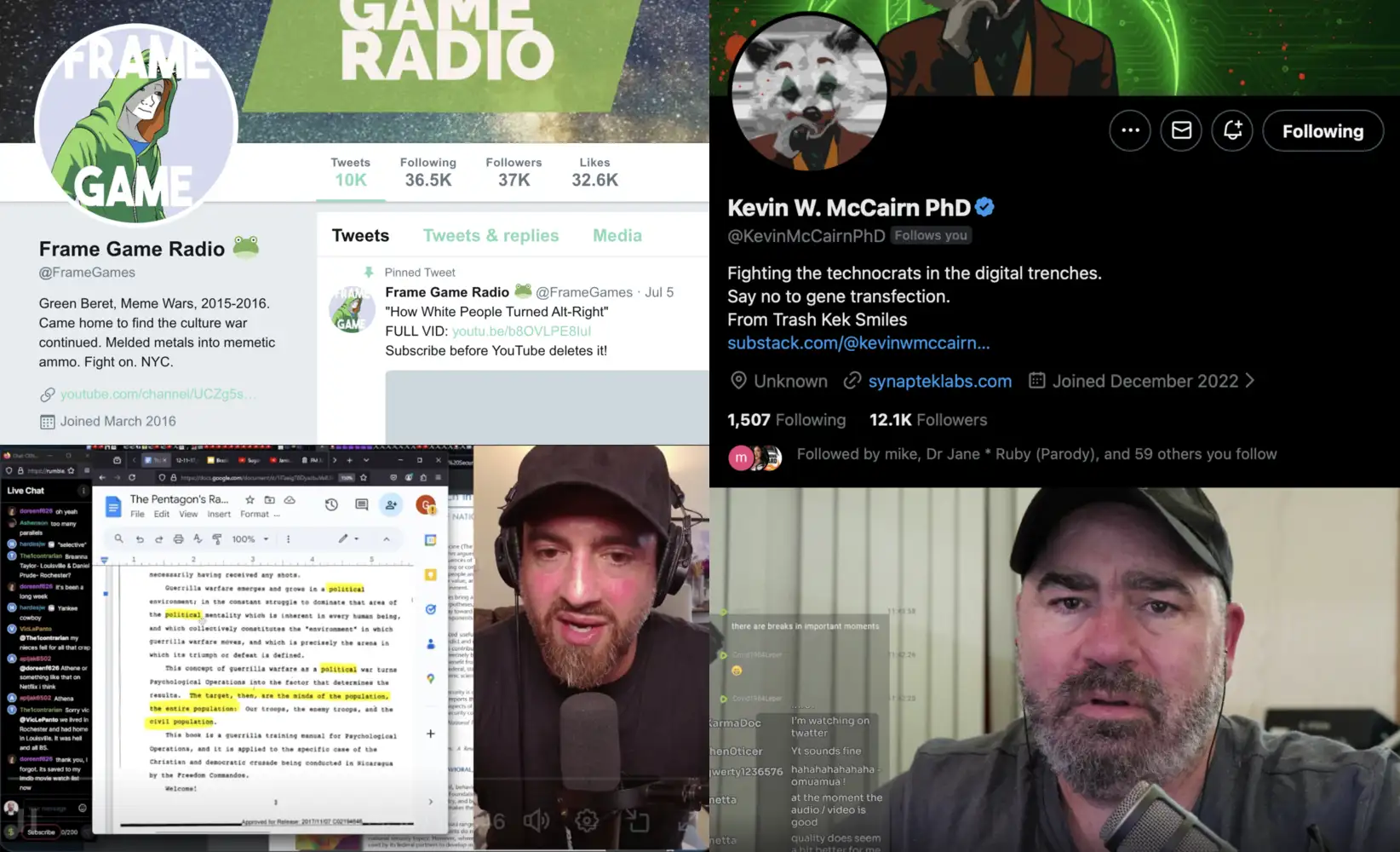
To my knowledge, Kevin McCairn has been featured as a coauthor of two scientific papers about COVID. One of them was a paper about COVID origins by several members of DRASTIC, who included Dan Sirotkin and J.J. Couey. [https://
Fleming claims that he started studying for his PhD degree in physics at age 12, because he was part of a secret program that was a successor to MK-Ultra, but he presents a fake photoshopped image as his PhD diploma. [fleming.
McCairn's sidekick Charles Rixey wrote the foreword for Fleming's book, and Rixey and McCairn were speakers on Fleming's Crimes Against Humanity tour. As far as I know, Rixey and Fleming were the only western people who provided testimony to Peter Kotlár's Slovakian COVID commission. The videos by the commission were published on the Facebook page of a lady who used to work as a newscaster on mainstream TV, but who later became the cohost of Kotlár's conspiracy video channel. Fleming and Kotlár wrote a paper about an analysis of vaccine lots by Soňa Peková, who is a member of a neo-Theosophical UFO cult called ALLATRA, which looks like a version of Falun Gong that is targeted against Eastern Europe instead of China, and which like Falun Gong appears to operate as a front for US intelligence.
I first found Couey's YouTube channel because it was linked at the top of a blog post by Dan Sirotkin. [https://
Christie Laura Grace is another one of the many suspicious people McCairn is connected to. Her pet topic is LNPs, and she blames just about everything on LNPs, so she predictably also says that the calamari clots are caused by LNPs (in the same way that Geoffrey Norman Pain says the clots are caused by endotoxin, and Bryan Ardis says the clots are caused by snake venom, and Marc Girardot says the clots are explained by bolus theory). McCairn has done multiple streams with Christie Grace about how the calamari clots are supposedly explained by LNPs, and Grace and McCairn appeared as guests together on a podcast to talk about the clots. [https://
In 2023, McCairn, Rixey, and Grace were featured in a video panel hosted by Philip McMillan, who seems like a disinformation agent because of his complicity in Greg's ORF hoax. [https://
Christie Grace has said that she "recorded experimentation on people" using equipment she received from Project Veritas, because she was going to be a whistleblower for Project Veritas. [i/
The DEFUSE proposal document was originally published by Billy Bostickson, who is supposed to have received the document from Joseph Murphy via Rixey, but a few months later the DEFUSE document was released again by Project Veritas with additional commentary by Murphy. Murphy supposedly found the document on a drive at the DARPA's Biological Technologies Office while he served as the liaison of the Marine Corps to the DARPA, but even though he is supposed to have leaked a document with vital importance to national security, he didn't lose his career with the Navy, but he instead got a job at the Office of Naval Research. [https://
In 2021 Addy Adds ghostwrote a Kindle book for Cirsten Weldon, which is supposed to have sold about 200,000 USD worth of copies in 3 weeks, even though I suspect the book was employed to launder money. [https://
Addy's mother taught Spanish on naval bases in Guam and Okinawa, so Addy went to a high school on the naval base in Guam, and he later moved with his family to Okinawa. [https://
Over the years McCairn has been connected to so many people in alternative media that it might be a coincidence that he has been connected to several people with intelligence ties. And he has later distanced himself from people like Cottrell, Kulacz, and Couey. But on the other hand it's suspicious how early on McCairn was associated with people like Paul Cottrell and George Webb, who both were obvious disinformation agents. And later on McCairn also became associated with people like Greg Harrison, who is one of the most obvious frauds in the whole anti-vaccine movement, and whose mystery ORFs were transparently disinformation that he himself did not believe in.
In March 2025 McCairn did an experiment where he injected pieces of Hirschman's clot into the heart of a hamster, which died right after the injection. He didn't do a public stream about the experiment, but he only livestreamed it on his Discord.
Wayne Crouch made an infographic about how McCairn killed the hamster after injecting it with "our amyloid jab clot samples". Crouch said that McCairn was linked to Solution of Scientists, which is the group that Crouch and Greg Harrison are part of, and which I'm calling the "Aussie Quinta Columna". Crouch is supposed to be a journalist, but in his infographic he somehow managed to misspell the words "scientist's", "hampsters", and "acess": [https://

Wayne Crouch also wrote a Facebook post where he referred to the people who conducted McCairn's experiment as "we": [https://

Crouch claimed that McCairn's experiment was proof that "we will see the rapid death to the shot recipients". But if the hamster died within seconds from the injection, then why haven't vaccinated people died rapidly yet, even though years have already passed from vaccination? And anyway, if McCairn injected protein into the heart of the hamster, it's hardly comparable to injecting LNPs filled with RNA into a muscle in the arm.
In March 2025, Tom Haviland wrote a Substack post where he described McCairn's analysis of the clots. [https://

Haviland's Substack post had a document attached named Kevin_, which described the results of McCairn's analysis of the clots. The authors of the document were anonymous, and the document was mysteriously signed by "The Researchers":

McCairn told me he was not involved in writing the document. However one of the authors was probably Greg Harrison, because the document was formatted in a similar way as Greg's documents. In 2024 Laura Kasner posted another similar PDF about the clots, where the PDF said that the "authors remain anonymous for safety reasons", but Kasner wrote that Greg was one of the authors. [https://
The document about McCairn's findings said that "ORF-19 and ORF-11 are now functionally implicated in the induction of prionic seeding":

The names of ORFs were written with a hyphen in the document. The names of ORFs are normally written without a hyphen, but Greg Harrison and Wayne Crouch have both written the names of ORFs with a hyphen. [https://
McCairn told me on his Discord: "You seem incapable of understanding that I am working independently and the only link is that is that Greg claims to have done some investigation on the clots. What he has done has nothing to do with my lab analysis." But I linked to the Kevin_ document, and I asked McCairn: "If you're so independent from Greg et al. then why did they write this report about your findings?" But McCairn replied: "I have no idea, and I did not give them permission to write that report or associate it with me any way."
Kevin McCairn's website has a page called "Prion Research Investigation Project", which includes a stock photo of people in a lab that I thought looked similar to the stock footage in An Unholy Triad: [https://

But then I found that McCairn's stock photo came from the same collection of stock footage that was used in An Unholy Triad: [https://


I thought that the stock photo on McCairn's website might be a clue that the same people who made An Unholy Triad were also involved in making McCairn's website. McCairn told me that the page on his website with the stock photo was made by Chris France, who has also made other parts of McCairn's website. But when I asked Chris France how he picked the stock image, he didn't answer me. So the question is still open if the matching stock footage was a coincidence or not.
Greg's AI seems to have prophesied the results of McCairn's Rt-QuIC analysis, because in December 2024 Greg wrote: "Thx Kevin, will send you emails with word docs attached in which AI is now telling us we have identified a new blood-born Amyloid-prion disease. All is conjecture but AI seems highly convinced we shall soon identify this new Amyloid-Prion hybrid disease with deep NMR's & RT-QuIC, plus a few more techniques to properly nail it. Interesting times ahead..thx Gregh" [https://
Greg Harrison, Wayne Crouch, and Lisa Johnston are all promoting a McCairn-style narrative about a coming prion apocalypse. Lisa Johnston tweeted that "Planet earth is under attack by prionic amaloidosis created by man": [https://

Wayne Crouch was credited as the director of the Unholy Triad videos. The final video in the series presented a scenario of a prion apocalypse. First vaccinated people started developing calamari clots, and then prions from the clots ended up in wastewater, and wastewater carried the prions into the sea. Then the seawater evaporated and formed into deadly prion rain, and also the prions spread to humans who ate fish, and in the end all of humanity died: [https://

In February 2025 Kevin McCairn appeared on a video panel about the clots hosted by Steve Kirsch, which also featured Kevin McKernan, Richard Hirschman, Tom Haviland, and Greg Harrison: [https://

Kirsch is connected to the story about the clots in multiple ways, because I believe he was the second person after Jane Ruby who interviewed Hirschman, and the first person who interviewed Anna Foster and Cary Watkins, who to my knowledge were the next two people after Hirschman who said they had seen the clots. Jane Ruby wrote that Kirsch worked with Epoch Times to put out his own version of the story about the clots, but they left her evidence out of the story. [https://
So I thought that McCairn might have somehow become involved with the clots through Kirsch, because Couey said: "Steve Kirsch wanted me to evaluate Kevin McCairn's grant proposal in 2022, and we had a nice little text exchange on my phone about that. And so there again, he even offered to send me to Tokyo to help him work, and help him do those experiments." [https://
So perhaps it was a coincidence that McCairn happened to send the grant proposal to Kirsch, because McCairn doesn't seem to otherwise be too closely connected to Kirsch.
In March 2025 when I compiled evidence on McCairn's Discord that Greg's ORFs were a hoax, McCairn recognized the ORFs to be fake. Then in April 2025 Greg Harrison tweeted: "And at this point in time, wish to retract my ORF 'rantings' due to our lack of credible evidence that any of our ORF stuff actually exists". [https://
When I asked McCairn on his Discord how he first got connected to Greg, he replied: "Here @Henjin is a screenshot of first emails, with time stamps with respect to Greg and Richard. Why don't we start here so you can order your thinking a little better. As memory serves I was involved in a Skype call, it was a group of researchers who had been looking at histological sections of blood from patients that showed microclotting where they presented their histological findings and I initially advised them on how to proceed to stain their tissue for presence of amyloid." I don't want to post the private email here. But later McCairn also explained: "As I recall it was meeting with clinicians who have worked with Richard to begin to measure and quantify what the clots were. They were trying to do thioflavin staining, but lacked the equipment necessary for precise histology. He [Greg] was a part of that call, I didn't know him but he was obviously co-ordinating with Richard and the clinician group in Alabhama who are treating amyloidogenic microclots. As they were making procedural errors in trying to type the tissue, and I had the facilities available, i offered to process the tissue properly so that histological staining for amyloids was done correctly. I have received no money from them to do this or for the subsequent anlayses I have done using RT-QuIC, SEM/EDX and Raman spectroscopy. All of those methods have confirmed an amyloidogenic signature. Does that make sense?"
So as of now it's more or less clear that Greg's crew is deliberately producing disinformation, but it's not yet clear if McCairn is complicit in their operation, or if McCairn rather got inadvertently involved with Greg's crew because he volunteered to help with the histological staining analysis, or because he was looking for samples of the clots to analyze.
But in the case that the clots are fake, and Harrison and Hirschman know themselves the clots are fake, then would they trust someone to analyze the clots who is not in on the scam? People who had presented a laboratory analysis of the clots before McCairn include Mike Adams, Ryan Cole, Ana Mihalcea, Clifford Carnicom, Diana Wojtkowiak, Zandre Botha, Arne Burkhardt, and Greg Harrison. But I believe all of them are controlled opposition. (I explained why I think Burkhardt and Cole are controlled opposition on my page about turbo cancer, because the term "turbo cancer" was first introduced in Burkhardt's conference in Germany, and I believe Cole was the first major person who promoted the hoax about turbo cancer but who was not German: turbo.
In March 2025, Philip McMillan did one video about McCairn's analysis of the calamari clots, another video about Greg's ORFs and how McCairn had found that the clots were autofluorescent, and another video about Greg's AI-generated document that had mystery ORFs going up to ORF100: [https://

Added in June 2025: Over a period of only two days, Greg Harrison posted all of these tweets that promoted McCairn: [https://
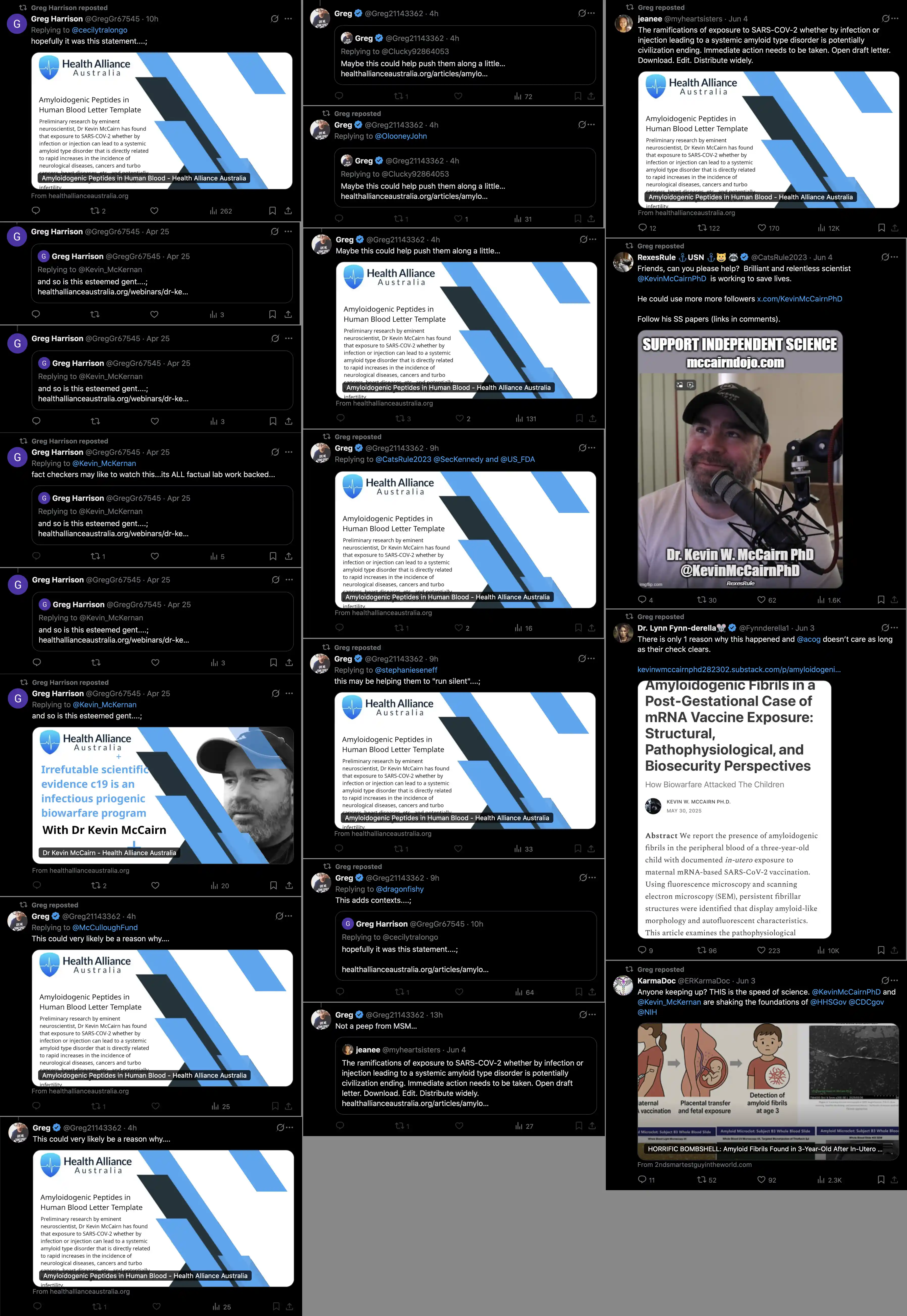
Added in 2026: Greg is still heavily promoting McCairn, and Greg has now released a paper where he supposedly replicated McCairn's Raman spectroscopy analysis of the clots.
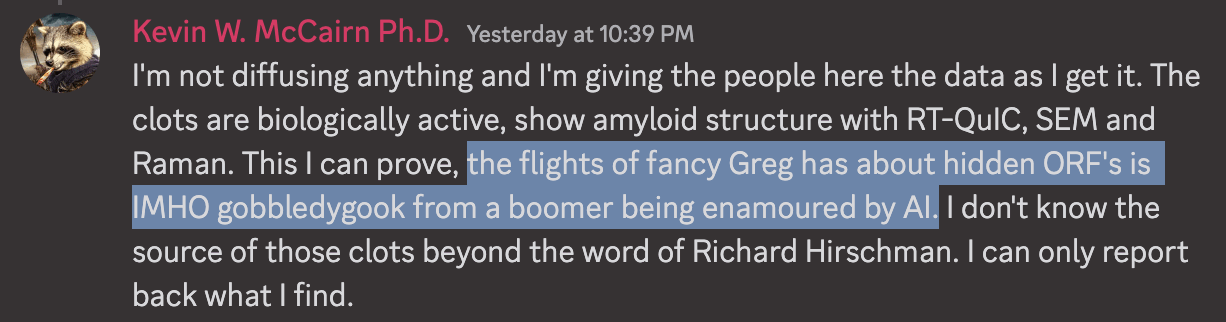
Even after I exposed Greg's ORF hoax, McCairn only threw grew halfway under the bus, because McCairn acted like Greg was just some foolish boomer who got tricked into believing in his own AI hallucinations (even though in reality Greg was clearly part of a coordinated disinformation operation that also included Wayne Crouch and Lisa Johnston):
I think McCairn is probably working for the same disinformation operation as Greg, so even though McCairn halfway distanced himself from Greg's crew, McCairn has avoided discussing the ORF hoax since early 2025, even though the ORF hoax serves as evidence that the clots as a whole are a hoax. And when Greg's crew released the trilogy of preprints about the clots in 2026, McCairn failed to mention how me and a moderator on his Discord had earlier shown how the data in the trilogy was likely fake. And he hasn't drawn attention to how Hirschman and Haviland have continued to support Greg even after Greg was shown to have fabricated the data about the ORFs.
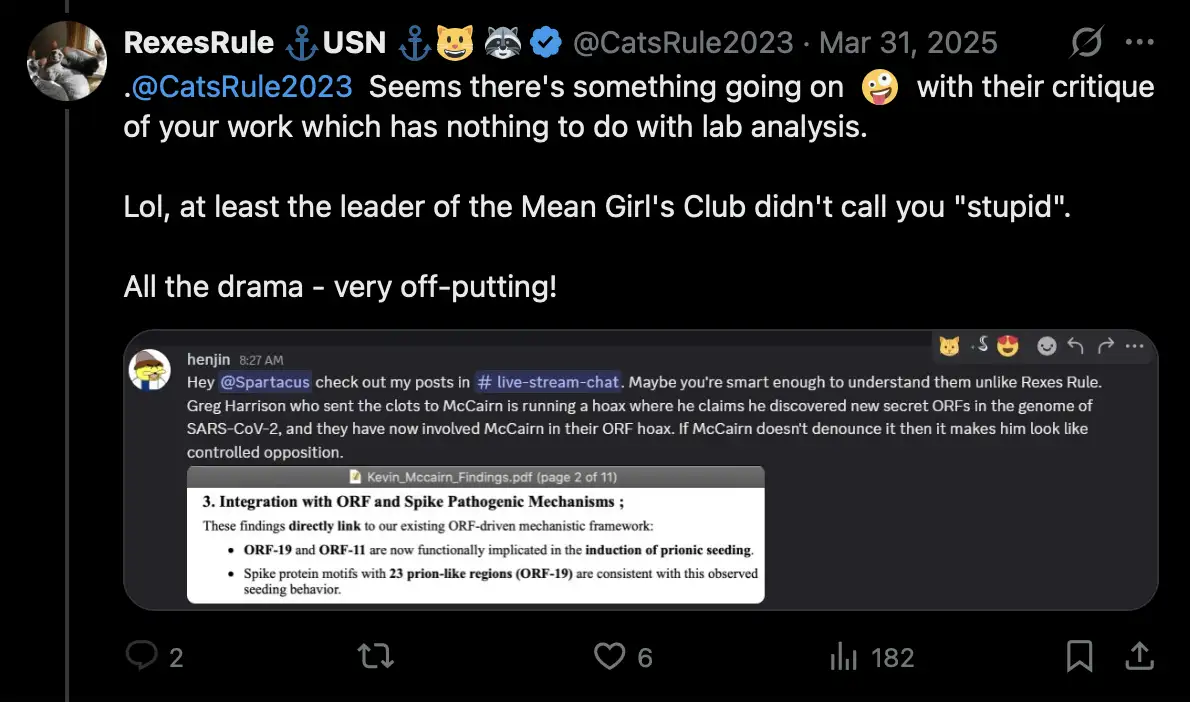
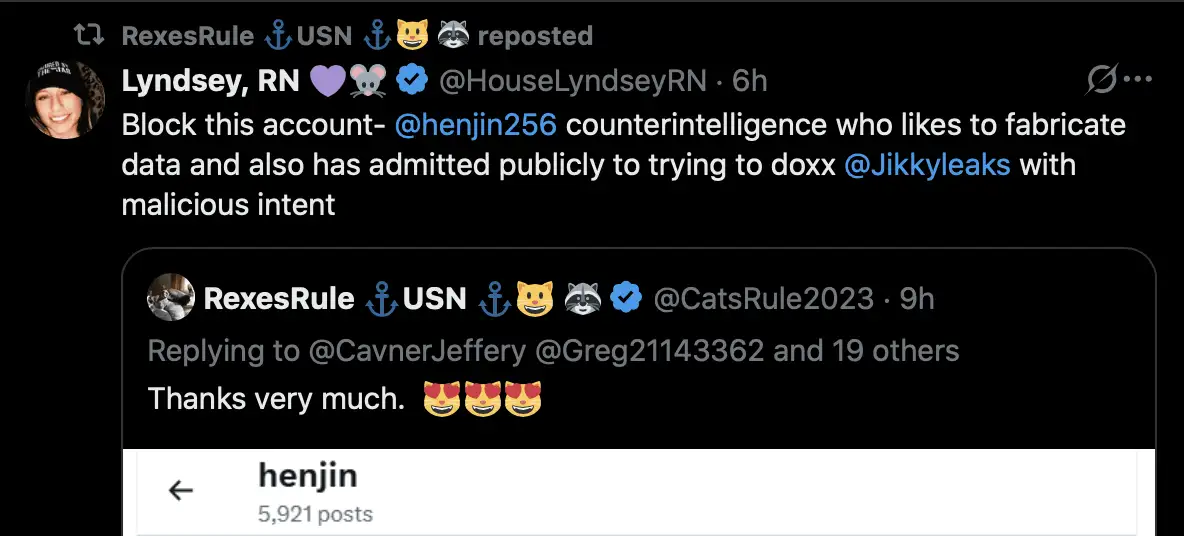
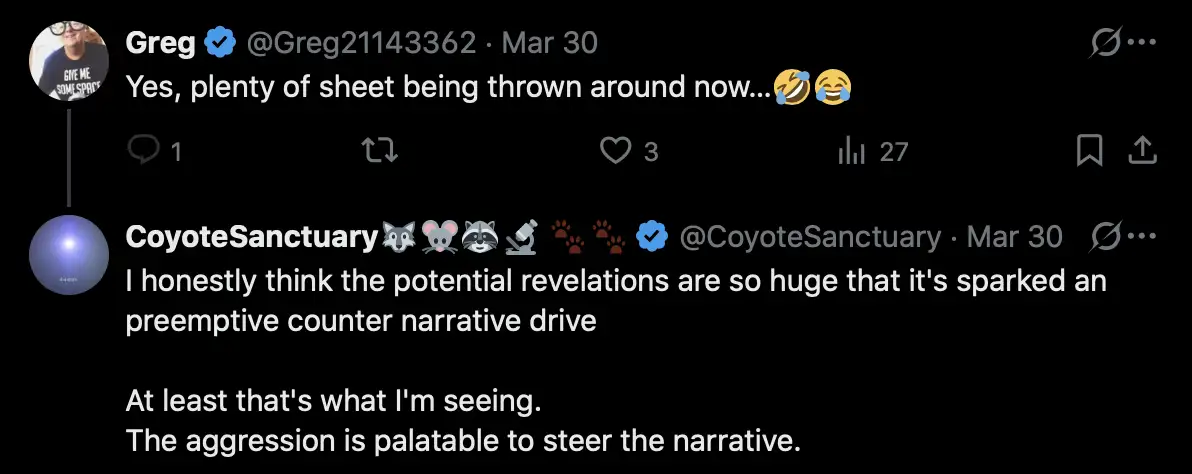
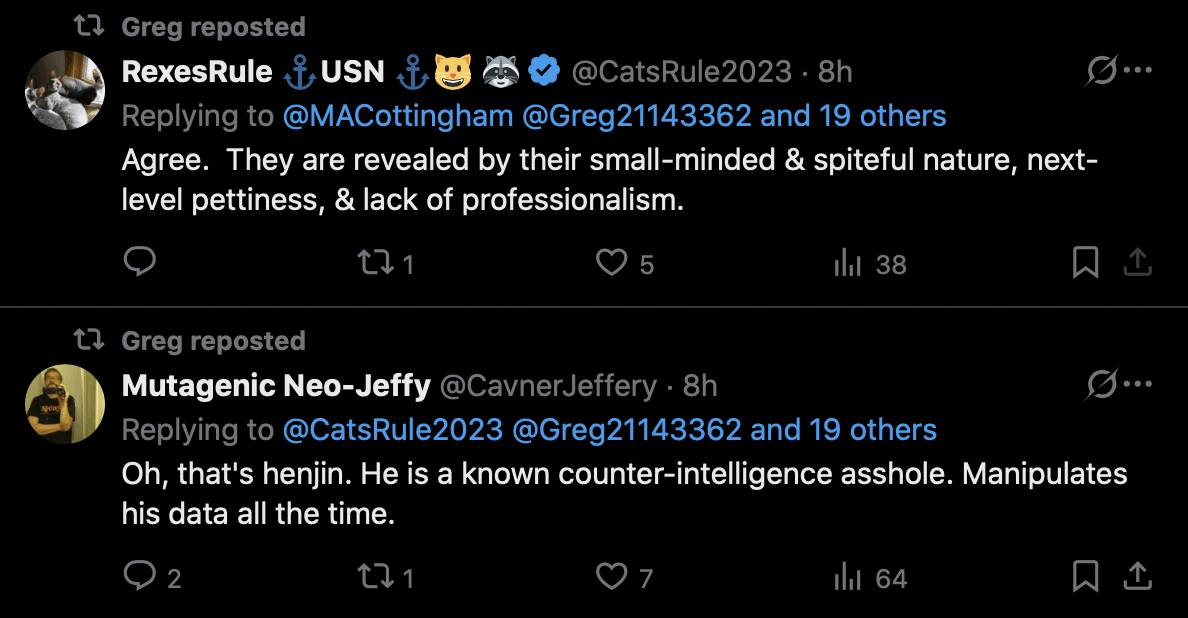
In early 2025 when Greg Harrison was promoting the hoax about the fake ORFs, his biggest cheerleaders on Twitter were users called CoyoteSanctuary and RexesRule/CatsRule2023. Both of them also joined Kevin McCairn's Discord around December 2024, which was after McCairn had started doing videos with Hirschman and Harrison. And CoyoteSanctuary even invited Greg Harrison on the Discord server.
Even after I posted exhaustive evidence on the Discord that the ORFs were fake, RexesRule and CoyoteSanctuary kept defending Greg's ORFs, and they just told me that I was crazy or that I was a counterintelligence agent. So I thought they might have been in on the scam, since otherwise their behavior of defending Greg's hoax did not seem reasonable: [https://

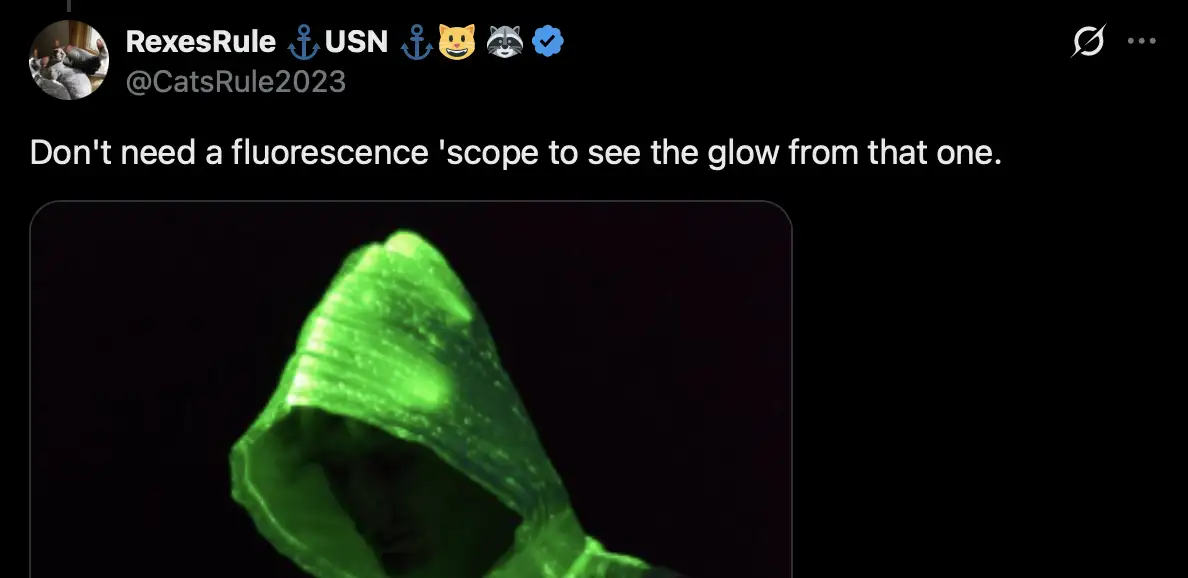
When I looked into RexesRule's Twitter profile, I noticed that her banner image had a seal that said "NAVSECGRUDIV" and "NAVCAMSEASTPAC": [https://

"NAVCAMS EASTPAC" is short for "Naval Communication Area Master Station, Eastern Pacific". [https://
Wikipedia says that NAVSECGRU is a former unit of naval intelligence, whose assets later formed the Information Operations Directorate of Naval Network Warfare Command: [https://
The Naval Security Group (NAVSECGRU) was an organization within the United States Navy, tasked with intelligence gathering and denial of intelligence to adversaries. A large part of this is signals intelligence gathering, cryptology and information assurance. The NAVSECGRU organization was active from March 1935 to September 2005.
In addition to being part of the Navy, NAVSECGRU was also part of the National Security Agency's Central Security Service.
The NAVSECGRU organization was transferred to the Naval Network Warfare Command (NETWARCOM) where its former assets made up the Information Operations Directorate.
I found a tweet where RexesRule wrote: "My NAVSECGRU team was the best." [https://

An announcement from 2005 said: "What was formerly NAVSECGRU has now become NETWARCOM's Information Operations Directorate." [https://
Later after I got Kevin McCairn to agree with me that Greg's ORFs were fake, Greg posted a tweet where he wrote "And at this point in time, wish to retract my ORF 'rantings' due to our lack of credible evidence that any of our ORF stuff actually exists." [https://
But on the other hand it's possible that RexesRule was not part of Greg's team in the way that Wayne Crouch seems to be part of a coordinated team with Greg, because the oldest tweet that matched the query @ was only posted in February 2025. And similarly the oldest tweet that matched the query @ was only posted in December 2024. But before that both RexesRule and CoyoteSanctuary had frequently interacted with Kevin McCairn. So RexesRule seems more like a cheerleader for McCairn, who started promoting Greg's ORF hoax after Greg had appeared as a guest on McCairn's stream.
I think CoyoteSanctuary is likely to be a useful idiot, but I'm not so sure about RexesRule, especially considering how McCairn is also connected to the US Navy or US naval intelligence through Charles Rixey (who is a former Marine, and who received the DEFUSE proposal from Joseph Murphy who works for the Office of Naval Research), through Spartacus (who is a merchant marine), through Paul Cottrell (who had a radio show on a network operated by a naval intelligence agent), through J.J. Couey (whose former boss works for the ONR), and through Addy Adds (who lived on US naval bases, and who ghostwrote a book for a Qtard lady whose channel was managed by someone who also managed the channel of an ex-Marine Qtard).
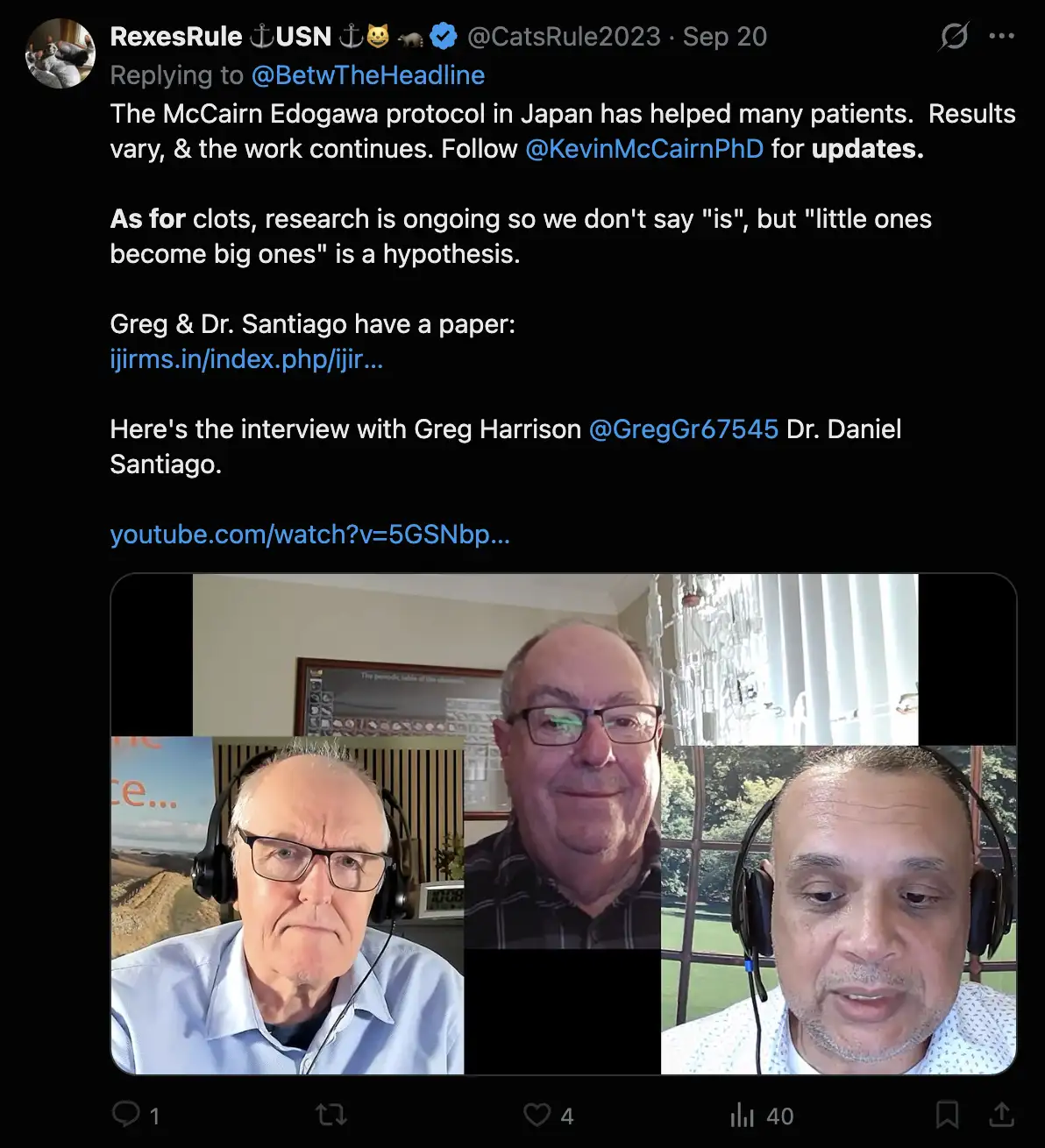
RexesRule has made many meme-style images where she has promoted Kevin McCairn, and she frequently posts tweets where she asks people to donate money to McCairn:


Greg Harrison also retweeted a tweet where RexesRule asked people to donate money to McCairn: [https://
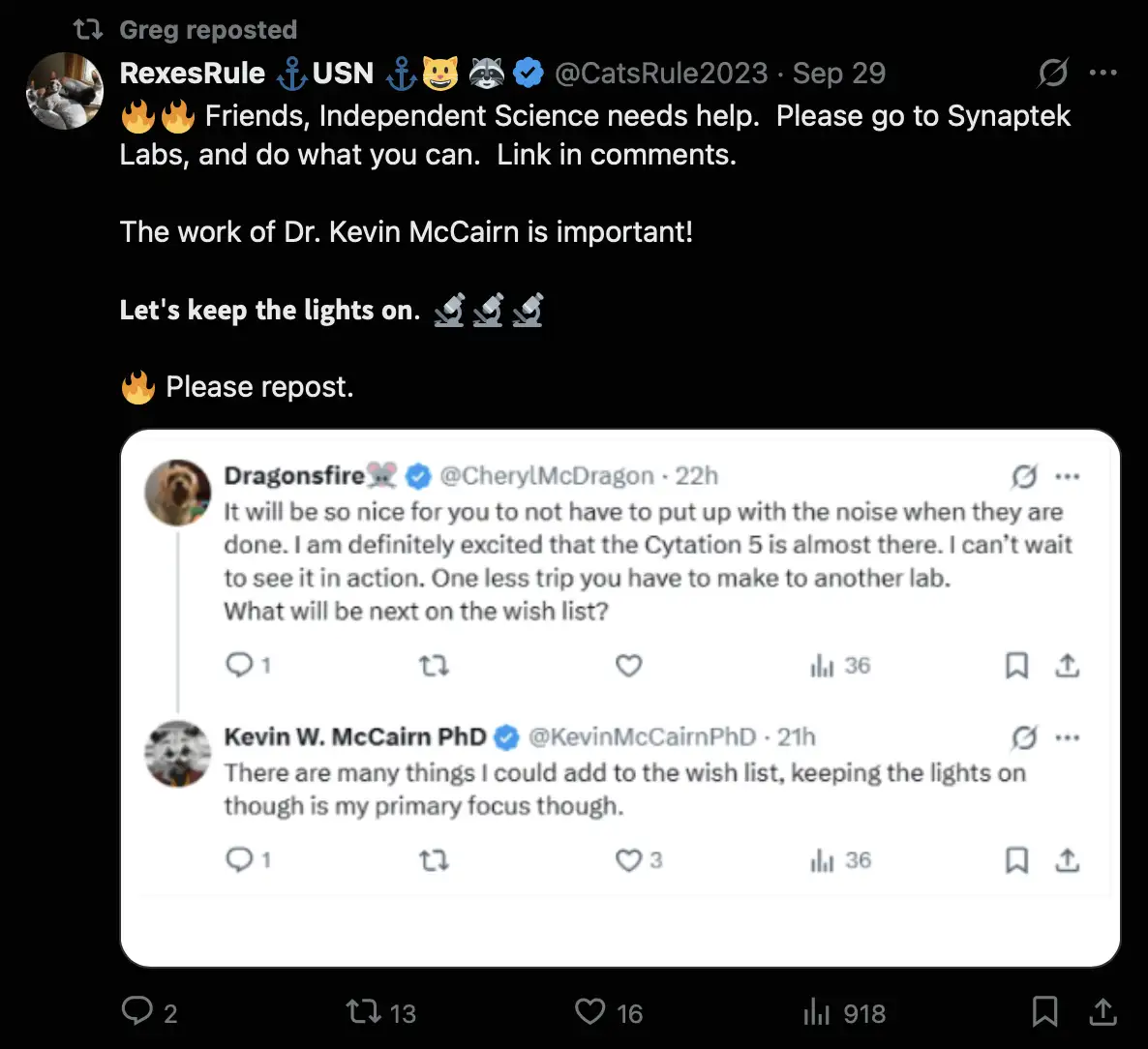
Added in 2026: RexesRule has now started making infomercial-style memes to promote McCairn's amyloid fibril removal scam: [https://
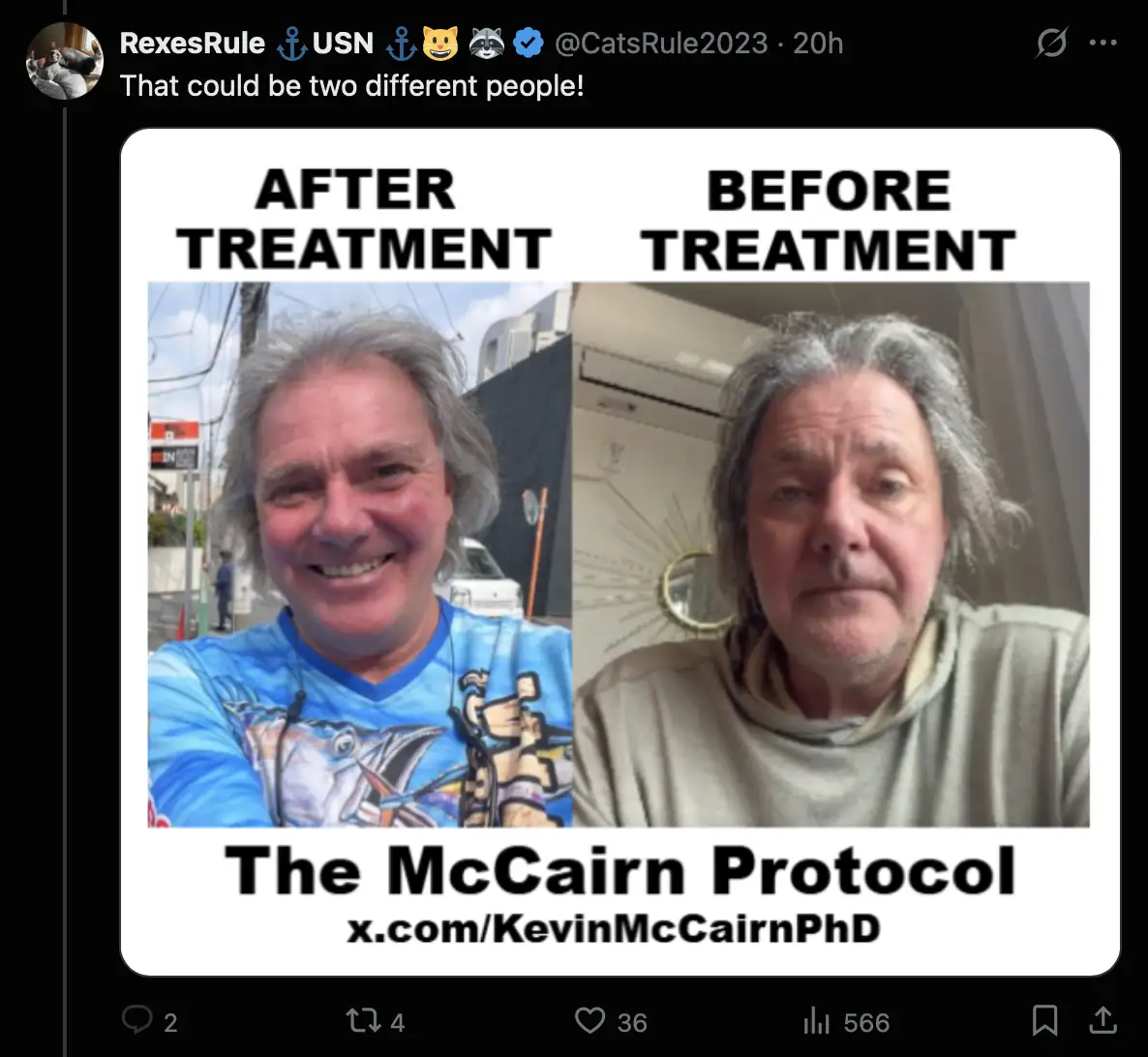
Now you too can get your fibrils removed for the low-low price of 60,000 US dollars: [https://
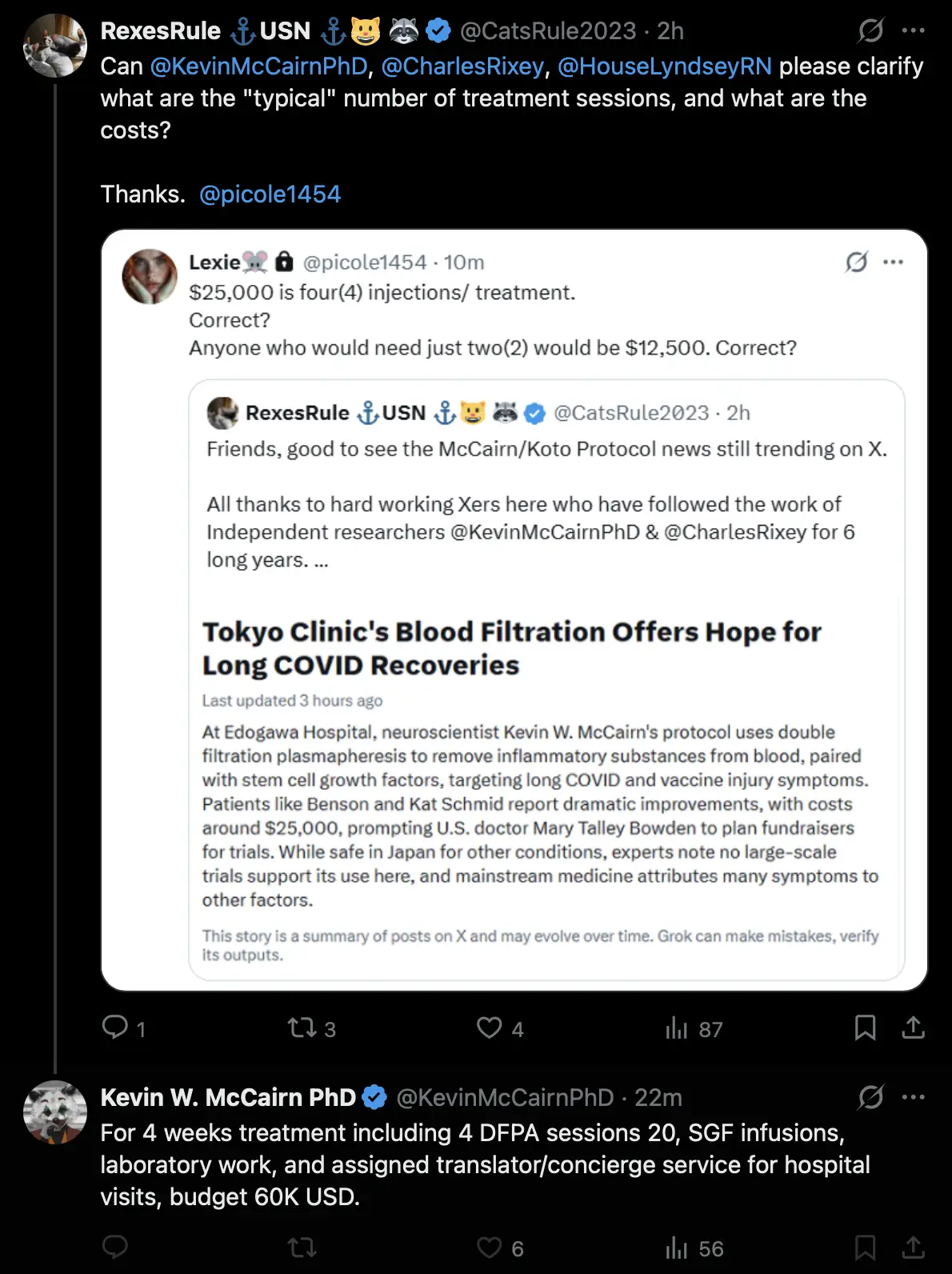
Added in June 2026: RexesRule has now started making videos promoting McCairn, because she says she is trying to get McCairn's work noticed by the mainstream media: [https://

Added in July 2026: RexesRule promoted this video of Greg Harrison, even though I had shown her many times that Greg had fabricated his data: [https://
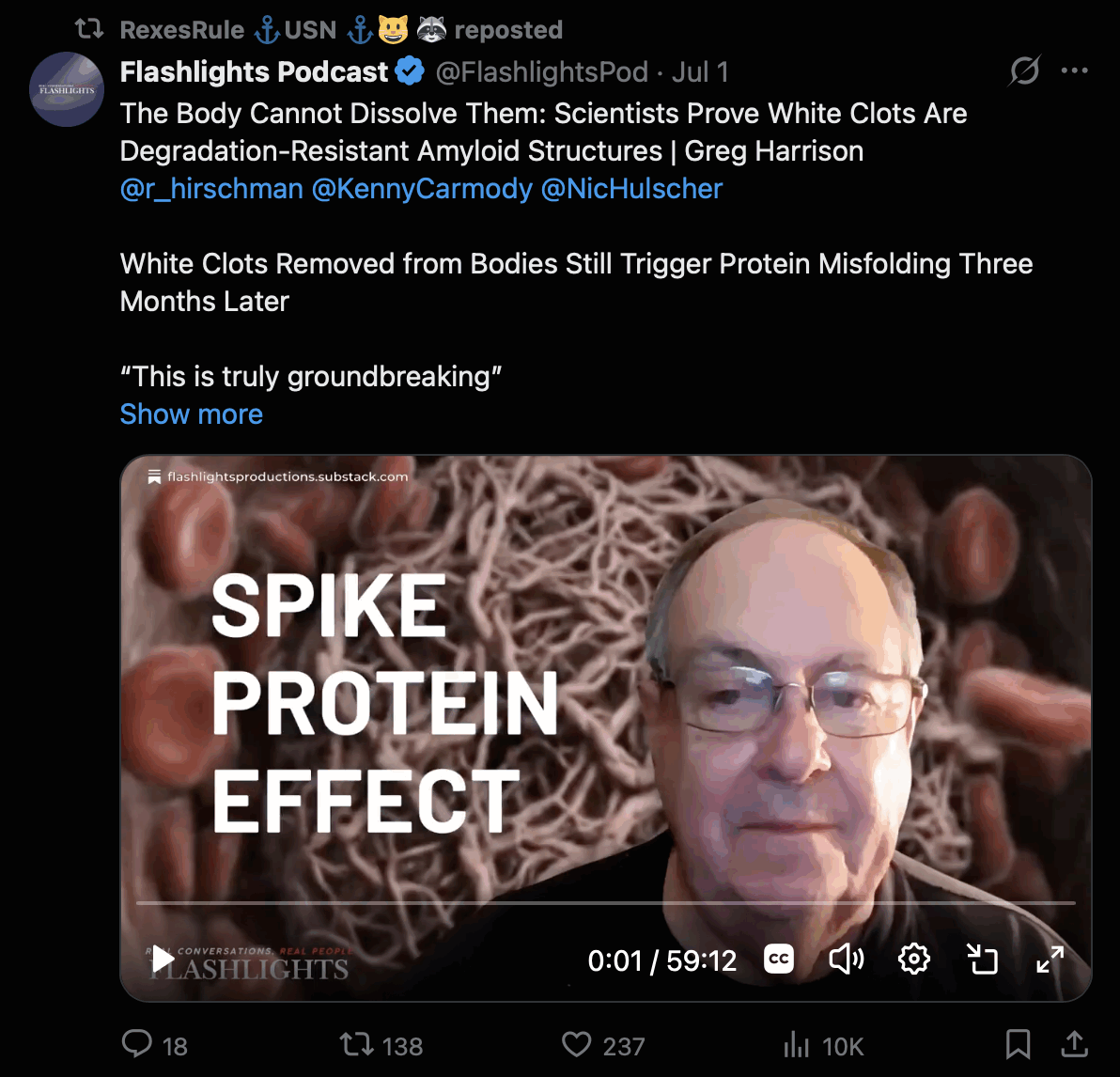
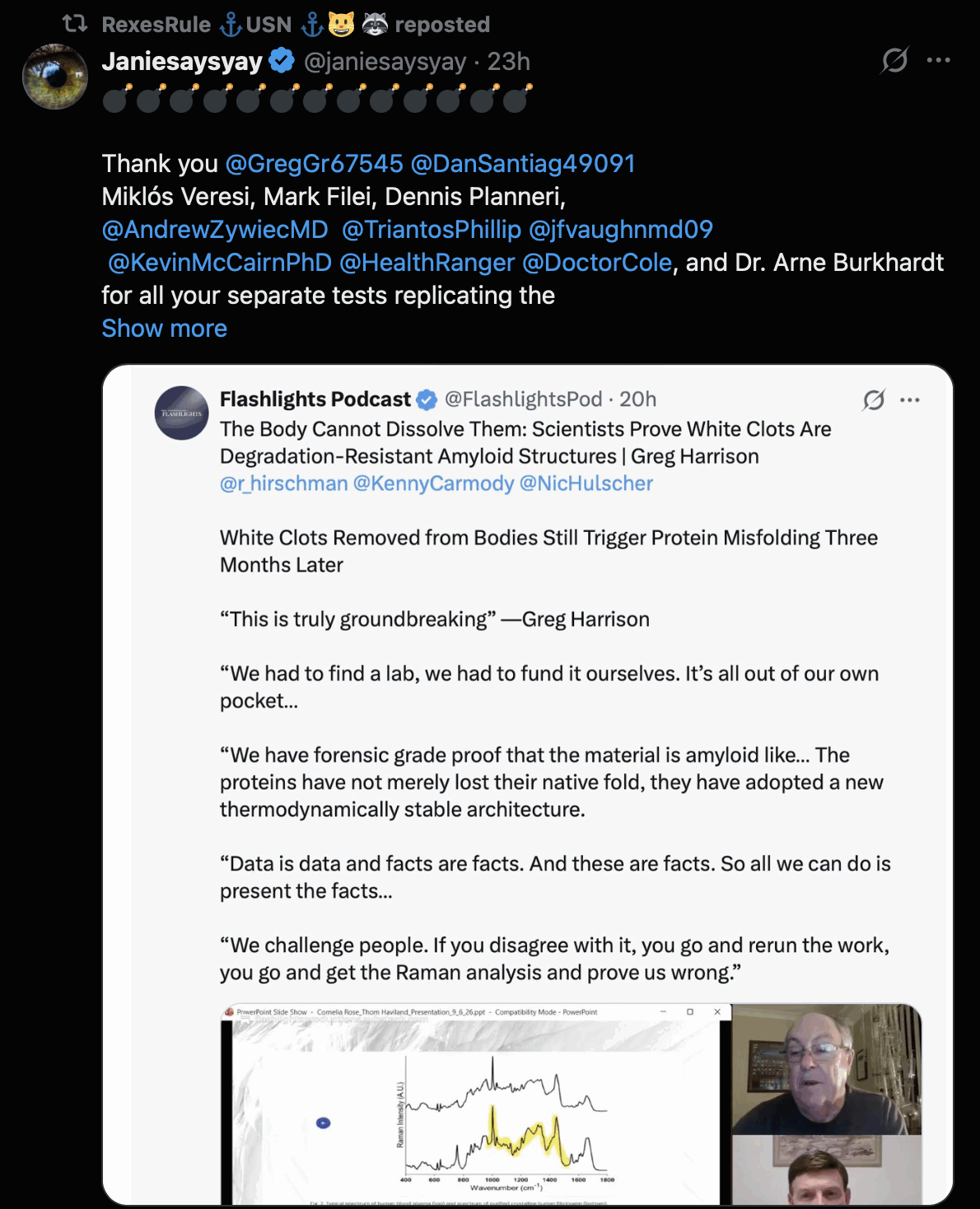
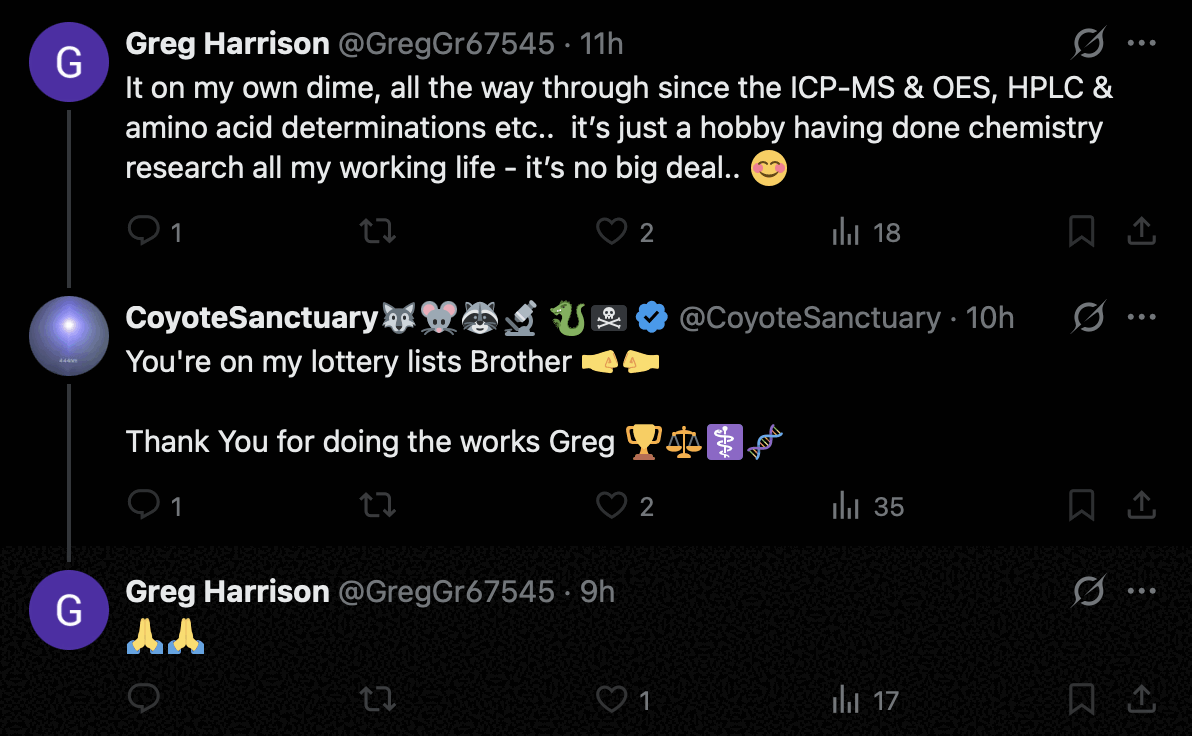
And even though CoyoteSanctuary knows about Greg's ORF hoax, CoyoteSanctuary was still cheerleading for Greg in 2026: [https://
Added in September 2026: RexesRule also promoted this interview Greg did with Nurse Campbell, but she didn't add any disclaimer about how Greg is a known fraud and a liar: [https://
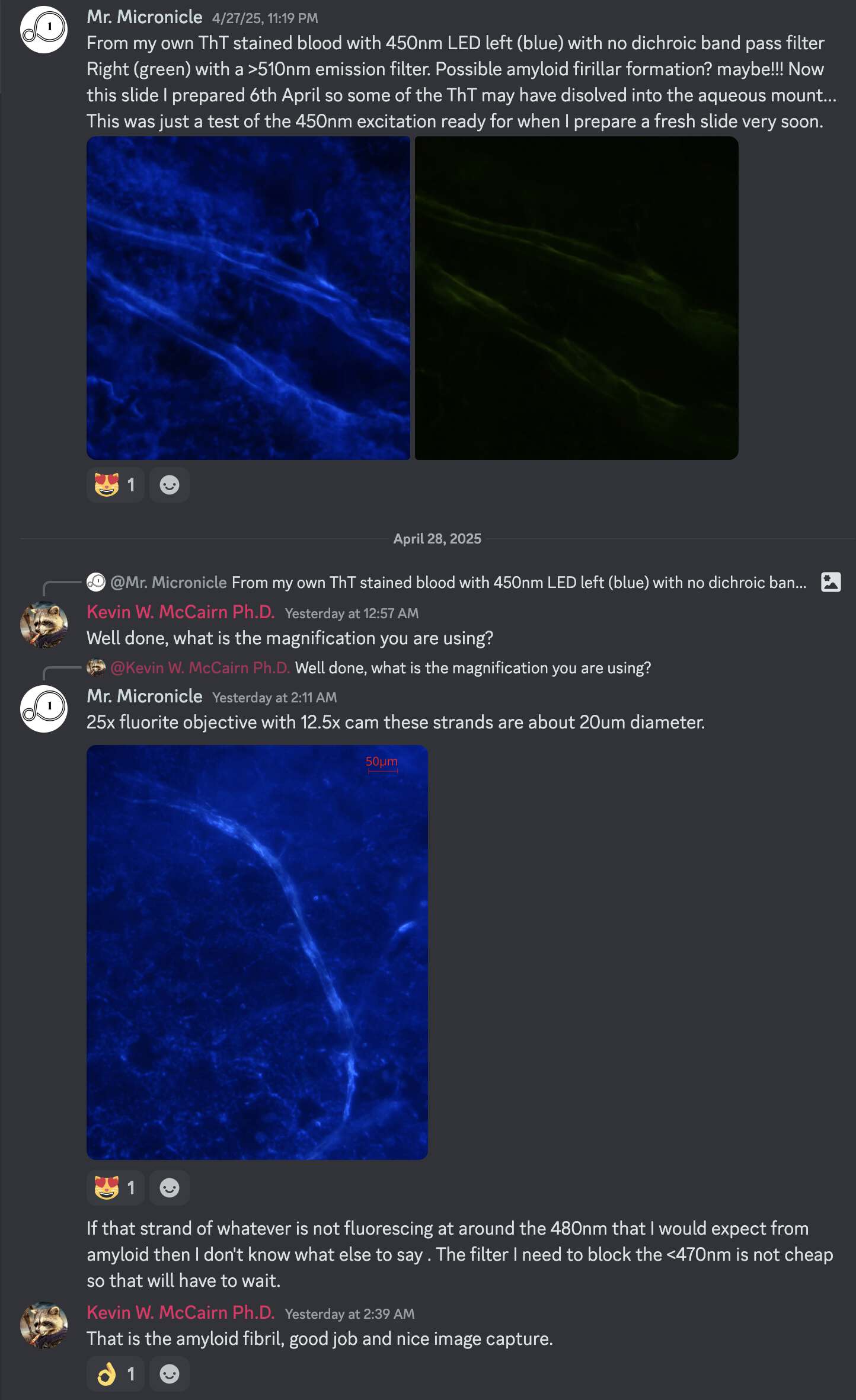
A user called Mr. Micronicle joined Kevin McCairn's Discord server in 2025. He posted various microscope images on the server, including images that he claimed showed calamari clots that came from the body of a dead person, even though he refused to answer me where he obtained the clots.
Mr. Micronicle said that he took microscope photos of his blood stained with Thioflavin T, and he showed an image of a fiber-like object in the blood with a diameter of about 10-20 µm. Then Kevin McCairn said "That is the amyloid fibril, good job and nice image capture":
I told McCairn:
Wouldn't it be an aggregate structure that consists of multiple fibrils? A single fibril would be much narrower based on what ChatGPT said:
Amyloid fibrils are very thin protein aggregates.
Their diameter typically ranges from 7 to 13 nanometers (nm), regardless of where they form (blood, organs, brain, etc.).
In blood-related diseases like AA amyloidosis or AL amyloidosis, amyloid fibrils circulate or deposit, and their size remains in that typical range.
Cryo-EM (cryo-electron microscopy) and atomic force microscopy studies have shown that some fibrils can be as thin as 6 nm or up to about 15 nm, depending on the specific protein involved and conditions of formation.
McCairn responded: "All peptides are aggregate structures. Depends on the method of aggregation though and their resistance to proteases as to how we classify them as pathogenic." But I showed that ChatGPT said:
In scientific terminology:
A fibril is understood to be a very thin, elongated structure, usually in the nanometer scale for diameter (approximately 7-13 nanometers for amyloid fibrils).
Structures that are micrometers wide (especially 10 micrometers, which is about 1,000 times thicker than a typical fibril) would more accurately be called:
Bundles of fibrils
Aggregates
Fibers or fiber-like structures (sometimes used when many fibrils associate)
Thus, a 10 micrometer-wide formation would be considered a fiber or an aggregate of fibrils, rather than a single fibril itself.
And McCairn said: "It is a fibril, singular, of oligomerized amyloidogenic fibrin. That description is correct." But I showed him that ChatGPT responded:
In principle, no - if you are using a standard light microscope, it would not be possible to image a single fibril of oligomerized amyloidogenic fibrin.
Here is a detailed explanation:
A single fibril (even one formed by fibrin adopting amyloid-like structure) would have a diameter of around 6-15 nanometers, sometimes slightly thicker depending on conditions.
The diffraction limit of optical microscopy (~200-250 nm) means anything thinner than that cannot be resolved as a distinct object.
Therefore, under a standard light microscope, what you would see would be aggregates, bundles, or dense regions of multiple fibrils - not an isolated, singular fibril.
Wikipedia says: "Fibrils (from Latin fibra) are structural biological materials found in nearly all living organisms. Not to be confused with fibers or filaments, fibrils tend to have diameters ranging from 10 to 100 nanometers (whereas fibers are micro to milli-scale structures and filaments have diameters approximately 10-50 nanometers in size)." [https://
McCairn's defense was that the calamari clots were a novel phenomenon that required a novel vernacular, so it was acceptable for him to use the word "fibril" in an unconventional sense. He told me: "Trying to use old vernacular to a new blood prion disorder will lead the spergs like you to blow a fuse, but you'll just have to put up with it."
Then McCairn said this about the clots: "Nothing @henjin is sore that there have been multiple replications of the same phenomena and that they satisfy the metrics required to call them amyloidogenic peptides." But I replied: "You mean the fibrin or other proteins in the clots contain segments that act as amyloidogenic peptides? It wouldn't make sense to say that the clots themselves are amyloidogenic peptides." And I pointed out that ChatGPT said:
Strictly speaking, no, it is not accurate to say that fibrin clots themselves are amyloidogenic peptides. Here is the proper interpretation:
A peptide refers to a small chain of amino acids, typically much shorter than full proteins.
Fibrin is a full-length, large polymeric protein (~340 kDa before cleavage), not a small peptide.
A fibrin clot is a macroscopic network formed by polymerized fibrin monomers, often extending hundreds of micrometers across - not a single molecular entity or a simple peptide.
Thus:
A fibrin clot is not itself a peptide. It is a supramolecular structure made of many fibrin molecules.
Amyloidogenic peptides are smaller fragments or sequences capable of forming amyloid fibrils on their own.
In pathological conditions, portions of the fibrin molecule become amyloidogenic - but the entire clot should be referred to as an amyloid-rich structure or amyloid-like fibrin network, not as a "peptide."
Accurate phrasing would be:
"Fibrin clots can adopt amyloid-like structures."
"Amyloid fibrin contains amyloidogenic regions within the fibrin protein."
"Pathological fibrin clots exhibit amyloid features."
Then McCairn just said that "we are dealing with a novel phenomenon, and as such the current repertoire of nomenclature does not fit well". But he wasn't willing to admit that he used the wrong terminology.
Earlier I had also called him out for saying that fibrin was a peptide, but McCairn's response was that "You should also be reminded that the vernacular peptide and protein are interchangeable." But I pointed out that ChatGPT said:
No, it would not really be correct - even in casual speech - to call fibrin a peptide.
Here's why:
- Fibrin is very large - it's made by polymerizing fibrinogen, which itself is almost 3000 amino acids long.
- Even a single fibrin monomer (before polymerization) is way too big to be called a "peptide."
- Peptides usually refer to short chains - dozens, or maybe a few hundred amino acids at most.
Calling fibrin a peptide would sound wrong to most people familiar with biology, even casually. It's much better (and more natural) to call fibrin a:
- Protein, or
- Polymerized protein, or
- Fibrillar protein, depending on context.
If McCairn sees a random fiber under a microscope, he says the fiber is an amyloid fibril, in the same way that Ana Mihalcea would say that the same fiber is a carbon nanotube, and Mike Adams would say that the fiber is a nanowire interface structure, even though all of those are nano-scale structures that are not visible with an optical microscope.
Mr. Micronicle's website used to be called "Zero Infinity One Network", which he said was "a reference to the esoteric sense of what mount Zion represents in esoteric terms": [https://

His Telegram channel was called "ZIO.NETWORK". [https://
Added in 2026: Greg's AI now told him that "fibril-like peptides" had been found in the laboratory, so the AI managed to combine McCairn's incorrect uses of both the words "fibril" and "peptide" into a single term: [https://
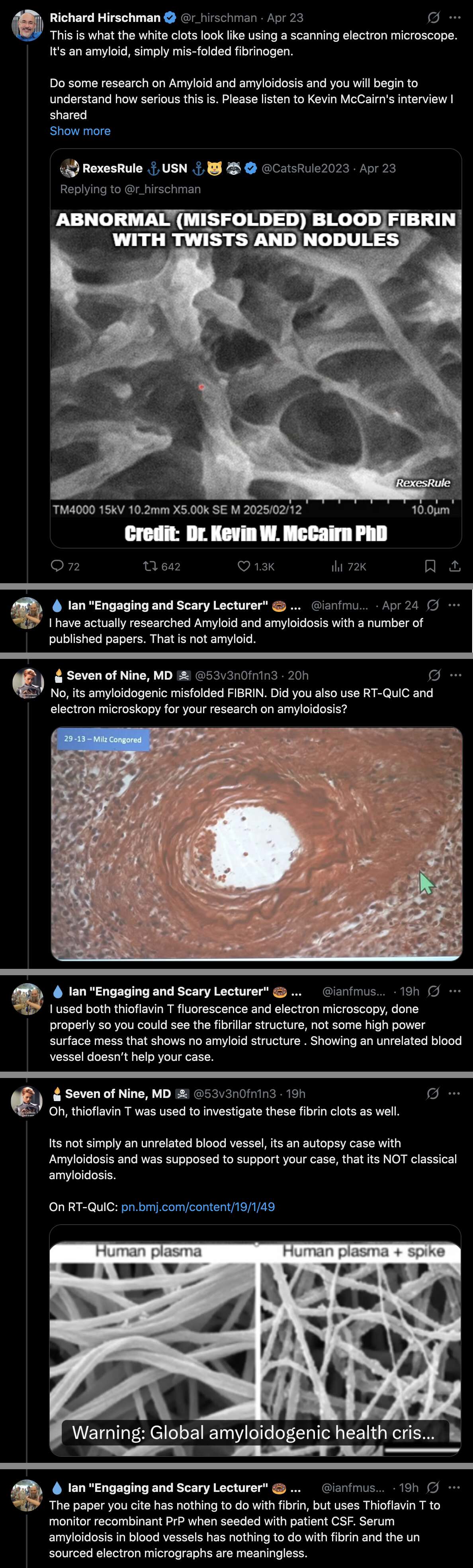
In the thread below, Richard Hirschman quoted a tweet by McCairn's naval intelligence cheerleader RexesRule, who posted McCairn's SEM image of one of Hirschman's clots. Hirschman said that the image showed amyloid fibrin, but a biologist called Ian Musgrave said it was not correct: [https://
In a stream McCairn did about the SEM images, he showed this image:
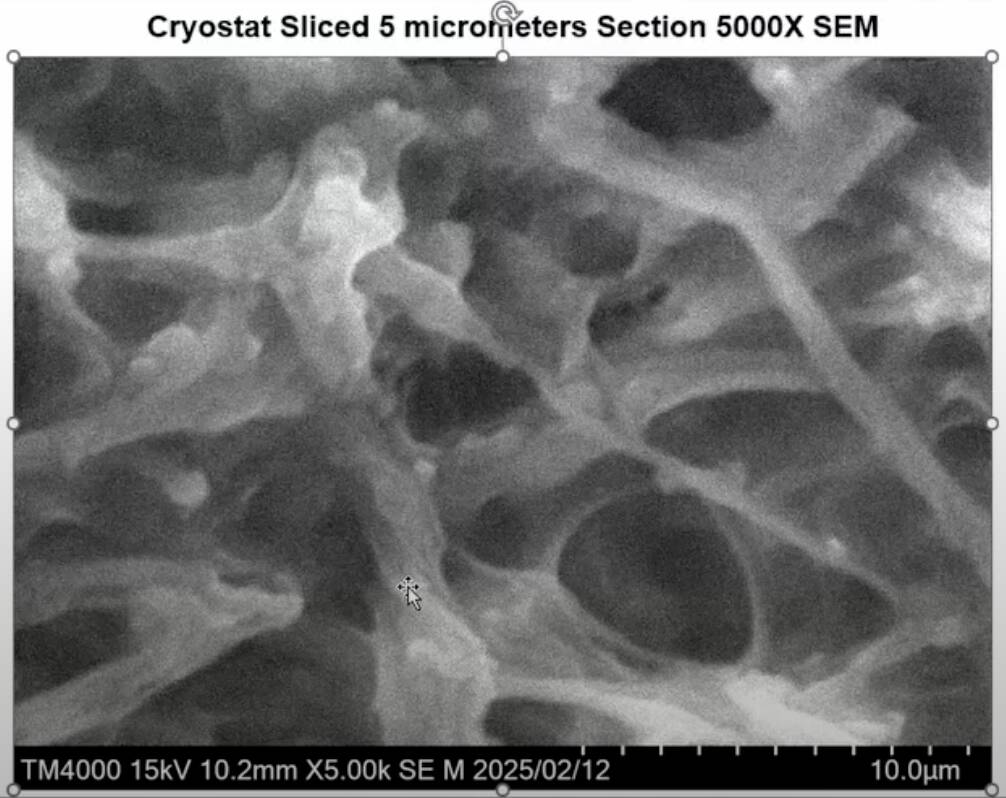
And then he said that he was somehow able to discern the shapes of individual peptides from the image, and he was "familiar with looking at peptides in and of themselves". He said: [https://
When you go down to 5,000 times, what you see here - and it's only because unfamiliar with looking at these structures, that this was a standout abnormal to me, right - there are very clear nodular forms on these peptides, ok.
I don't know if you can see that, right, so my cursor is here, right, like this will stick out. And if we look at this primary branch here, what you see is - fibrin should be a long smooth rope-like peptide that essentially just overlays itself to form the network around which platelets and other tissues that form a clot - can aggregate, ok.
Here what you're looking at is a - and so, you're looking at very abnormal structural properties that are standout to someone who's familiar with looking at peptides in and of themselves, ok.
And those are these nodular forms, and also - what I would point out to people is that - pay attention to this thicker filament, right, and um, in biology, often what you see - and that's not the best example that I can give for people to think about - is often when you look at a tree, a tree, as you look at the trunk has a sort of twisting effect to it, right.
It sort of starts at the roots, and it sort of has a rotation to it, as it goes up to form the branch area of the tree. But the trunk often, if you pay attention to it, you'll see it has a rotation to it.
And generally in biology, I would say it's a right-hand rotation, it's the right hand rule of thumb, and you can get into all sorts of metaphysics around electrodynamics and what that - how that relates to the body.
But in this instance, what you're seeing is that you're seeing a faster twist - so rotations per unit of distance - than you would expect to see in normal healthy tissue.
He kept saying that fibrin was a peptide, even though fibrin is not a peptide but a protein. Peptides are short chains of about 50 or fewer amino acids.
The reason why he said that a twisted shape was somehow characteristic of misfolded fibrin might be because earlier he claimed that helical twists were characteristic of microclots made of misfolded fibrin, even though the twisted fibers he showed under a microscope were likely not even made of fibrin, but they were probably textile fibers or cellulose fibers that he misidentified as fibrin.
But the so-called "primary branch" in his image has an irregular shape, and the branch looks like it might contain torsion-axis twists, even though it's not clear if that's the case or not:
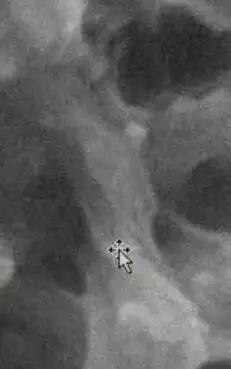
The fibers McCairn showed earlier were about 10-30 µm wide, but his so-called "primary" branch is only about 2 µm wide. McCairn has not presented good evidence that a twisted shape would be a characteristic of structures made out of misfolded fibrin, or that the twisted shape would occur in different types of structures with diameters at different orders of magnitude.
McCairn also showed the images below of the same sample at 250x and 1000x magnification (edited later to take higher-quality images from McCairn's Substack post): [https://
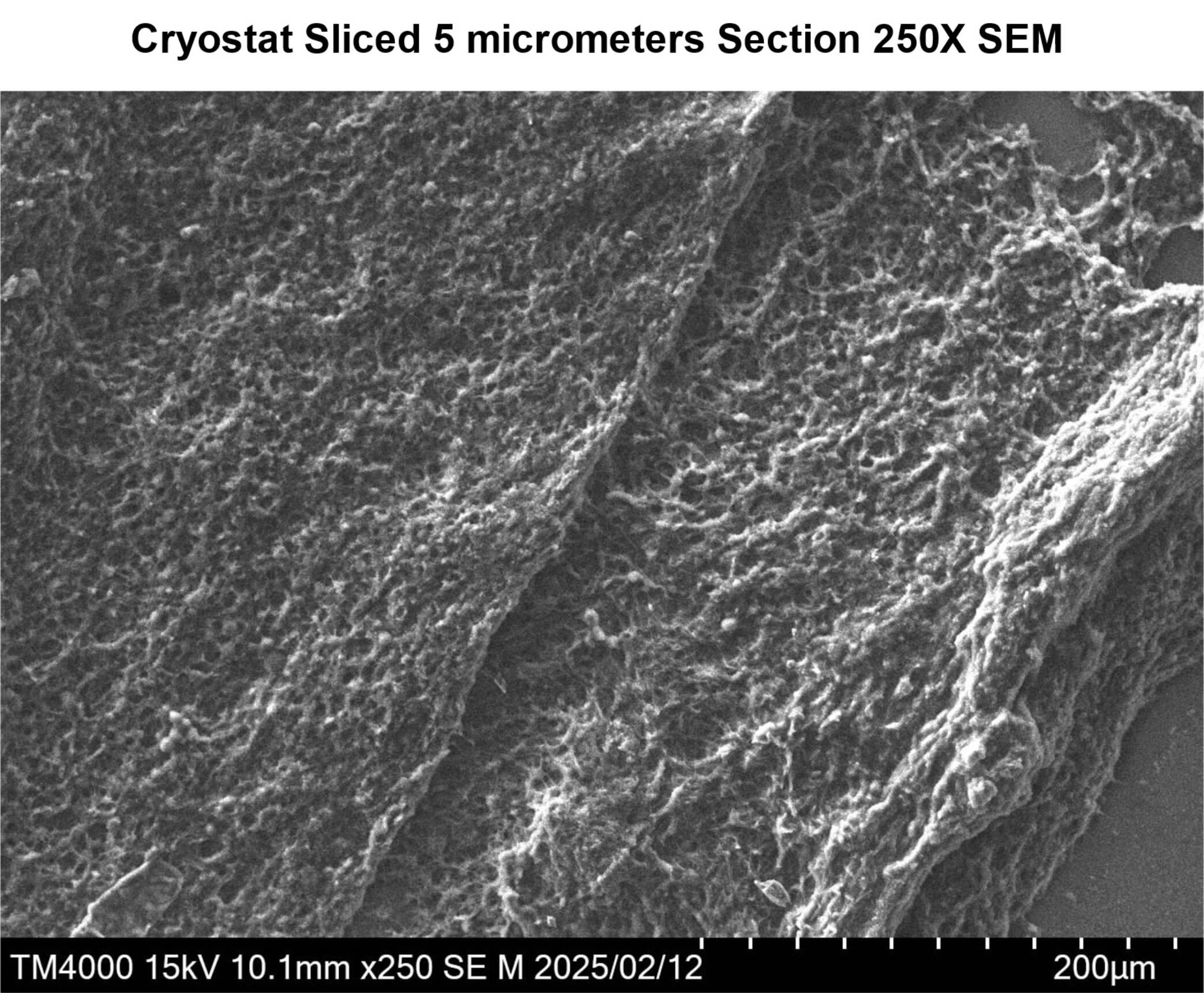
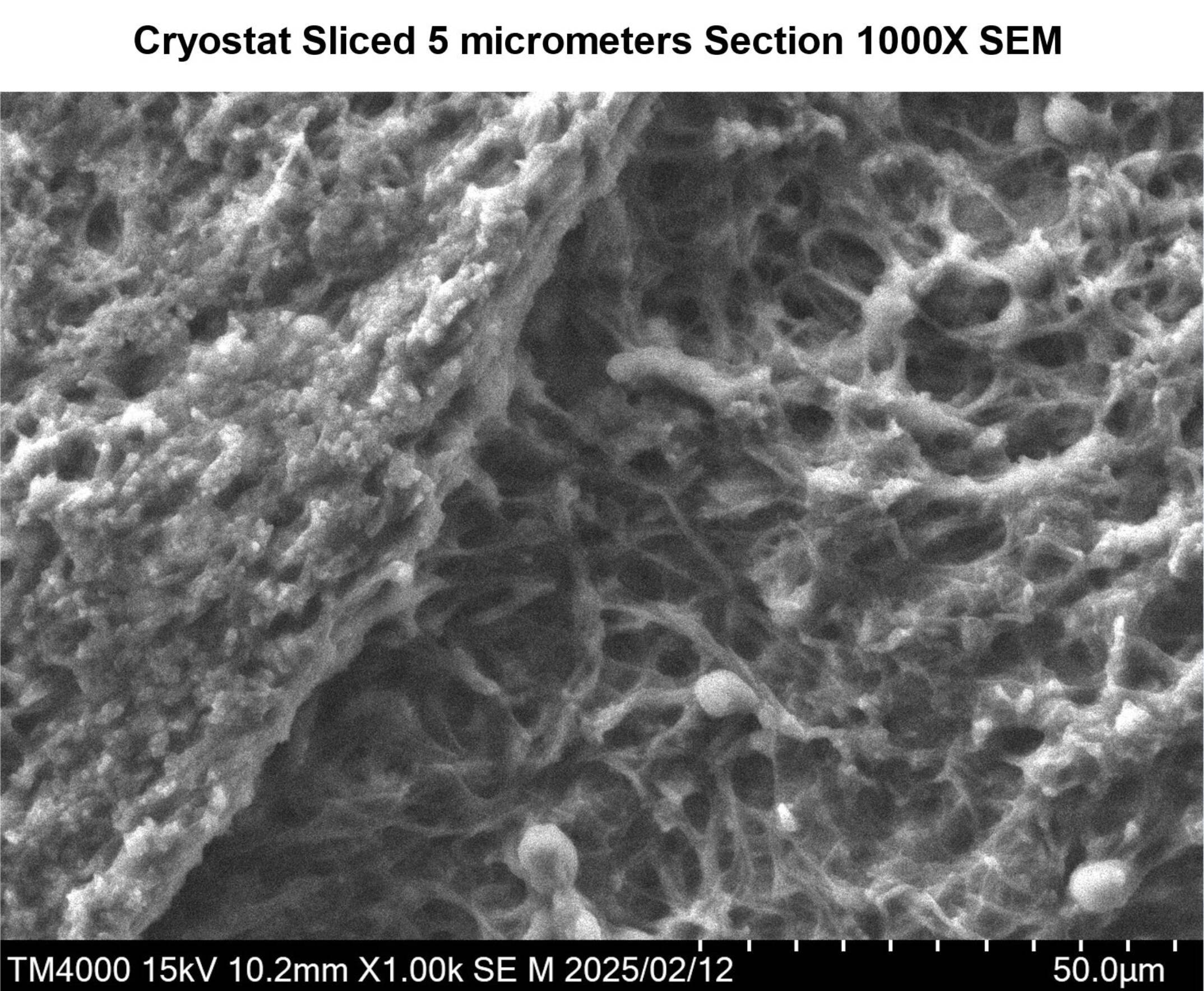
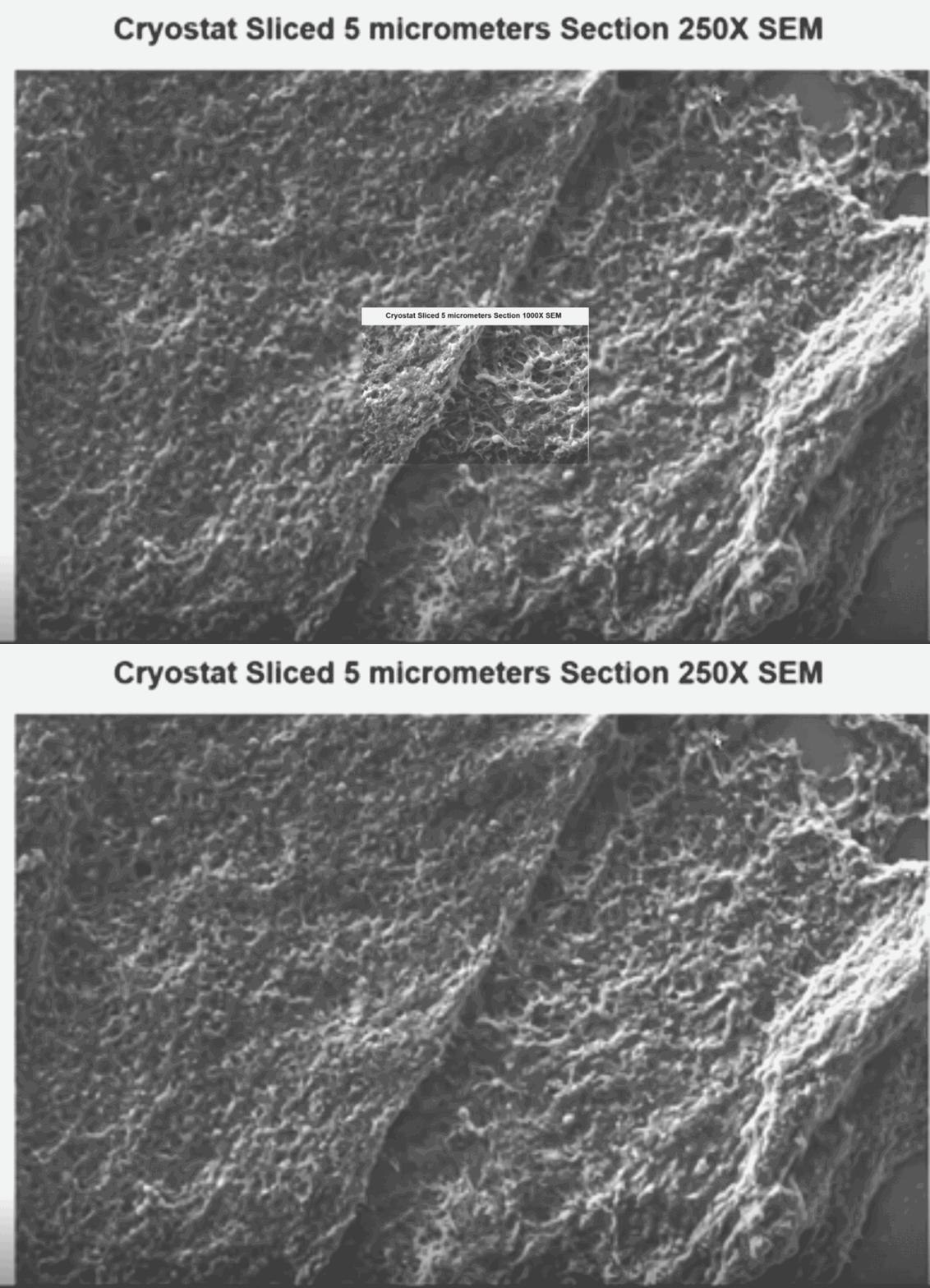
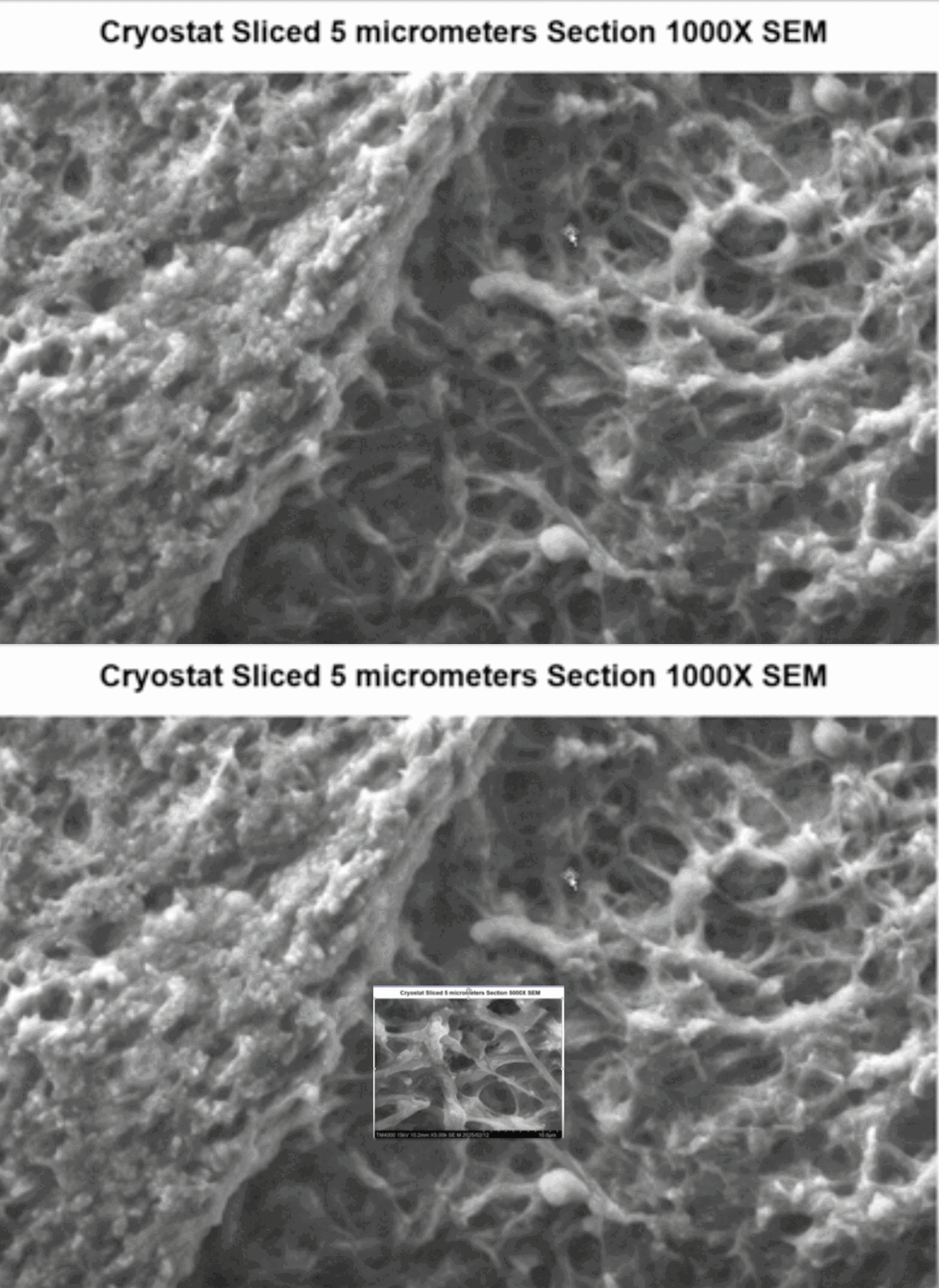
The GIF files below show the 1000x image overlaid with the 250x image, and the 5000x image overlaid with the 1000x image. The 5000x image doesn't have a much higher level of detail than the 1000x image:
Below McCairn's 5000x image is shown next to an SEM image of a regular fibrin clot at 5000x magnification. [https://

A typical diameter for a fiber of fibrin is about 0.1 µm: [https://

When I tried to find SEM images of fibrin clots that resembled McCairn's image, so that had they wide branches with an irregular structure, I found the image below. Image A shows regular spaghetti-like strands of fibrin that have a fairly uniform diameter of about 0.1 µm. But in image B where fibrin was clotted in the presence of a lipid, the fibrin formed wide irregularly shaped structures, so some branches of the structure have a diameter above 1 µm like in McCairn's image. Image B was described like this: "In contrast, in the DPPC MLV suspension the heterogeneous large-pore gels are formed with thin branched fibers and lipid particles incorporated into the gel structure (Figure 1, B). The images reveal many free fiber terminations. Fibers appeared to be highly adhesive forming dense mats and tight bundles." DPPC is a lipid, MLV means multilamellar vesicle which is a type of liposome, so the balls circled in image B are balls of lipid: [https://

I also found a paper where fibrin clots were created in the presence of a fibrinolytic compound, which resulted in the formation of wide strands with a diameter of about 0.5 to 3 µm: [https://
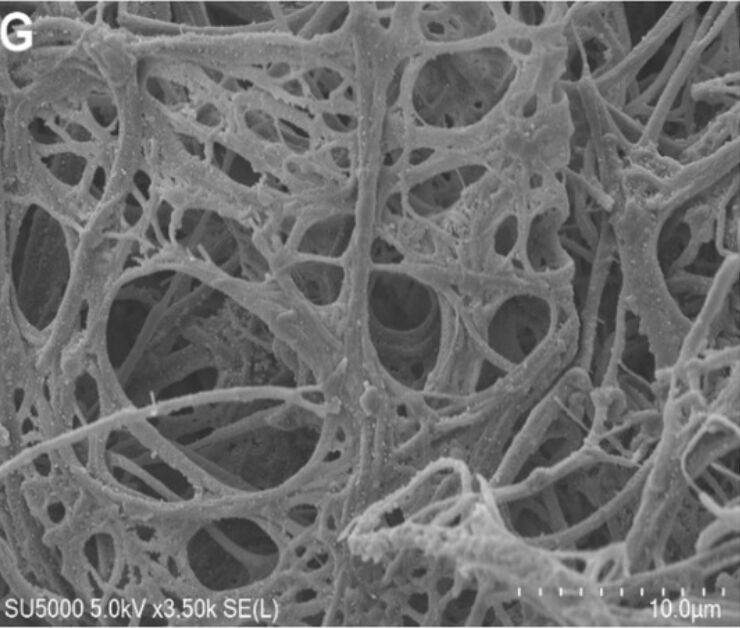
The branches in McCairn's image had a diameter of about 0.2 to 3 µm. ChatGPT said that fibrin structures with a diameter on the micrometer level are unlikely to consist of individual fibrin fibers, but rather bundles of multiple fibrin fibers glued together:
Under normal physiological conditions, fibrin fibers (the building blocks of a blood clot) have diameters typically in the range of 50 to 200 nanometers (nm), sometimes up to 500 nm. So 0.05-0.5 µm is usual.
However, under abnormal or pathological conditions, fibrin fibers can become thicker, but usually not to the extent of 1 µm, and very rarely close to 10 µm as single fibers.
[...]
Bundles of fibers can easily be 1-10 µm in diameter - but those are multiple fibers glued together, not single fibrin polymers.
Single fibrin fibers, even under weird conditions, very rarely cross the 1 µm diameter threshold.
However later ChatGPT said that even fibers of fibrin with a diameter over 1 µm might not necessarily consist of multiple narrower fibers glued together, but wide fibers might also be formed due to a greater degree of lateral aggregation in the stage where the protofibrils form into fibrils:
Thick fibrin fibers with diameters over 1 micrometer generally form through a similar basic polymerization process as regular thin fibers (around 0.1 micrometer), but there are important differences in how they become thick.
Both thick and thin fibrin fibers start with the same initial steps: thrombin cleaves fibrinogen to create fibrin monomers, which then align end-to-end to form protofibrils, and protofibrils laterally aggregate to form fibrils. In thinner fibers, this lateral aggregation is moderate - a few protofibrils come together to form a fibril, and those fibrils form relatively fine fibers.
For thicker fibers, the key difference is that more extensive lateral association occurs. Multiple protofibrils aggregate side-by-side more completely, and sometimes additional bundling happens between already-formed fibrils. There is evidence that under certain conditions - such as low fibrinogen concentration, low ionic strength, or altered thrombin activity - multiple narrow fibers can clump together after initial formation, effectively fusing into wider fibers.
Thus, thick fibers (>1 µm diameter) can result from both mechanisms:
More extensive lateral aggregation during initial assembly, leading to inherently thicker fibers.
Post-assembly bundling or merging of multiple narrower fibers.
If indeed McCairn's image does even show a clot that is made of fibrin, then I don't know if the thickest branches in his image are bundles of multiple strands of fibrin joined together, or if they are just single wide fibers of fibrin. McCairn said that his image showed misfolded fibrin because the branches had an irregular and twisted shape, and the branches didn't look like smooth spaghetti like regular fibrin. But maybe the irregular shape was if the branches were made up of bundles of fibrin and not individual strands of fibrin. (And the clumping of the strands may have been if for example the fibrin structure formed in the presence of a lipid or a fibrinolytic compound, and not necessarily because the fibrin was misfolded.)
When I asked McCairn on Discord why his SEM image had such a poor level of detail, he said: "The difference in detail comes from using a graphene base vs glass slide, and other factors, backscatter acquisition from surface or combined." When I asked why he couldn't use a graphene base, he said: "I use glass to be able run Raman on the same sample." He also posted another similarly blurry SEM image at a 5000-fold magnification level:
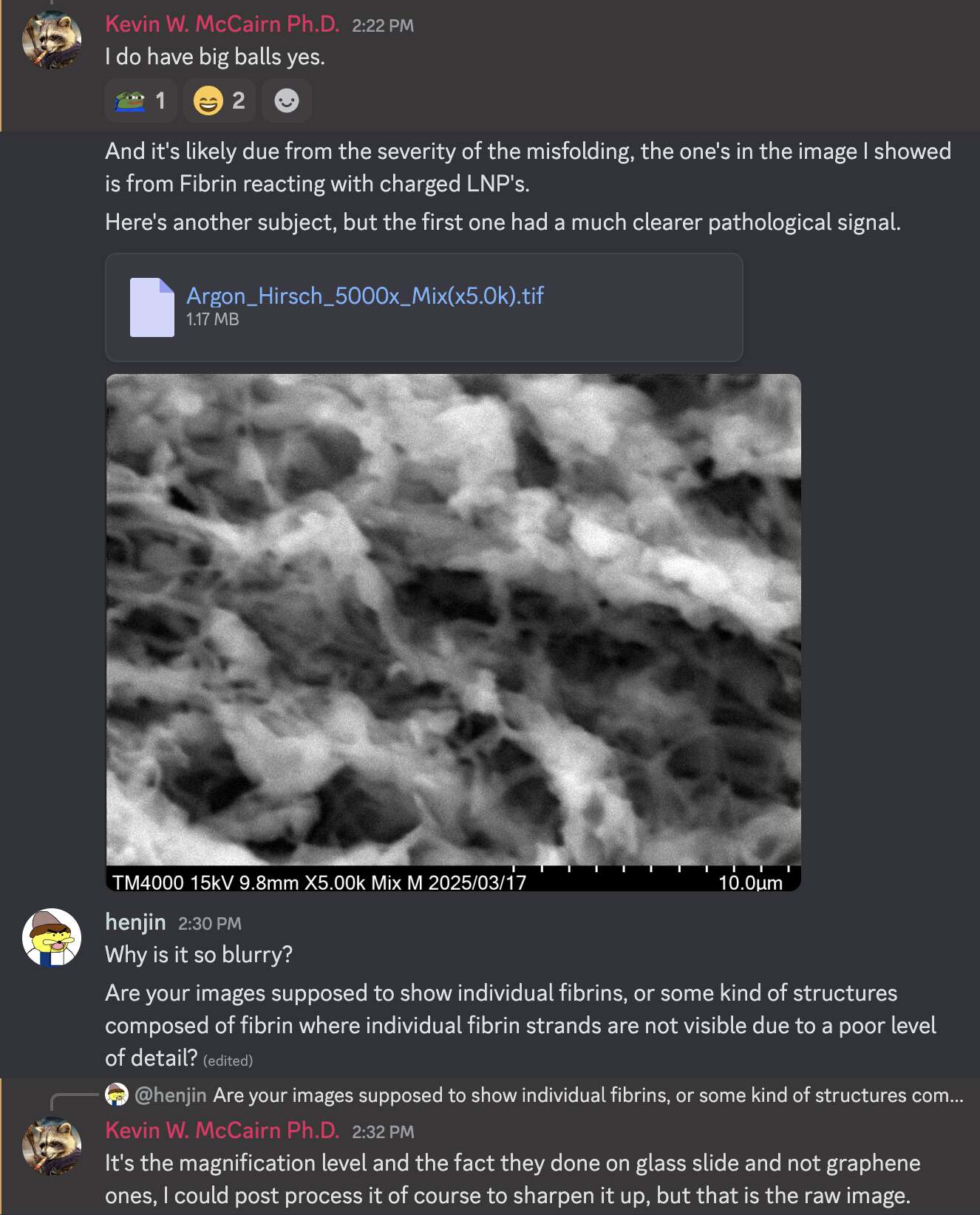
I initially questioned if McCairn's images were really even taken with an SEM, because McCairn made it seem like he had bought his own SEM instrument, which would've seemed like an unnecessarily expensive purchase, but I didn't see an SEM in his lab in his videos, so I questioned if he had actually bought an SEM. For example in a video where he showed his SEM images, he showed a photo of the Hitachi TM4000 SEM, and he said: "It costs serious money to go and get this type of data, ok. The machine you're looking at there is hundreds of thousands of dollars." [https://
But McCairn told me on his Discord that he didn't end up buying his own SEM instrument, but he visited a lab in Japan to do the SEM and Raman analysis, and he linked to an old video where he visited the same lab and used the Hitachi TM4000 microscope. [https://

Hirschman also said: "We've got now Kevin McCairn who's done this work. It costs lots of money. This equipment that he uses costs hundreds of thousands of dollars. It's not like you can just walk up somewhere and have this work done." [https://
One of McCairn's followers went around asking billionaires to donate money to McCairn, because he said McCairn "LITERALLY JUST NEEDS A FEW HUNDRED THOUSAND DOLLARS IN EQUIPMENT AND COULD SAVE EVERYONE FROM DYING HORRIBLY": [https://


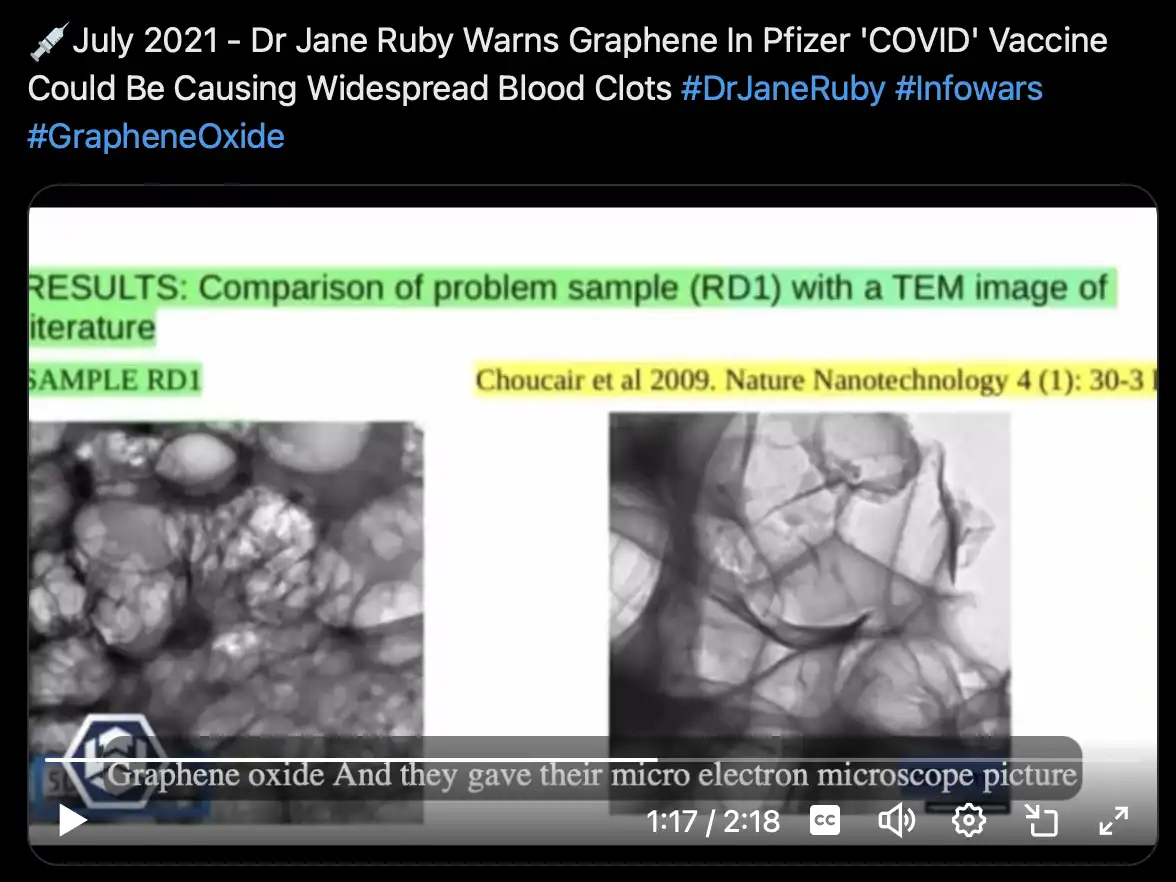
In 2021 Jane Ruby said that an electron microscope image of COVID vaccines looked similar to graphene oxide, which she presented as evidence that COVID vaccines contained graphene oxide. Her images reminded me of McCairn's SEM images of the clots: [https://
Added in 2026: Apparently McCairn is now again asking for a million dollars in donations so he can buy new equipment, even though him and Edogawa are already making millions from their plasmapheresis scam: [https://
McCairn claimed that the image below showed a "fibril" he found from the blood of Lyndsey House. He said "this long strand here is an abnormal fibril from a known vaccine injured patient": [https://
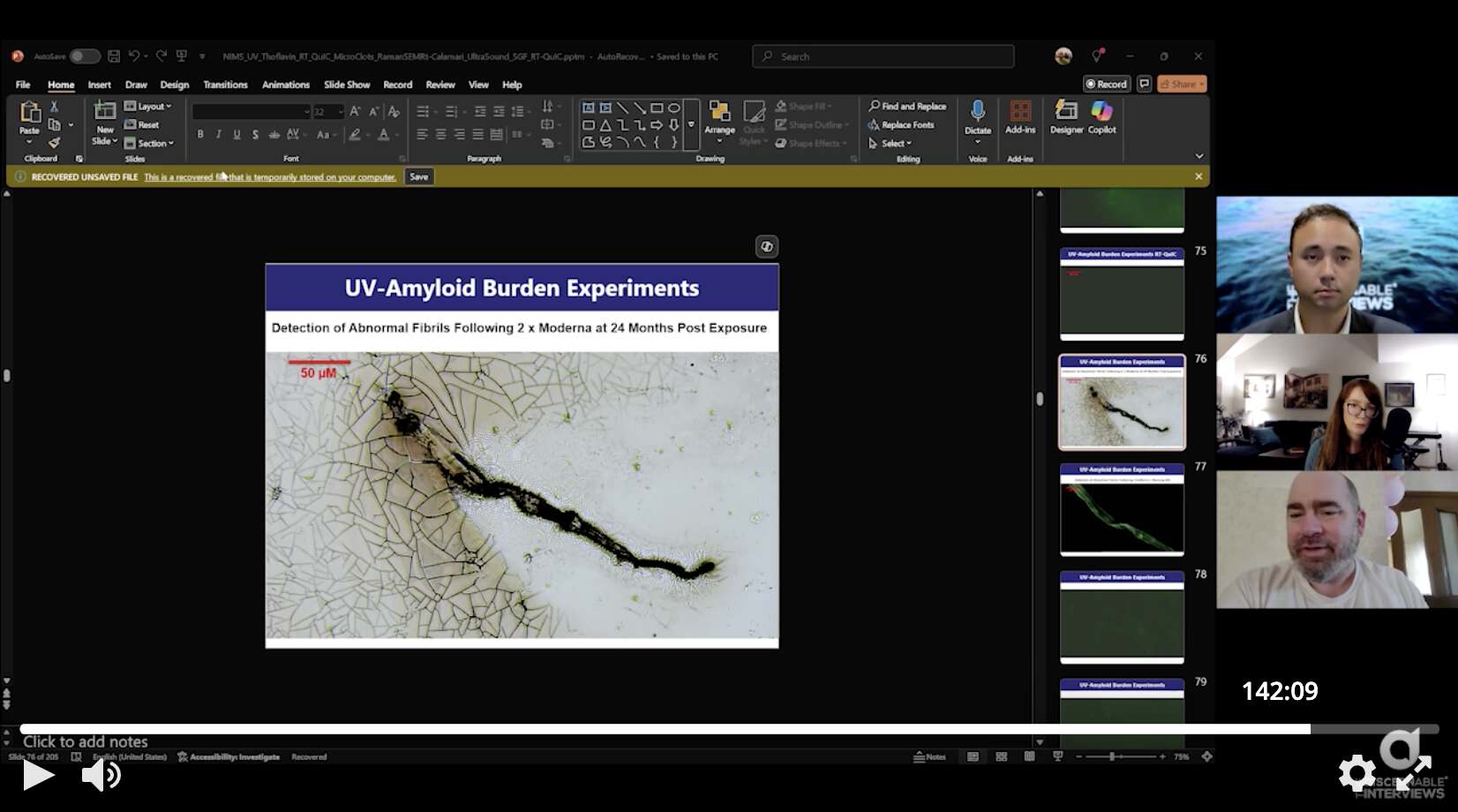
I think he is using the term "fibril" wrong, because ChatGPT said:
The term "fibril" is typically used in biology and materials science to refer to very fine fibers, often in the nanometer to low micrometer scale (usually less than 1 µm in diameter). For example:
Amyloid fibrils are generally 5-15 nanometers in diameter.
Collagen fibrils are typically 50-500 nanometers in diameter.
The structure shown in the image, with a diameter in the range of 10-20 micrometers (µm), would more accurately be described as a fiber or filament rather than a "fibril." A 10-20 µm diameter is quite large for something labeled as a "fibril" in the conventional biological context.
The same image was featured on a page of McCairn's website where he advertised his services for detecting abnormal fibrils. But the text next to the image looked like an AI was asked to describe what was shown in the image (which doesn't inspire too much confidence in McCairn's skill in analyzing abnormal fibrils): [https://
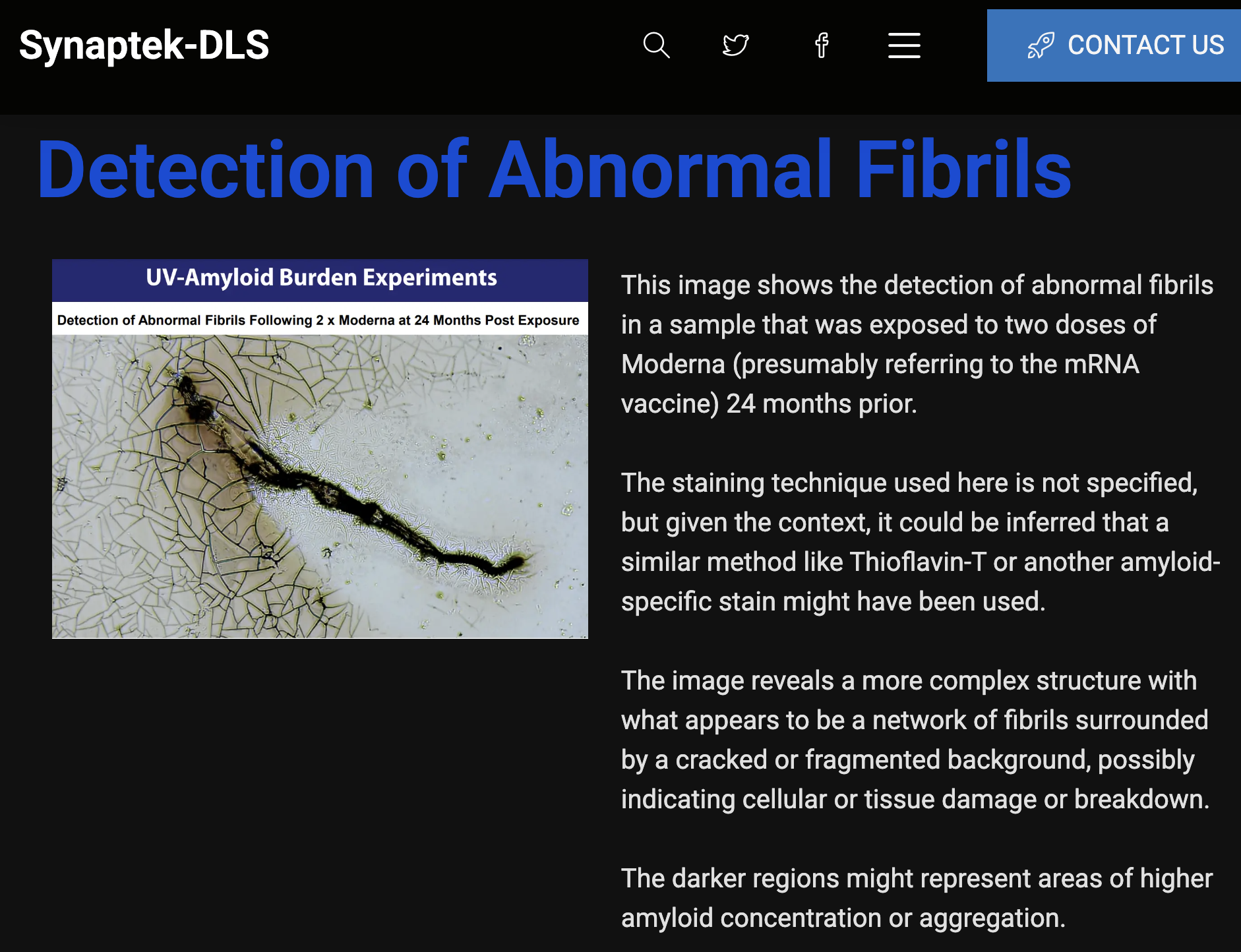
McCairn said that the text was generated with AI by Chris France who made the website. But McCairn used to advertise his fibril detection services on almost every stream, and he actually managed to trick several people into paying him to look for fibrils in their blood, and his followers went around asking billionaires to donate money to him so he could improve his fibril detection scheme, so why didn't he even bother to write the text on his website himself?
The next image shows the same fiber as the previous image under UV microscopy, where a UV light excites the object to emit visible light through fluorescence. In fluorescence microscopy the camera captures only the intensity of the emitted light but not the hue, but the green tint used in the image is arbitrary, and the image might as well be displayed in grayscale or with some other tint. On his website McCairn described the fiber as a "fibril", even though in one of his presentations where he showed a version of the image with a scale bar, the fiber was shown to have a diameter of about 15 µm: [https://

Lyndsey's fiber in the image above has a fold that runs along the middle lengthwise. When I asked McCairn on his Discord what the fold was, he said: "And the fold running length wise is indicative of it being a coherent structure, that is one of the reasons why fibril is a fair description of the phenomenon. Again this is you running into the axiom of those that can and those that can't. This is a highly unusual amyloidogenic form." And when I said the structure was too big to be called a fibril, he said: "And one could say fibrillar forms, but fibrils is good enough at this stage, again because of the extremely large size differential between normal amyloids and these unusual fibrin amyloids." Then I asked someone else: "How do you even know that the structures shown by McCairn and Micronicle are fibrin clots? I think fibrin clots wouldn't have the kind of lengthwise fold in the middle as McCairn's green mystery fibril." But McCairn replied: "This objection to raw data comes from your years of extensive lab experience working with amyloids, I presume?" He also seemed to suggest that the mystery fiber he showed on his website was the same type of structure as the fiber in Mr. Micronicle's image (even though Mr. Micronicle's fiber didn't have a lengthwise fold running along the middle, and it didn't look as flat as Lyndsey's fiber).
But anyway, are there even mini calamari clots that float freely in human blood, and that have a diameter of about 10-30 micrometers and a length of hundreds of micrometers?
The purpose of fibrin is to form a web that captures red blood cells, so then the tangled mess of fibrin and blood cells form a clot that blocks a punctured blood vessel. The reason why large clots have elongated shape is because they conform to the shape of a blood vessel, like if some entangled sticky mess was poured through a tube and the tube got clogged.
But if there's a micrometer-scale clot of fibrin that floats freely in the blood, why would the clot have an elongated shape? Did the clot form inside a small blood vessel and then get dislodged?
ChatGPT said:
1. Fibrin Clot Structure In Situ
Fibrin forms a mesh or network of thin fibers during clot formation, creating a gel-like matrix that stabilizes platelets and red blood cells.
This structure is highly entangled and irregular, not a single, uniform fiber.
2. Shape of Freely Moving Clots (Emboli)
When parts of a fibrin-rich thrombus dislodge and enter circulation, they become emboli.
The shape of these emboli depends on:
Origin: Venous thrombi are often elongated or serpentine, as they form in the low-shear environment of veins.
Mechanical deformation: They may elongate as they pass through blood vessels.
However, emboli are generally amorphous, irregular, or elongated masses, not slender, fiber-like threads.
3. Fiber-like Structures?
While fibrin fibers themselves are nanoscale or microscale strands, a free-floating clot is a bulk mass of these fibers entangled with cells and plasma proteins.
You will not see individual fibers moving freely in the bloodstream in vivo.
I asked McCairn that if the fiber in his image formed inside a blood vessel and then got dislodged, then why is the fiber flat, and why does it have the lengthwise fold in the middle? He came up with this weak answer: "Good question why does this diseased protein have the form it does, it should be noted it's not the only form there are irregular & spheroid forms. I think it comes down to location of formation, nature of the underlying nano-scale fibril geometry, the species of protein, fibrinogen which makes long linear forms. Again we are in a process of discovery and relying on orthodox frameworks you constrain yourself to being able to competently describe it. But it's a common form, even described in the published literature." But I didn't find any paper in the medical literature that would've described fibrin clots as having a flat ribbon-like shape with a lengthwise fold running along the middle.
When I asked why McCairn's fiber has the lengthwise fold, ChatGPT said the fiber might be a fiber of cellulose where the hollow lumen in the middle has collapsed:
A lengthwise fold or groove is not characteristic of fibrin or amyloid aggregates. Instead, it is a well-known feature of certain textile or environmental fibers:
Cotton fibers: Typically ribbon-like, twisted, and often show central folds or convolutions due to the collapse of the hollow lumen inside the natural fiber.
Cellulose fibers (like paper fibers or lint): Also tend to flatten and develop longitudinal folds.
Synthetic fibers: Usually round or oval in cross-section, smooth, and don't typically have the central fold unless manufactured with a special cross-section.
Based on the ribbon shape, width (tens of micrometers), and the longitudinal fold, this looks much more consistent with a collapsed plant-derived cellulose fiber (e.g., cotton lint) rather than any protein fibril or clot material.
Added later: I now found the stream where McCairn originally presented the microscope images of Lyndsey's fiber. [https://
At time 2:23:18 McCairn showed the fiber under UV microscopy and said: "That whole structure is fluorescing green. That tells me that it's highly likely that we're looking at an amyloid structure in the patient's sample." However he only showed the fiber after he had applied the ThT but not before it, so you couldn't see if the fiber was already autofluorescent without the ThT.
From the stream you can see that the end of the fiber has a torn appearance, which doesn't seem like characteristic of a fibrin clot:

You could also see that the diameter of the fiber tapers out towards the other end:
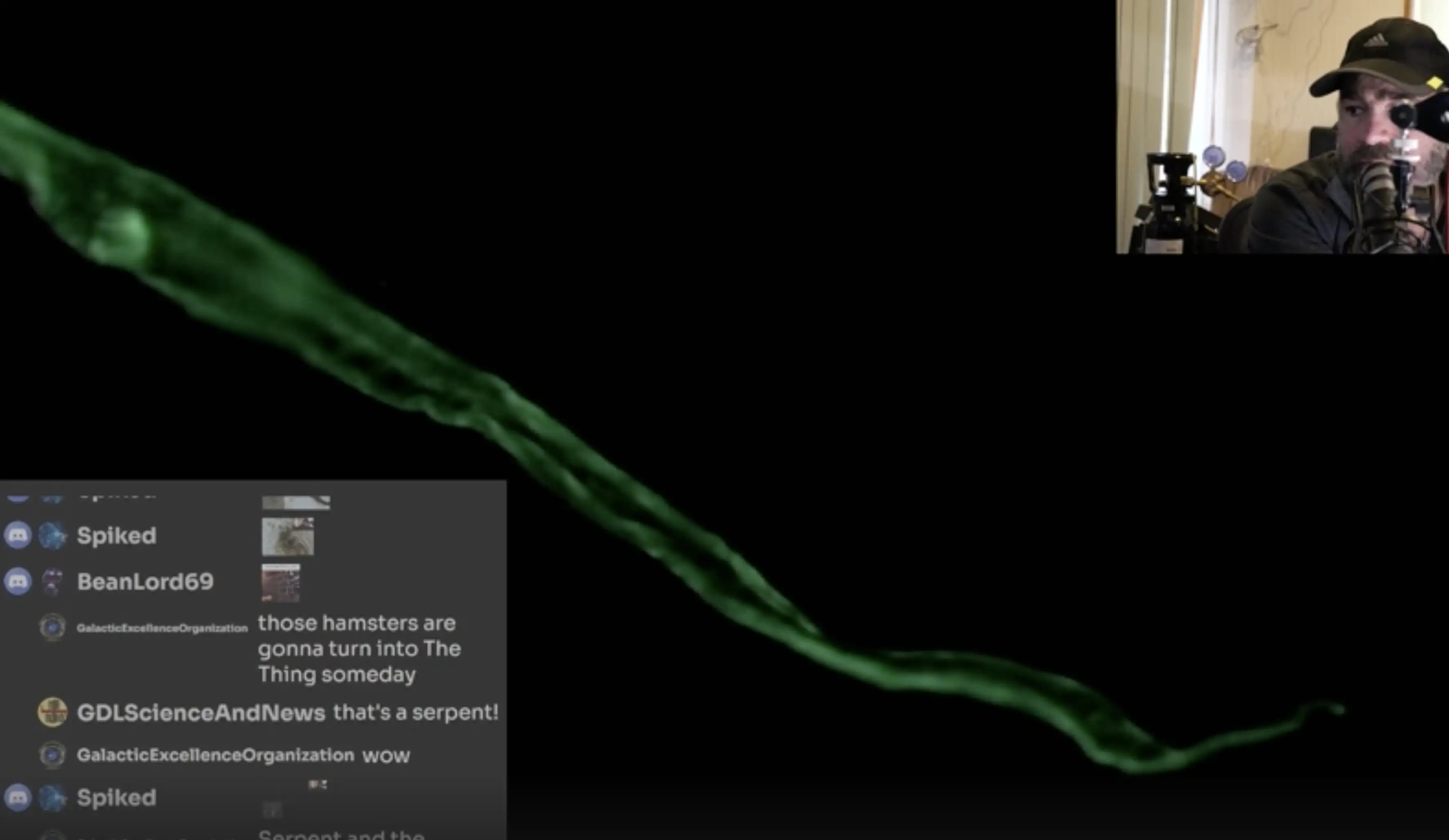
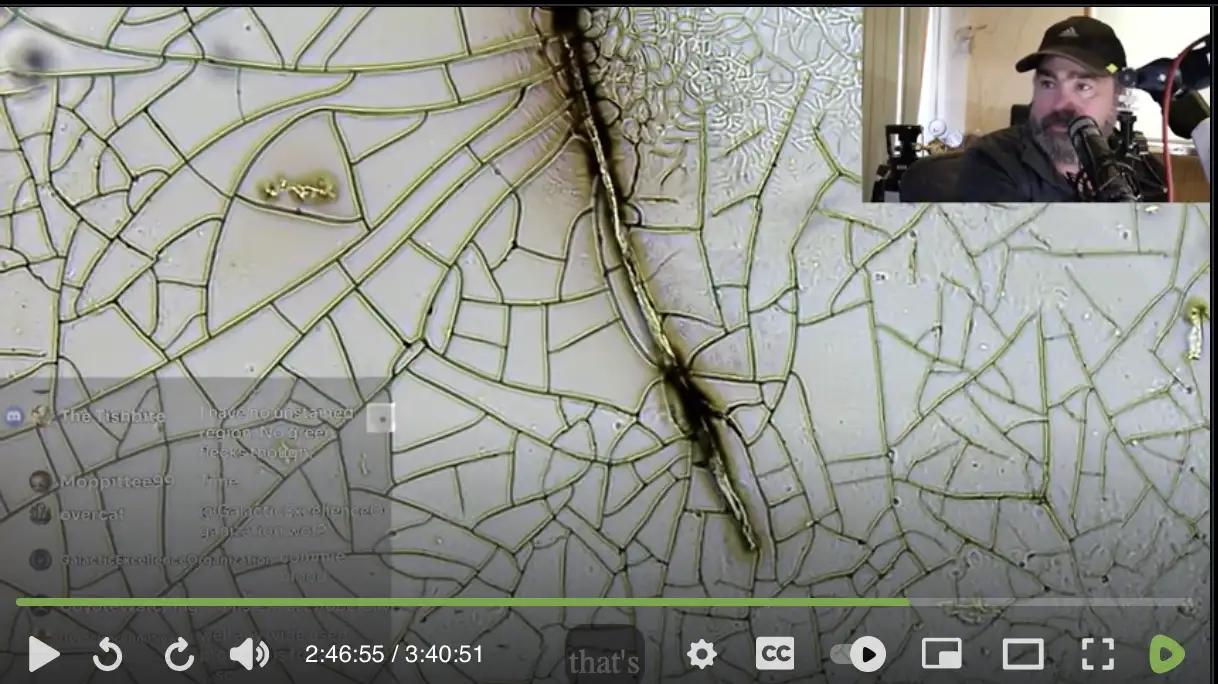
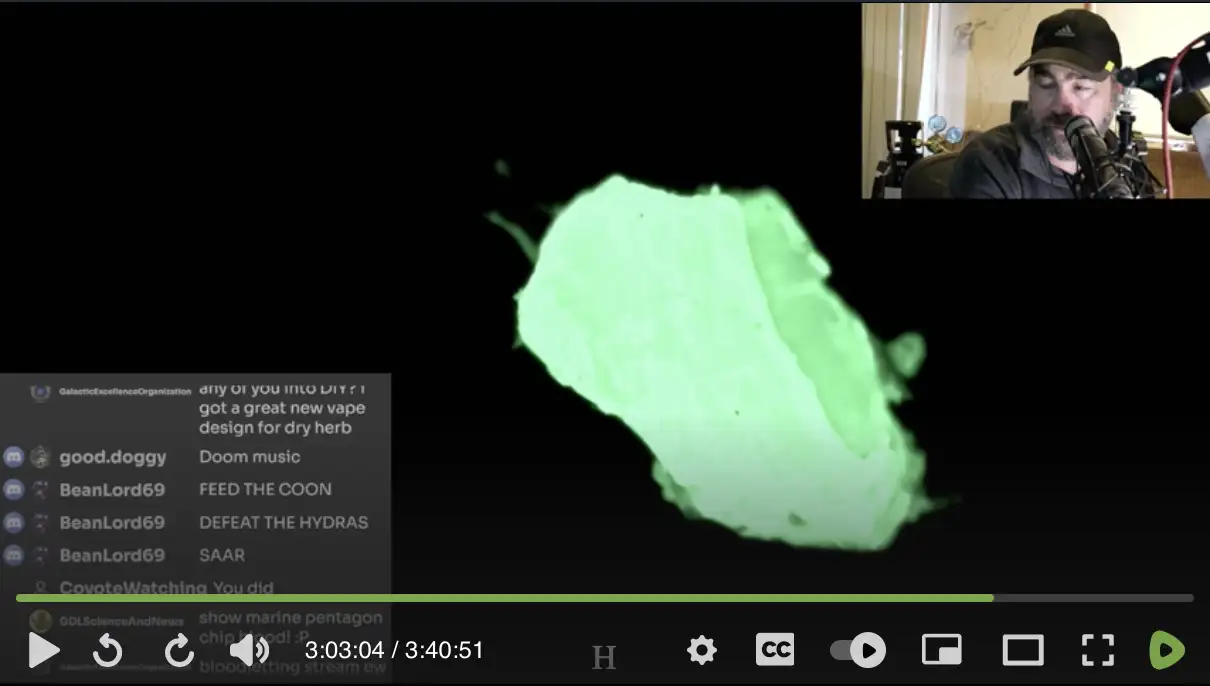
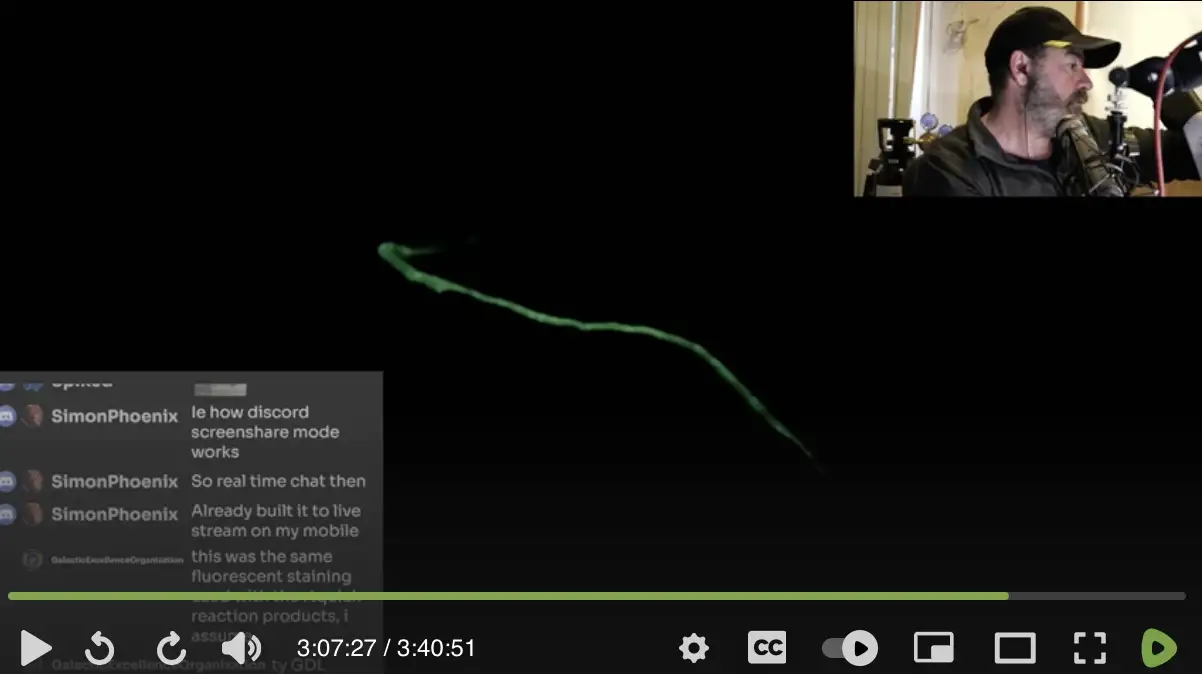
Next McCairn compared Lyndsey's blood to a sample of his own blood, where some regions of the slide were stained with ThT but others were not, so while he was panning around the slide, it was not always clear if he was looking at the stained region or not.
His slide contained this fiber that was fluorescent, even though I don't know if the fluorescence was because of the ThT staining or not: [2:46:27]
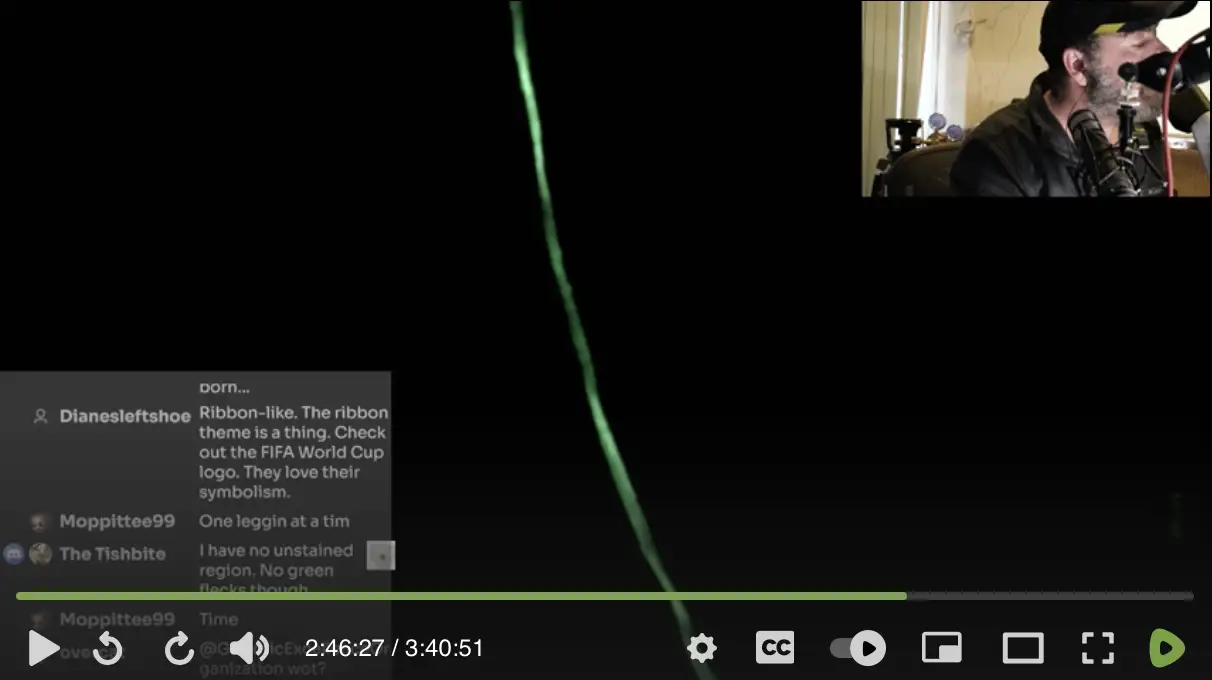
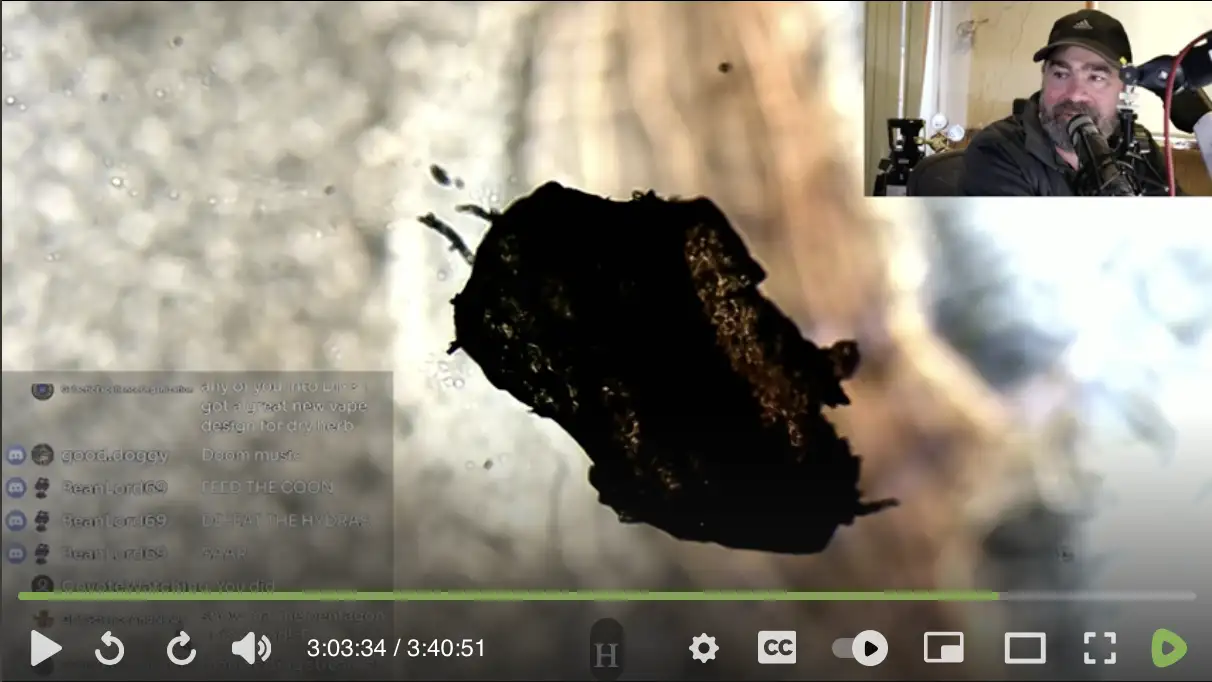
His slide contained this structure that was fluorescent but that was not in plane with the rest of the sample, so McCairn said the structure was probably a contaminant from dust: [3:03:02]
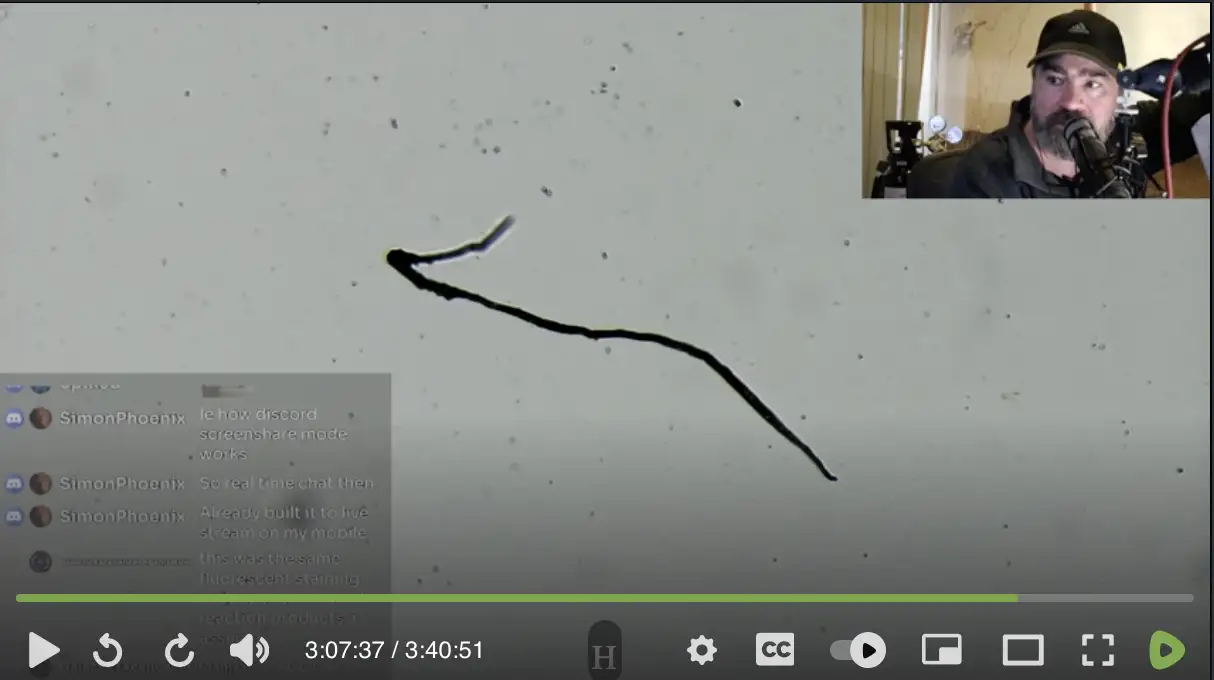
His slide contained this fluorescent fiber, which was not in plane with the rest of the sample, so after he had focused the microscope on the fiber, he had to refocus the microscope to get the main part of the plane in focus, and McCairn said the fiber may have been dust: [3:07:14]
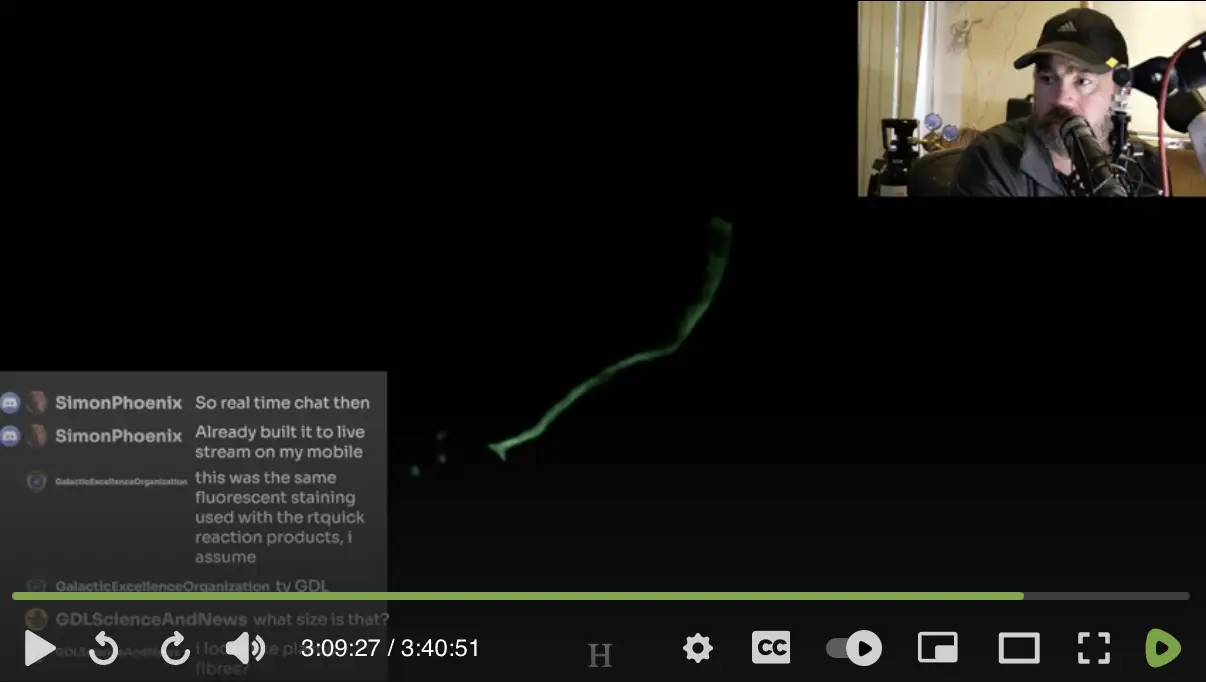
Next he showed this fluorescent fiber, which unlike the previous fiber was approximately in plane with the rest of the sample: [3:09:38]
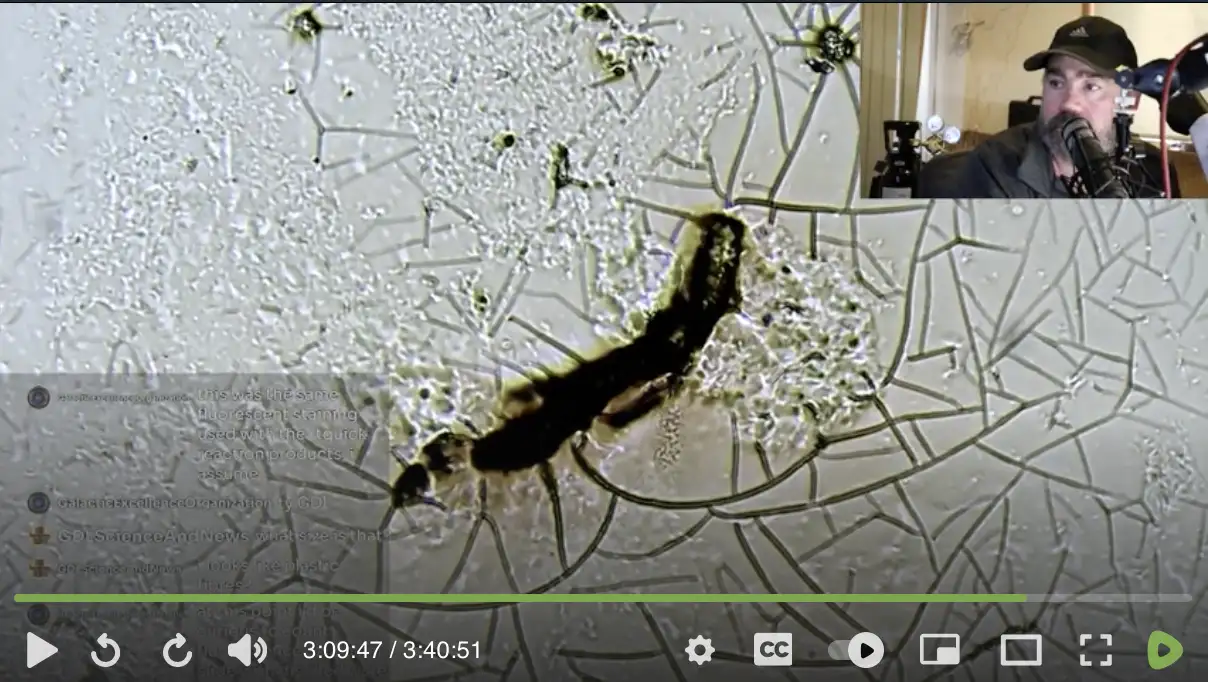
At time 3:16:19 when McCairn instructed his followers on how to send a blood sample to him, he said "don't put a cover slip on it, air dry it overnight" (but he didn't mention how dust might fall on the slide while the blood was drying).
At time 3:17:23, he listed four criteria that he relied on to determine if the structures on his slide were microclots, which he said were that the structures "are in plane with the blood, have a filamentous and helical stucture to them, and fluoresce." Some of the fibers that McCairn said were likely dust fulfilled 2 of his 4 criteria, because they were fluorescent and had a filamentous structure. By "helical structure", he likely meant the kind of lengthwise twists that are called convolutions in cotton, so cotton fibers might easily fulfill at least 3 of his 4 criteria, even though if a cotton fiber from dust fell on the sample of blood after the blood already dried, I don't know if the fiber would be in plane with the blood so that the fiber would fulfill the 4th criterion.
ChatGPT said: "If a cotton fiber falls onto a fresh blood smear, it will generally remain at or near the surface rather than becoming completely submerged. A dry cotton fiber is porous and can initially float on the liquid blood because surface tension and trapped air support it. As the fiber absorbs blood, however, it becomes heavier and its buoyancy changes, so it may partially sink into the blood film. If the blood is already very thin or begins drying rapidly, the fiber can become embedded in the drying blood film, with blood drying around and through its fibers. Thus, its final position depends strongly on blood thickness, fiber properties, and the stage of drying."
McCairn published his second Substack post in May 2025. [https://
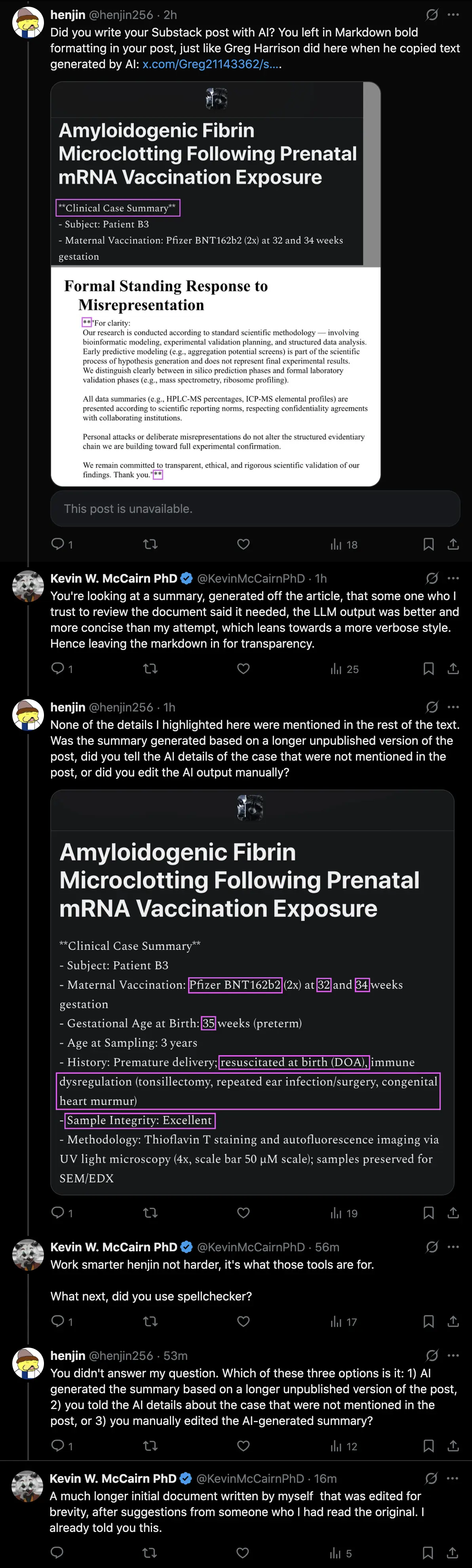
The post may have been partially generated by AI, because a heading before a list was formatted as Markdown. Substack doesn't even support Markdown, but some AI utilities add Markdown formatting to copied text:

McCairn's post has the air of cheap propaganda because of the emphasis on harm done to babies. A common trope among morticians in alt media is that they have a dramatic story to tell about dead babies, like how the British funeral director Wesley said that there was about ten times the normal number of babies dying, so the fridges were packed full of dead babies. [https://
The focus of McCairn's post was on scary microscope images, which is reminiscent of content by the Quinta Columna and the Stew Peters crowd. ChatGPT said that McCairn's post "strongly resembles pseudoscientific or hoax material, exploiting scientific-sounding language and visual data without meeting the necessary standards of scientific proof".
In his post McCairn presented the images below, which both show the same fiber that he supposedly found in the 3-year-old's blood. The bottom image was taken under a UV light, where the UV light stimulates the Thioflavin T to emit visible light in the blue-green range. The microscope captures only the intensity of the light but not the color, so the green tint employed in the image is arbitrary. The bottom image shows that the fiber was fluorescent under a UV light even before McCairn had applied Thioflavin T on the sample, so McCairn said that the fiber was autofluorescent:

He also showed images of a second similar fiber, and he described the fibers as "autofluorescent fibrillar structures" and "UV-reactive fibrillar microclots" and "amyloidogenic fibrin microclots".
However just because McCairn's fibers are fluorescent under UV light doesn't mean that they are "amyloidogenic fibrin clots", but they might for example be fibers of cotton, because in the same way that a white t-shirt is fluorescent under UV light, fibers of cotton that have been treated with optical brightening agents are also fluorescent under UV light. (Based on the scale bar in the two images above, the fiber appears to have a diameter of about 5 µm, but later it turned out that the scale bar was incorrect and the diameter was actually about 15 µm, which fits within the typical range of diameter for fibers of cotton, which is around 12-25 µm.)
One of Greg Harrison's AI-generated documents had similar Markdown bold formatting as McCairn's post. [https://
McCairn told me that his post was an AI-generated summary, and that he left "the markdown in for transparency". But I don't buy his excuse, because the Markdown formatting was not even a clear sign that his post was generated by AI, and he could've been much more transparent by explicitly writing that his post was an AI-generated summary.
The Markdown formatting appeared in the heading of a list titled "Clinical Case Summary", so at first I thought McCairn meant that only the list was generated by AI based on the rest of the post, and therefore I was wondering why the list mentioned details that were missing from the rest of the post. But McCairn clarified that he meant that the entire post was an AI summary based on a longer original article: [https://
McCairn supposedly does his blood analysis using slides of blood that he receives in the mail from his followers, even though it's not clear if that's how he received the sample of blood of the 3-year-old. I pointed out that if mini calamari clots are so common that he frequently finds them in small random samples of blood, there should be vast fleets of mini calamari clots swimming around in the bloodstream of people. But he refused to even answer me what volume of blood he analyzed: [https://


A Twitter user called Markus pointed out that McCairn said one of his microscope images was taken at a 4-fold magnification, but the scale bar seemed to indicate that the image was taken at a much higher magnification level: [https://

ChatGPT said that typically "the field of view (FOV) for a 4x objective on a standard microscope with a 10x eyepiece is around 4-5 mm (4000-5000 µm)", but based on McCairn's scale bar, the area shown in his image was only about 550 µm wide, which is only about 12% of the typical FOV:

But McCairn said he didn't even use an eyepiece, so the FOV at 4x magnification should be about 40-50 mm, which means that the visible width of his image is only about 1.2% of a typical FOV.
When I asked ChatGPT if an eyepiece can go up to 100x, it said 100x eyepieces are extremely rare and not practical for most applications, and typically eyepieces only go up to about 15x or 20x magnification. When I asked what could explain McCairn's narrow FOV if the image was taken without an eyepiece, ChatGPT wasn't able to give any reasonable explanation. But it did say it was possible that the scale bar was wrong or the magnification level was reported incorrectly.
McCairn replied to me: "The field of view is not 0.5mm you cretin, the scale bar shows the pixels derived from the camera using a calibration slide placed on the slide holder. you are looking at an amyloidogenic fibril that is 100's of micrometers in length and the scale bar in red shows 50 micrometers not 0.5mm you moron". [https://
In the last tweet I quoted above, McCairn referred to an SEM image of the 3-year-old's fiber that he had now posted on Substack. His SEM image was taken at 40-fold magnification, but the object in the image now took up about 50% of the FOV: [https://

So why did the same object take up about 75% of the FOV in the other image that was supposedly taken at 4-fold magnification?
The object in the new SEM image is about 731 pixels wide, and the 1 mm scale bar is about 460 pixels wide, so the width of the area covered by the object is about 1.59 mm. But in the earlier optical microscope image, the width of the area covered by the object was only about 0.38 mm based on the scale bar.
Jikkyleaks asked: "Kevin are your scales correct on the SEM pic? In the first picture it looks like that fibril is about 500micrometres long, but the SEM scale is marked in millimetres." [https://
But anyway, I still didn't have an answer to why the old microscope image had a FOV of only about 0.55 mm, even though the image was supposedly taken at 4-fold magnification. So I asked McCairn: "So was your 4x image cropped or not? If so then what percentage of the width of the original image did the cropped image show? It's probably not nearly enough to explain why the FOV was only about 0.55 mm even though a typical FOV at 4x magnification would be about 40-50 mm." [https://

McCairn seems to routinely screw up the scale bars in his microscope images. In this image the scale bar is shown to be 10 µm wide, even though it's about 13 red blood cells wide, and red blood cells have a diameter of about 7 µm, which means that the scale bar is really somewhere around 90 µm wide: [https://

McCairn responded "Yes the scale bar is wrong it should say 50 micrometers, the 10 micrometers is a holdover from a scene done for more detailed analysis for an individual who wanted their blood looked at." [https://
I have joined Kevin McCairn's Discord server multiple times since 2020, and I was even made into a moderator on the server at one point, but I have usually left the server after a while because it had a very low quality of posts. McCairn banned me from the server in May 2025, because I said that the calamari clots were fake and he was probably controlled opposition.
Since his early videos in 2020, McCairn has said that he got COVID from the Korean superspreader event in Daegu, and that he had severe neurological symptoms, which was a reason why he knew that COVID had a neurotropic effect and he decided to focus on researching the neurological aspects of COVID.
However the problem with his story is that the Korean superspreader event occurred in February 2020, but McCairn says that he was in Daegu from late November into December 2019. I hadn't seen anyone call him out for his claim until I brought it up on his Discord:

I used to think McCairn probably had some other illness but he mistook it for COVID, but after I found out how there's also many other people in alt media who claim that they were among the first people in their country who got COVID, I started to think it's possible that he just made up the whole story about having COVID.
It also seemed like an unlikely coincidence that McCairn was an early YouTube streamer who was focused on COVID, but he also happened to be at the right place at the right time to get infected with COVID very early on. Often if a fabulist invents an embellished biography for themselves, they insert themselves in various locations around the world at a time when some event of historical importance happens to occur at the location. But the Korean superspreader event was probably the best-known event that occurred in Korea in the entire year of 2020.
In the unlikely scenario where McCairn actually got COVID in November or December 2019, he might have been the first person with COVID in Japan, because he claims that he was still sick with COVID after he returned home to Japan in December 2019.
In the screenshot above, I pointed out how on January 28th 2020 UTC, Steve Pieczenik claimed that a month ago he had the first case of COVID in the United States, and he got COVID after he met with a Chinese student from Wuhan (because I guess he didn't count the student as an earlier case of COVID). [https://
I don't know if McCairn actually even visited Daegu in 2019 like he claims, but in one video he also said: "I got hit by the biggest superspreader event in Asia, right early on, in November to December." [https://
McCairn's American sidekick Charles Rixey also claims that he got COVID at a time when there were only a few reported COVID cases in the US: [https://

Added later: I didn't find the early videos on McCairn's YouTube channel archived anywhere, because his first channel was deleted fairly early on, and his videos were not even archived by AltCensored. But these were McCairn's earliest videos about COVID I found that were still available online:
I listened to a couple of the videos above, and I searched through the transcripts of a few more videos, but McCairn only said he may have gotten COVID in Daegu in one of the videos, which was a video he did with Addy Adds in March 2020. In the video McCairn said: "And, uh, where I had my lab, which was in South Korea in a city called Daegu, they'd asked me to sort of come and give a, uh, to help them in a project they were doing. And that time was October, no, sorry, November - I want to say it was November into December, but late November, right. And at that time, um, I came back, and over the Christmas period, I got really, really ill, right. And, um, it's sort of left - like the fever I was delirious, so I can't - and again, so I get memory issues because of the head injury. And so apparently when I was in the fever bit, I was coming downstairs and thinking days had passed. And, uh, it, it wasn't, you know, and it took me a week to sort of get over that. And then I was left just, um, with, it's called dyspnea where you can't really breathe." [https://
McCairn claims that a string-like shape is somehow characteristic of fibrin microclots. I have pointed out to McCairn that individual fibrils of fibrin have a string-like shape because their purpose is to form a web that traps red blood cells. And large blood clots have an elongated shape because they conform to the shape of blood vessels. But that doesn't mean that if there is an intermediate-scale formation of fibrin that floats freely in the blood, the formation would also have an elongated string-like shape, unless for example the formation first develops inside a small blood vessel and then get dislodged from the vessel.
In McCairn's first Substack post about the 3-year-old's fiber, he didn't attempt to explain why the fiber would have a string-like shape, but now in his second post about the fiber, McCairn provided the following explanation: [https://
These comparisons between nano- and macro-structures highlight the conserved geometry of pathological amyloidogenesis. This scale-invariant preservation of fibrillar architecture aligns with prior biophysical studies demonstrating that amyloid formation follows universal thermodynamic pathways, forming twisted ribbon-like or lamellar structures irrespective of protein species or environmental origin (Chiti &
Dobson, ; Eisenberg &2017 Sawaya, ). The similarity across scales - from nanometer-thick fibrils to centimeter-scale clots - suggests a deeply encoded biophysical template likely seeded by persistent amyloidogenic peptides, such as SARS-CoV-2 spike protein.2017
However I'm not convinced by McCairn's explanation, and I didn't find any part of the two papers he cited that actually backed up what he wrote, or that would've explained why amyloid formations on the micrometer scale would have a string-like shape.
When I asked ChatGPT to describe the shape of micrometer-scale amyloid formations in the human body, it gave me the following list:
1. Aβ (Alzheimer's)
- Shape: Dense plaques (spherical, irregular, starburst)
- Size: 20-200 µm
- Location: Extracellular (brain cortex, hippocampus)
2. Tau (Alzheimer's, FTD)
- Shape: Neurofibrillary tangles (flame-shaped, globose)
- Size: 10-50 µm
- Location: Intracellular (neurons, dendrites)
3. α-Synuclein (Parkinson's, LBD)
- Shape: Lewy bodies (round with halo), neuritic threads
- Size: 10-25 µm
- Location: Intracellular (neuronal soma, axons)
4. Transthyretin (TTR, Amyloidosis)
- Shape: Linear, patchy, or amorphous deposits
- Size: 10-100 µm
- Location: Extracellular (heart, nerves, GI tract)
5. Light Chains (AL Amyloidosis)
- Shape: Nodular, perivascular linear deposits
- Size: 20-200 µm
- Location: Extracellular (kidneys, heart, tongue)
6. IAPP / Amylin (Type 2 Diabetes)
- Shape: Sheet-like or intercellular ribbon deposits
- Size: 10-50 µm
- Location: Extracellular (pancreatic islets)
7. Serum AA (Systemic Amyloidosis)
- Shape: Diffuse, collagen-bound linear aggregates
- Size: 10-100 µm
- Location: Extracellular (liver, spleen, kidneys)
8. Fibrin-Amyloid (Microclots, Long COVID)
- Shape: String-like, thread or net-like filaments
- Size: 50-500 µm
- Location: Circulating blood, capillaries, microvessels
ChatGPT said that IAPP/amylin forms "sheet-like or intercellular ribbon deposits", but IAPP doesn't quality as a formation with a diameter on the micrometer-scale, because ribbons of IAPP typically have a diameter of about 10-15 nanometers. Out of the 8 types of formations listed by ChatGPT, only the microclots associated with COVID had both a string-like shape and a micrometer-scale diameter. But I couldn't get ChatGPT to cite any source which said that microclots associated with COVID actually had a string-like shape, so ChatGPT may have been influenced by McCairn's Substack post which I had referred to earlier in the same conversation.
I asked McCairn: "Is there some specific part of the papers you cited which says that formations amyloid protein have a tendency to form into a ribbon-like shape in the micrometer scale?" [https://
Here we go again, you are not looking at the canonical amyloidogenic form, merely based on the size of the aggregations .
How many times do I have to tell you this? That is why I as the domain level expert uses the language as I see fit.
Especially when it reacts to all the diagnostic measurements used to detect amyloids.
ThT Fluorescence, SEM structural characteristics, RT-QuIC reactivity, Raman Spectra confirmation.
I replied: "You suggested amyloid structures have a 'scale-invariant preservation of fibrillar architecture' so they have a tendency to form into a ribbon-like shape on the micro-scale, and you cited two papers from 2017. Which part of the papers supports your point?" But he didn't answer me.
A paper by Pretorius and Kell featured the images of microclots below, which had a globular or blob-like shape, but they didn't look anything like the fibers that McCairn finds under a microscope: [https://

I asked Douglas Kell if his group had seen the kind of fiber-like microclots that were shown in McCairn's Substack post, but he just replied "these experiments are quite different so comparisons are not usefully made". [https://
Then McCairn replied: [https://
In the experiments conducted by @dbkell and colleagues, the whole blood is spun in a centrifuge, larger aggregates would be pulled to the bottom of the tube.
Spinning and looking at the plasma phase would leave the smaller amyloidogenic seeds in the plasma phase. This allows automated sorting through techniques like flow cytometry. This is a better approach for batch processing, you will miss the larger aggregations due to centripetal forces being greater on larger amyloidogenic forms.
Slide analysis is much slower, requires someone with trained eyes, is labor intensive, and requires the follow on tests of ThT staining, SEM/EDX, Raman Spec, for categorization.
However if vaccinated people are now suffering from a novel pathology where their blood is full of clots that look like textile fibers, then is there anyone except McCairn who has published an image of one of the clots? I didn't find any similar images of clots published by Pretorius and Kell. Similar images of fibers in blood have been presented by Ana Mihalcea, Shimon Yanowitz, David Nixon, people at Burkhardt's pathology conference, and Mr. Micronicle, but as far as I know, none of those people claimed that the fibers were clots made of fibrin.
Mihalcea said that in her microscope images of blood, a web-like structure was fibrin, and blobs within the web were fibrin microclots, but a larger isolated fiber was a "hydrogel/graphene ribbon": [https://
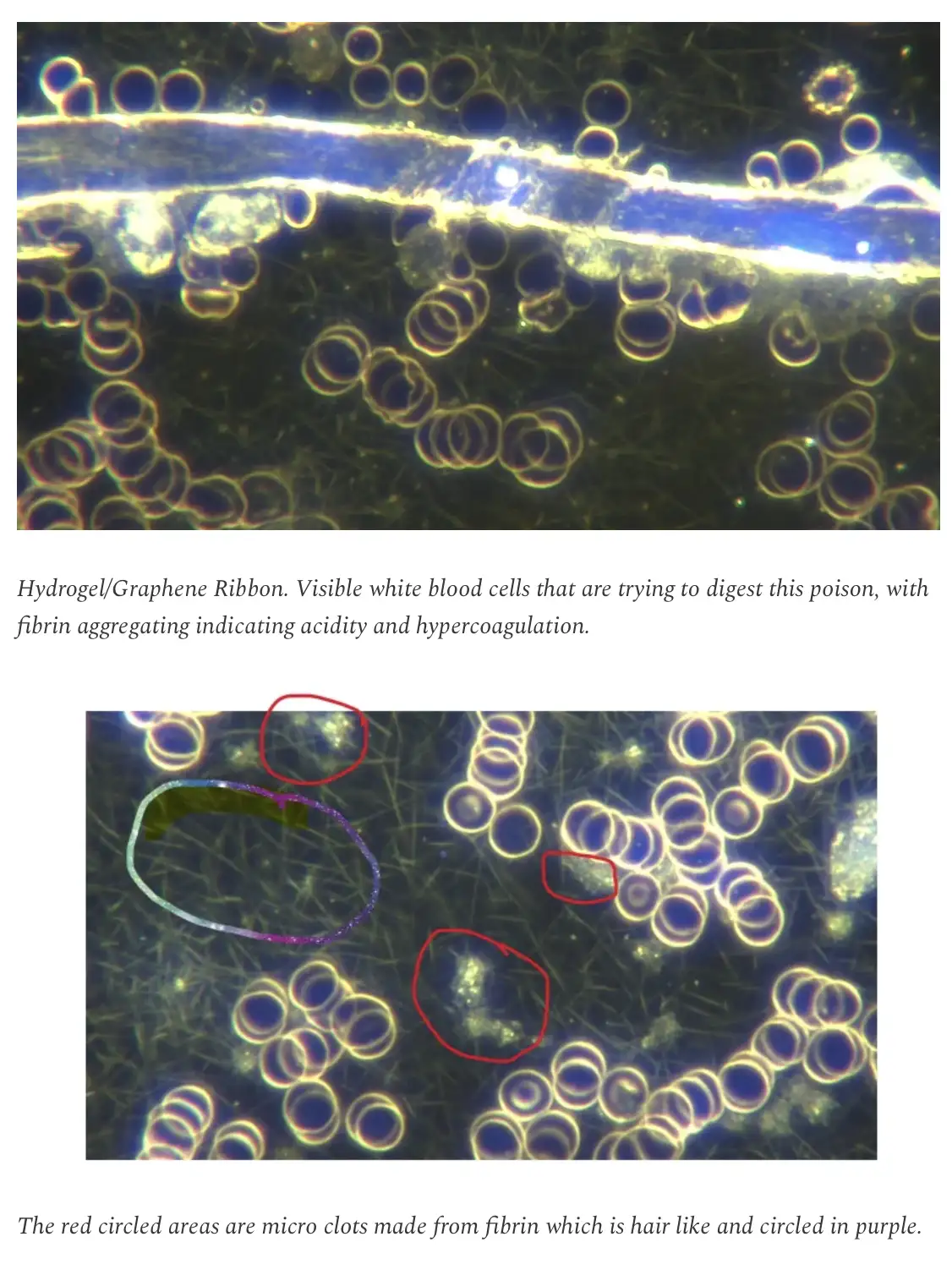
(Added later: I now found one Substack post where Mihalcea said that a fiber with a diameter of about 30 µm was a fibrous rubbery clot "in early stages". [https://
Added in June 2025: I now asked McCairn again that when he cited the two papers from 2017, what part of the papers supported his claim that aggregates of amyloid protein tend to organize into a ribbon-like shape on the micrometer scale. [https://
These β-structured oligomers are able to grow further by self-association or through the addition of monomers, often with further and sometimes dramatic structural reorganizations, to form well-defined fibrils with cross-β structure and a high level of structural order (Figure 1). Alternatively, the disordered aggregates or native-like aggregates can grow without any major structural conversion and give rise to large amorphous deposits or native-like assemblies, respectively, retaining the structure characterizing the initial oligomers (Figure 1).
Such large aggregates, including amyloid, amorphous, or native-like assemblies, have links with human disease as they accumulate in well-defined pathological states. Tables 1 and 2 list the proteins and the disorders that have now been identified to be associated with the formation of amyloid fibrils or other types of aggregates, respectively. (Supplemental Tables 1 and 2 also list, for each protein, references reporting the identification of the protein in the aggregates and the characteristics of the aggregate type.) We have arranged both tables in terms of proteins rather than disorders to stress the fact that many of these proteins have been found to be involved in a variety of pathological conditions. Interestingly, immunoglobulins or their subunits are found in all the different types of protein aggregates, including amyloid (as in light-chain amyloidosis), amorphous (as in light-chain deposition disease), and native-like (as in Berger disease) structures, thus representing a remarkable manifestation of the multiplicity of pathways existing in protein aggregation and of the structures and morphologies that can be generated (24-26). Those proteins that form intracellular inclusions of types that are still debated, such as TDP-43 and p53, are included in Table 2 with a footnote explaining this uncertainty.
But I pointed out that Figure 1 illustrated typical nano-scale amyloid fibrils, and not micrometer-scale amyloid formations. And in Supplemental Table 1, the shape of various types of amyloid structures was characterized as "intrinsically disordered":

Then McCairn replied:
You're so retarded! This particular amyloid, is novel and not listed because you're looking at science being done in real time.
The principles of misfolding though, are likely the mechanism leading to the macroform and of course the species of protein undergoing change. Fibrin is inherently primed to make macromolecular structures, hence the amyloidogenic form is going to be larger.
Which is why I have gone to the effort of showing concordant structure across scales.
So I told him: "Post-COVID clots are not relevant to my question. You cited two pre-COVID papers to support a claim that amyloid aggregates have 'scale-invariant preservation of fibrillar architecture' and they form 'twisted ribbon-like or lamellar structures irrespective of protein species'." And McCairn replied: "That's because there is no post-COVID manuscripts showing the phenomenon, in the manner that I have, you're looking at it being made right now, and disseminated to the public. It is usual in scientific writing to point to key historical citations that demonstrate concordance within hypothetical frameworks." But he still didn't answer my question, so I told him: "We already know you claim that baby calamari clots have a tendency to form into a ribbon-like shape on the micrometer scale. The question was which part of the sources you cited supports the claim that the same applies to other types of amyloid formations."
But then McCairn said "there is a coherency in the epistemological grounding of the amyloid PRION formation", so I told him that it sounded like great pseudo-profound bullshit, because the pseudo-profound bullshitters are always talking about epistemology: [https://


There's a user on Twitter called DopplerEffect93 who has a PhD degree in neuroscience, and who worked on a postdoctoral project that involved analysis of amyloid fibrils: [https://
He said that the string-like object in McCairn's microscope image was too big to be an aggregate of amyloid protein, and the object looked like dust or debris. McCairn cited a paper by Pretorius and Kell which said that "the fibrinaloid microclots that we observe are typically in the range 1-200 µm on their longest axis": [https://

However the text he quoted referred to this figure, which showed that the microclots described by Pretorius and Kell did not have a string-like shape:

Added in June 2025: CHD posted a video where Suzanne Humphries said that when she looked at the contents of a vaccine vial under a microscope, she saw structures that looked like circles and squares, which transformed into structures that looked like circuit boards: [https://

Under replies to the tweet, some random users posted about microscope images that they apparently thought were related to the discovery by Humphries. They included images of a chip-like structure shown by people in Burkhardt's pathology conference, graphene disks found by Zandre Botha, and the amyloid fibril that McCairn supposedly found in the blood of the 3-year-old (but what Burkhardt, Botha, and McCairn all have in common is that they all belong to the small group of people who have presented a laboratory analysis of the calamari clots):


The tweet about McCairn's amyloid fibril was posted by a user called PinkBeachGirl1, which looks like a bot, and which has posted almost 200,000 tweets: [https://

Added in June 2025: McCairn now did a stream where he looked at the contents of a Moderna vaccine vial under a microscope. He saw these fiber-like structures that were autofluorescent under a UV light, and he said "If I saw that in blood, I'd be like, uh, that looks suspect": [https://
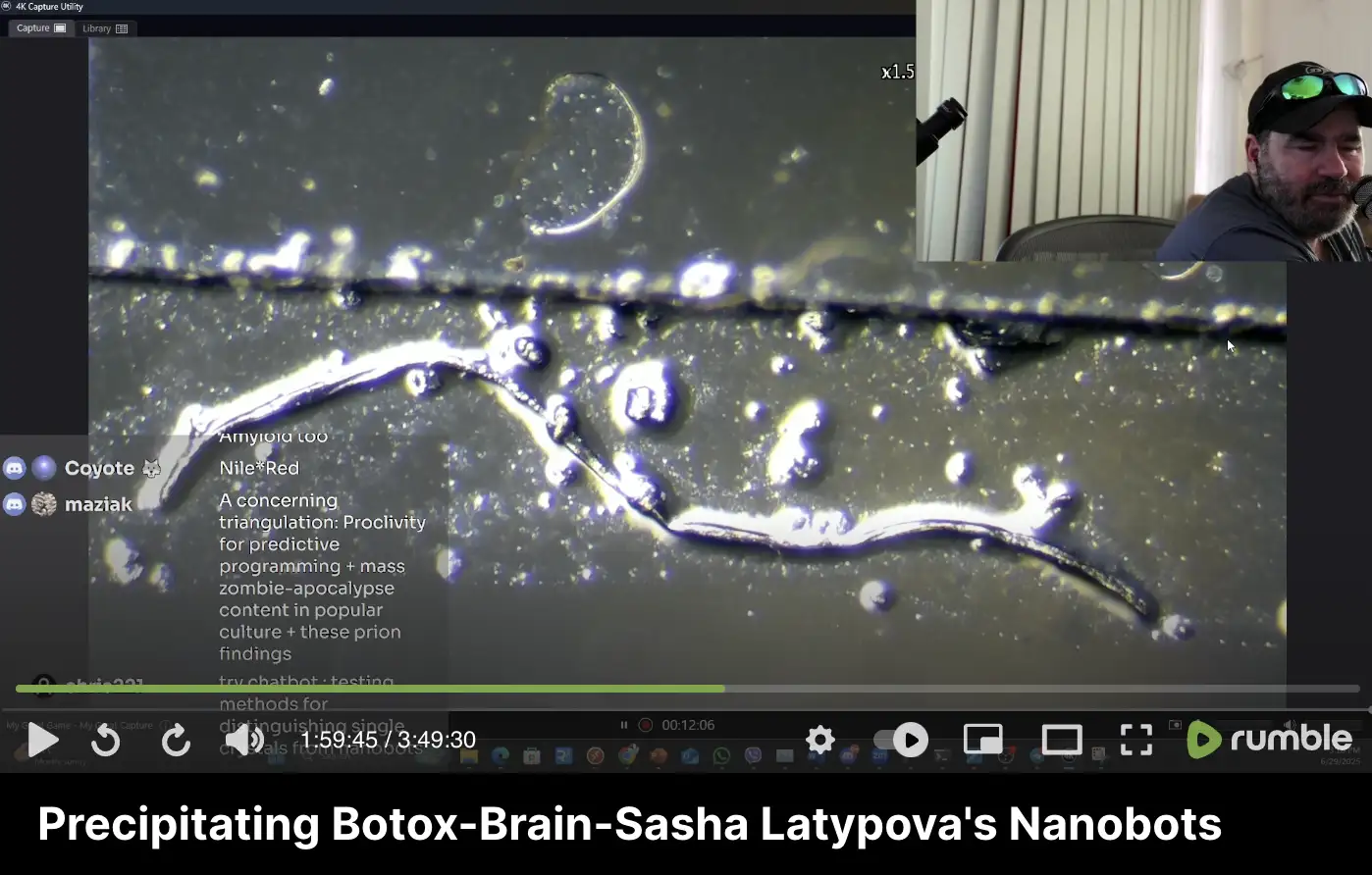
He also found this strongly autofluorescent fiber in the sample:
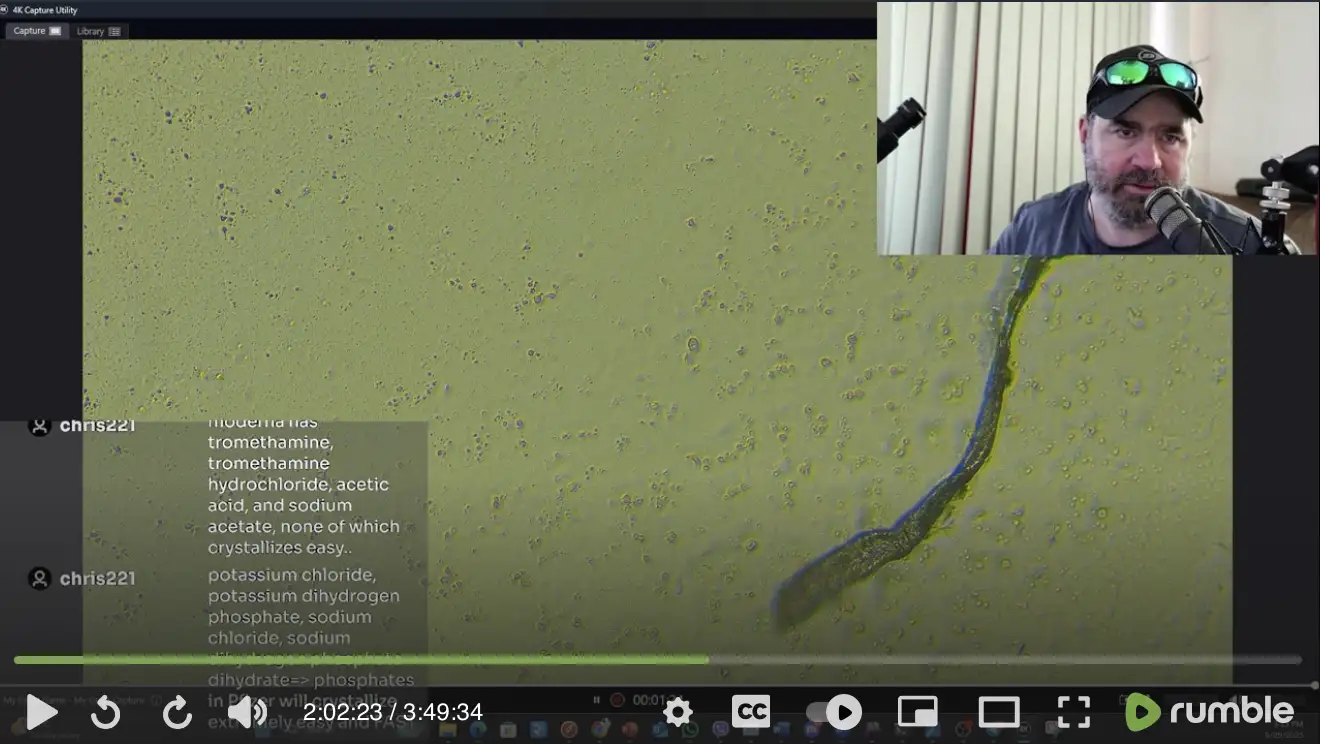
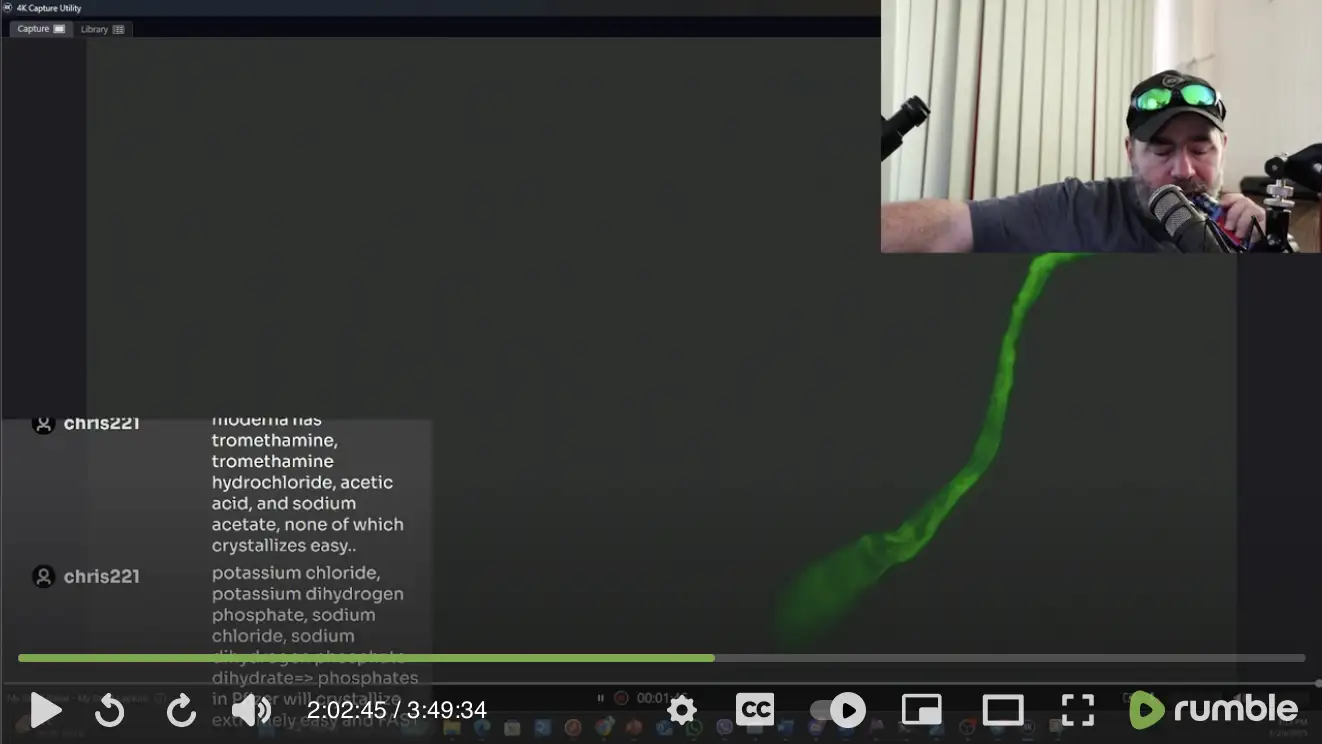
And this is another strongly autofluorescent fiber he saw, which looks like it might be a paper fiber:
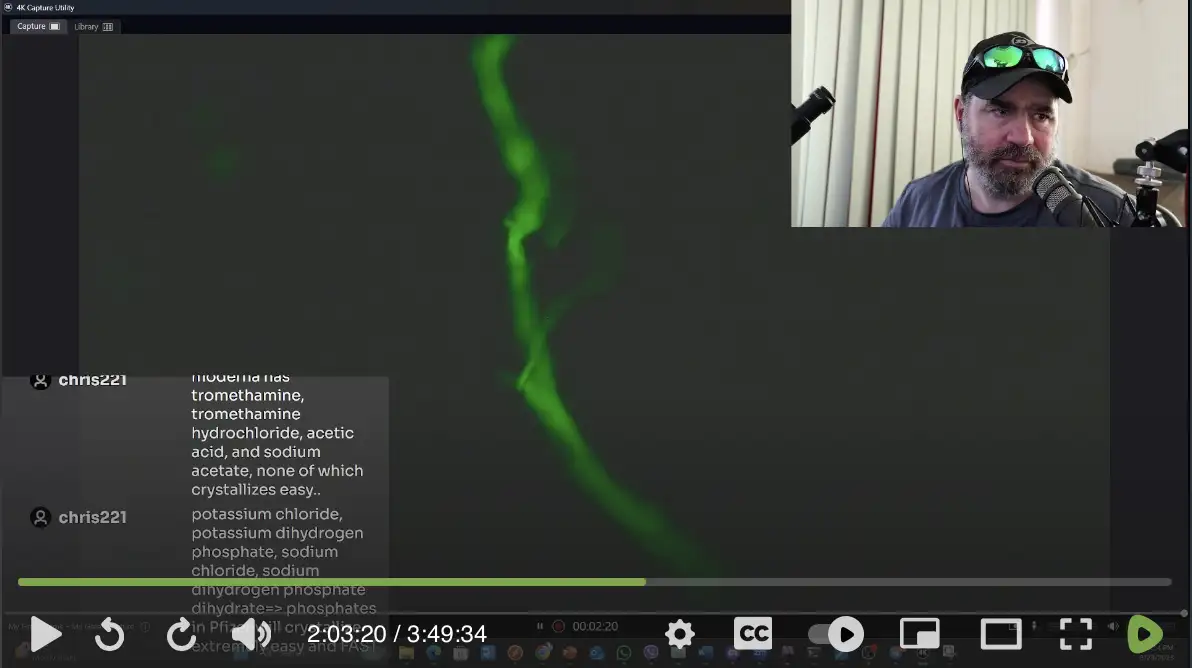
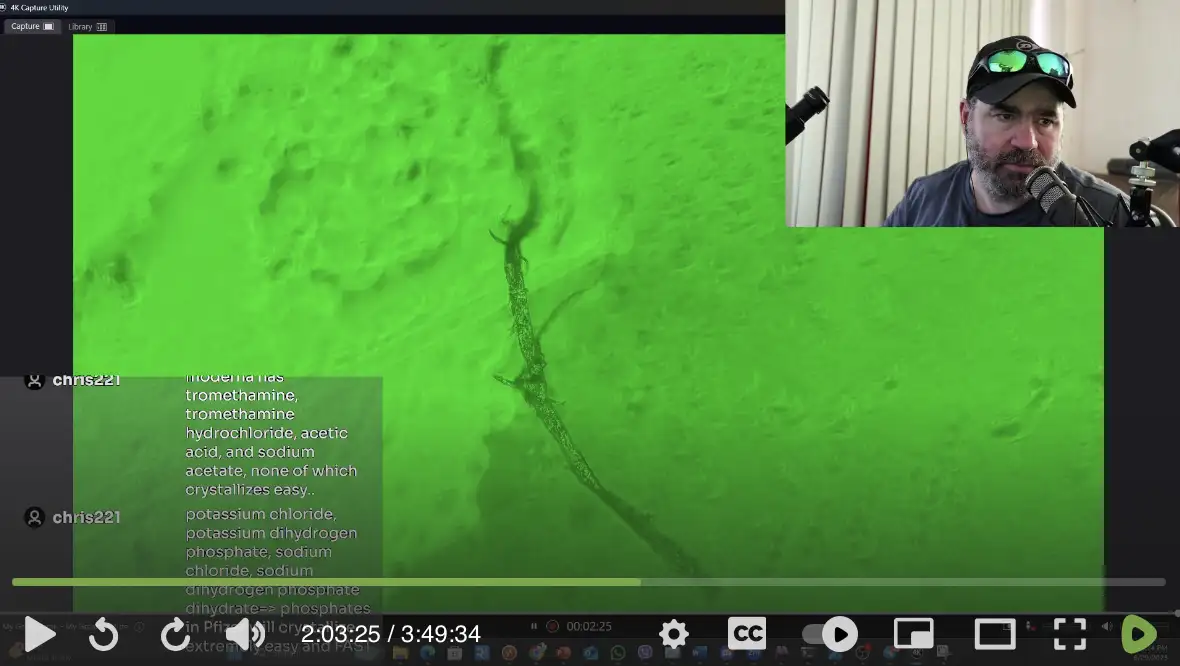
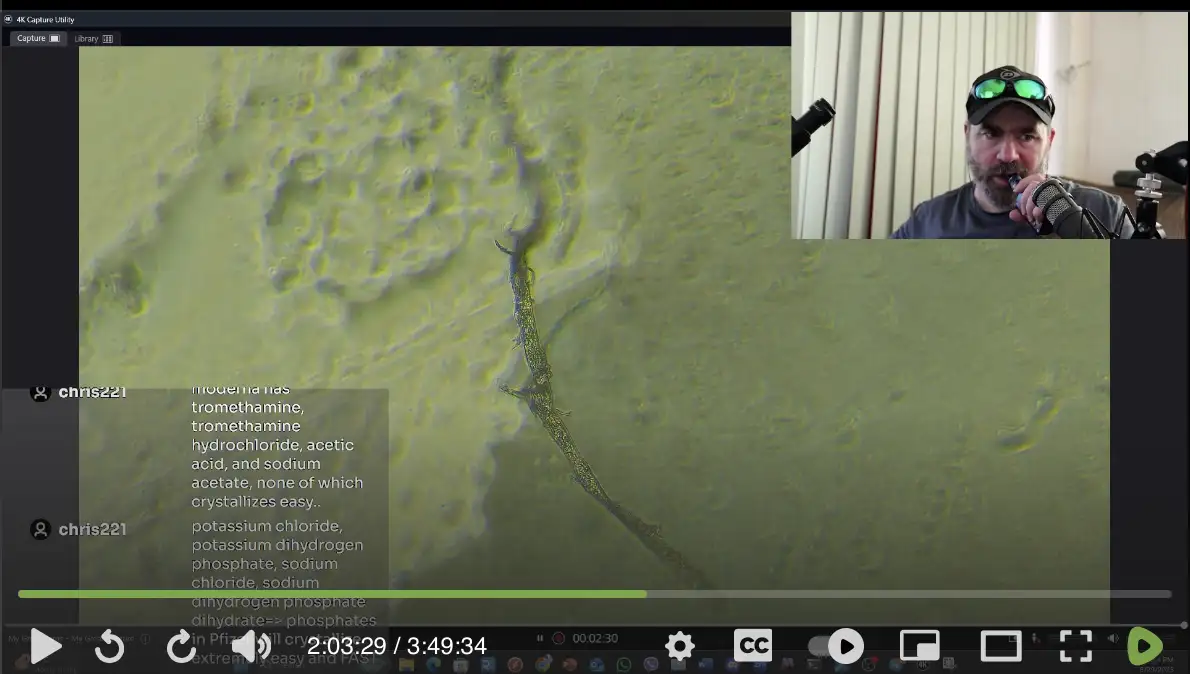
He said he didn't know what the fluorescent fibers were, but he said: "And the problem with there being bacterial contamination - I don't know how much those fibrous mats are like bacterial hydrogels in this instance." [2:05:23] He sounded like Ana Mihalcea when he suggested that random fibers he saw under a microscope were "hydrogel".
When I asked what bacterial hydrogels were, an LLM said: "Bacterial hydrogels (also known as Engineered Living Hydrogels) are a new class of 'smart' materials made by encapsulating living bacteria within a 3D water-swollen polymer network." Grok said:
Bacteria do not produce autofluorescent fibers with diameters of 10-50 micrometers that can be characterized as hydrogels. Typical bacterial extracellular structures, such as curli amyloid fibers or bacterial cellulose nanofibrils, are much smaller, usually in the range of 5-100 nanometers in diameter. These nanoscale fibers can form networks within biofilm matrices that behave like hydrogels due to high water content, but the individual fibers themselves remain far too thin to match the described size.
Bacterial cellulose, produced by species like Komagataeibacter, consists of nanofibrils that occasionally assemble into larger mats or pellicles, yet even bundled structures rarely approach 10 micrometers in diameter. Autofluorescence can occur weakly in some bacterial proteins or amyloids, but it is not a prominent feature of large fibrous structures. Larger hydrogel-like materials involving bacteria are usually engineered systems, where bacteria are encapsulated in synthetic hydrogels rather than naturally secreting thick autofluorescent fibers.
Below the first image shows a fiber without ThT staining and in non-UV mode, and the second image shows the fiber with ThT staining and in UV mode. McCairn showed that the fiber glowed brighter than the background after the staining:
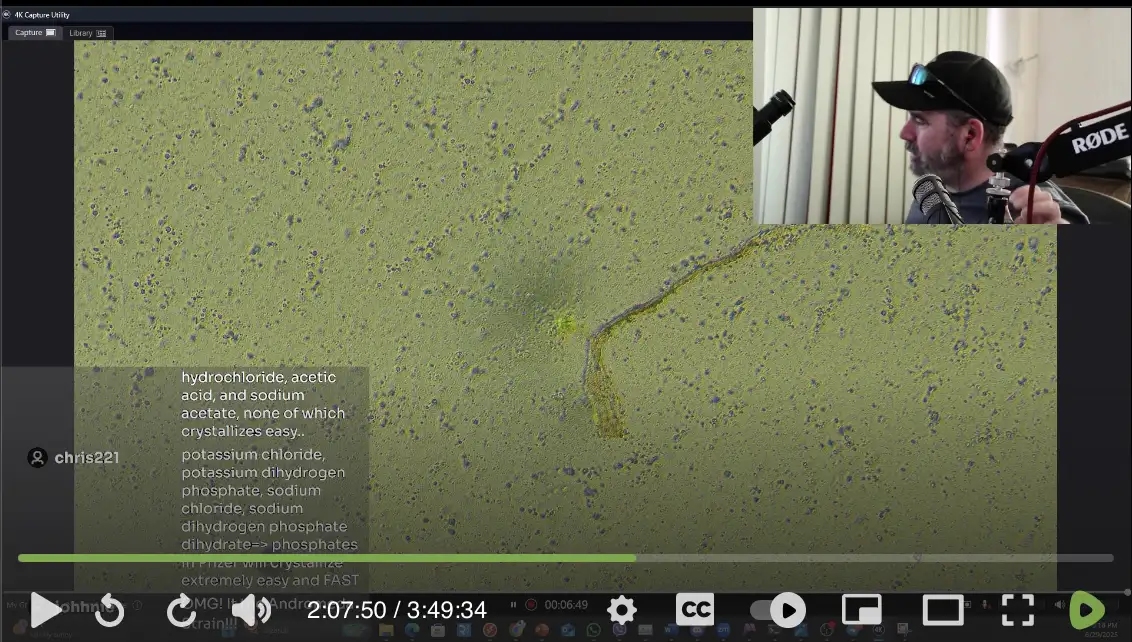
However a few minutes earlier when McCairn showed the same fiber, you could see that the fiber was already autofluorescent before he applied the ThT, so the fluorescence was not even because of the ThT:
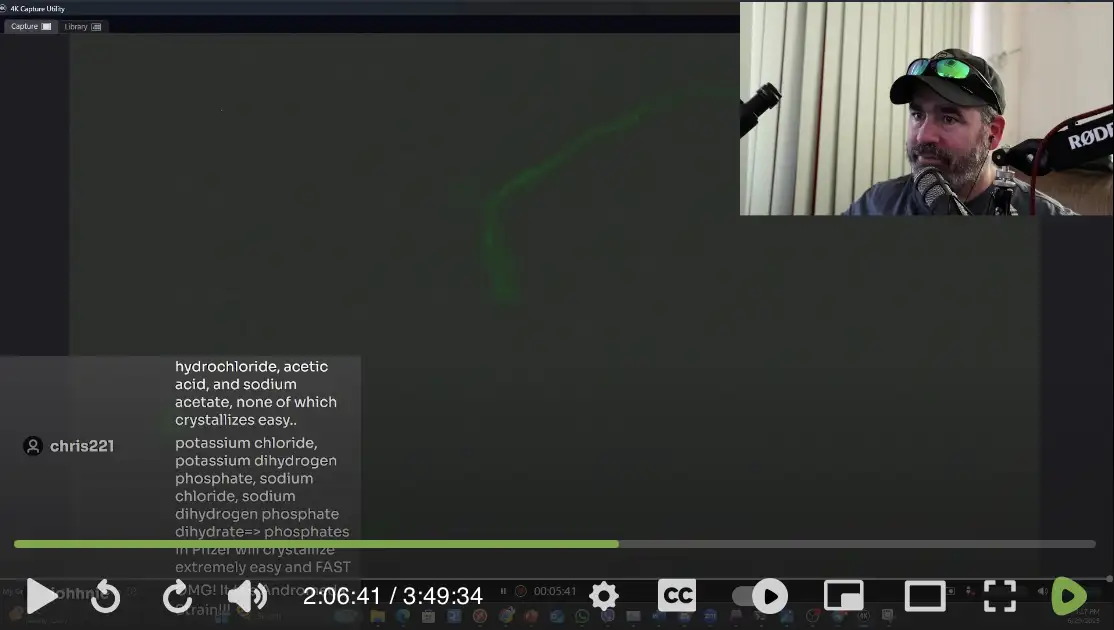
At time 2:23:21 he said: "I can't explain the takeup of Thioflavins. So, well, the only thing I could think of was, well, these are bacterial." But he didn't mention that the same fiber that supposedly took up Thioflavin was already autofluorescent even without the ThT.
He also showed this fiber in the Moderna vaccine sample, which might be some textile fiber because it has a fairly uniform diameter of about 2-3 red blood cells (but the structures towards the bottom left side are not connected to the fiber):
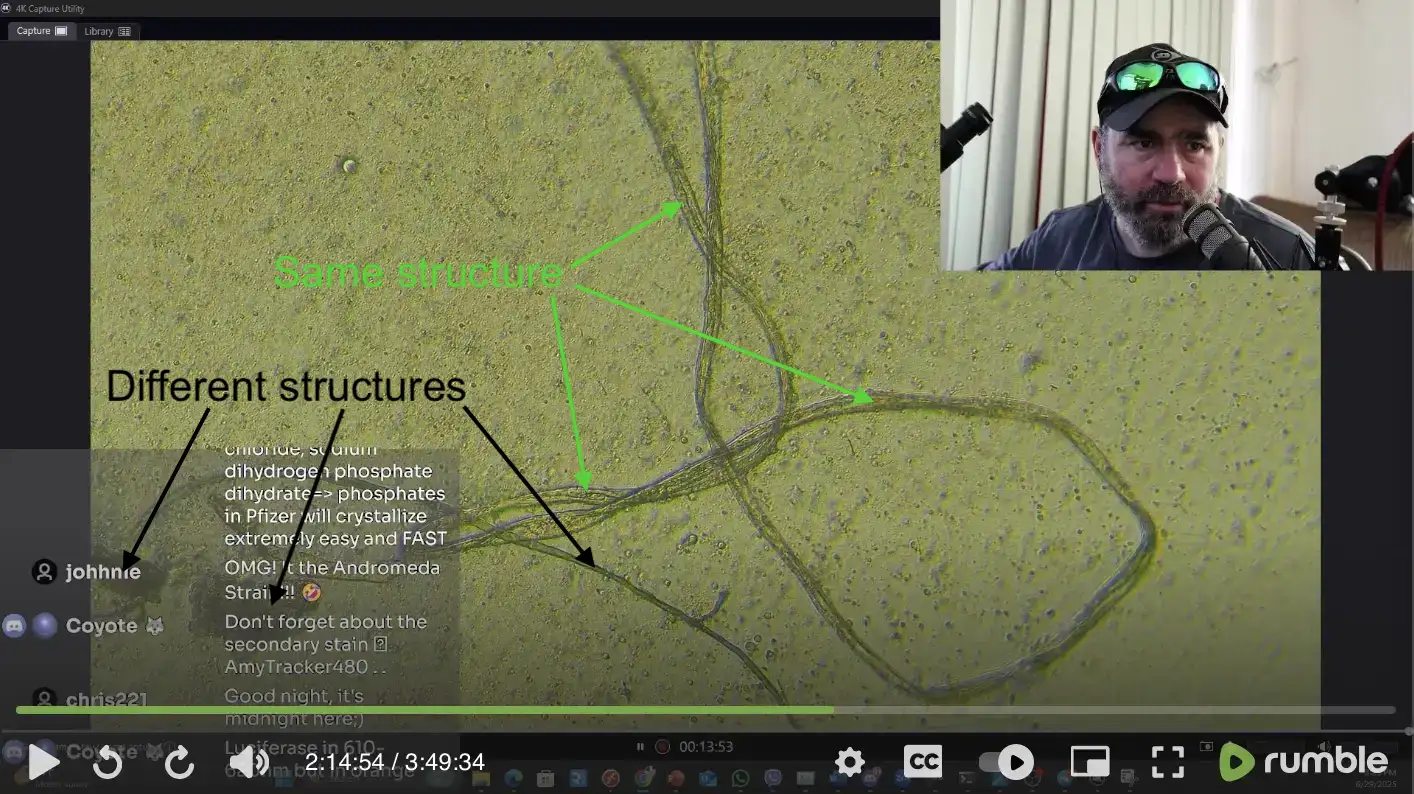
McCairn's slide included multiple different types of fibers and other structures, some of which may have been fungal or bacterial. Many bacteria and fungi glow in UV light, so UV lamps are specifically employed to detect bacteria or fungi on the surfaces of a room, or to see if a room has been cleaned properly.
The so-called "amyloidogenic fibril" that McCairn found the blood of the 3-year-old may have also been a false positive, because it was similarly autofluorescent even without ThT staining: [https://
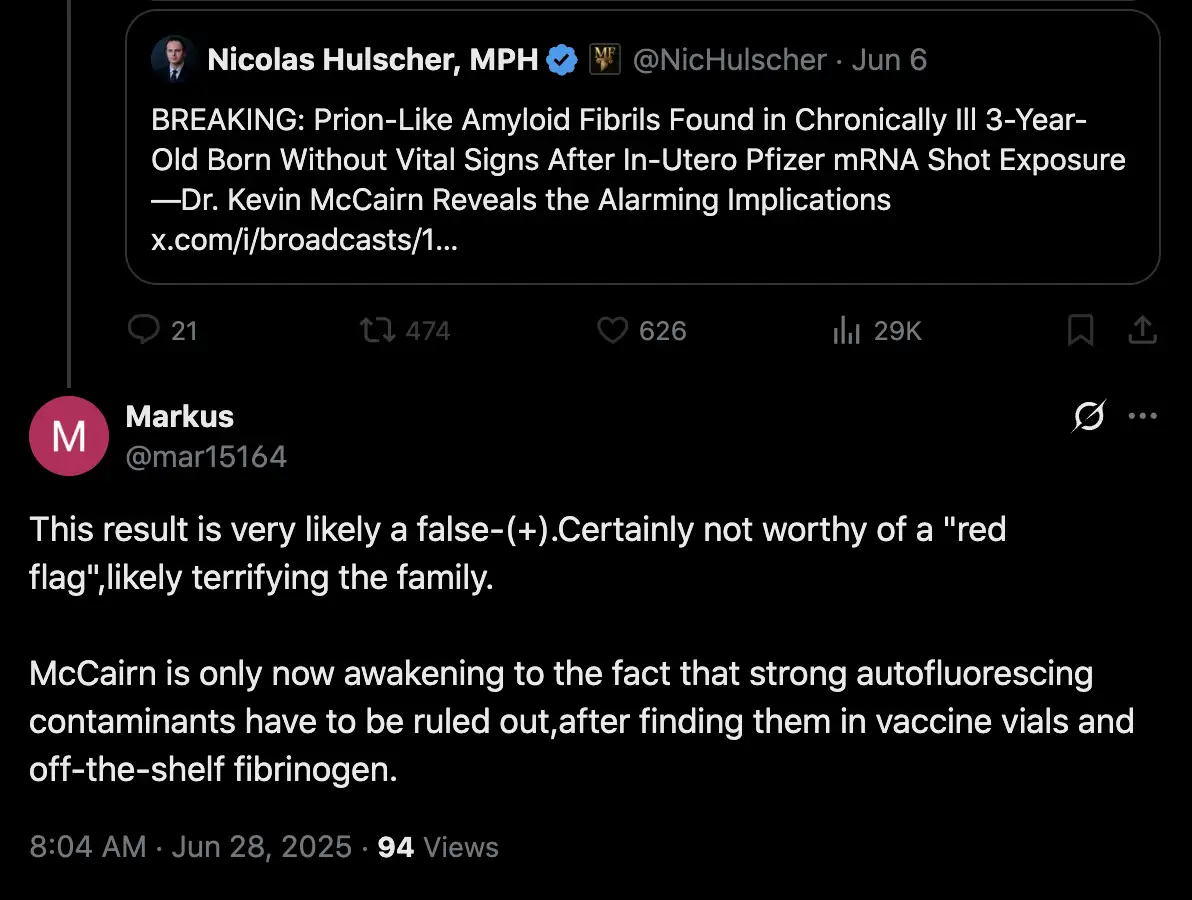
McCairn's new discovery reminded me of the mysterious fibers that were supposedly discovered in a Moderna vaccine vial by Carrie Madej: [https://

A biologist user on Twitter pointed out that amyloid fibrils are nano-scale structures, and that McCairn's fiber looked like a fiber typically seen on slides: [https://
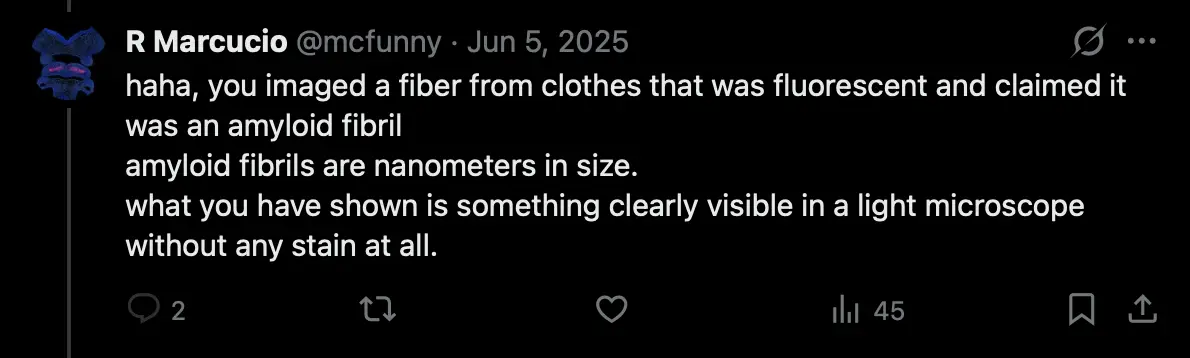

In a video in 2022, McCairn showed the microscope image by David Nixon below, and McCairn said: "Everything that I see here is cholesterol, and literal fibers that you pick up in dust in the air. What I've seen these people do - they're not doing it in clean rooms - and you've gotta be in exceptionally clean rooms to make sure that slides are not getting contaminated. Sorry. You don't get to say that these are graphene internet fiber optic cables." [https://

McCairn's Substack post was titled "Amyloidogenic Fibrils in a Post-Gestational Case of mRNA Vaccine Exposure: Structural, Pathophysiological, and Biosecurity Perspectives". So the title didn't employ the term "amyloid fibril", which is a standard scientific term that refers to nano-scale structures, but the title rather employed the nonstandard term "amyloidogenic fibril", which might plausibly refer to something other than the typical meaning of an "amyloid fibril". In the post McCairn also referred to the so-called "amyloidogenic fibril" as an "amyloidogenic fibril formation", a "fibrillar formation", a "fibrillar aggregate", and a "macro-fibrillar form".
However Nicolas Hulscher's tweet about the post said "BREAKING: Amyloid Fibrils Found in 3-Year-Old After In-Utero mRNA Injection Exposure". Hulscher also employed the term "amyloid fibrils" in the title of his Substack post: "BREAKING: Prion-Like Amyloid Fibrils Found in 3-Year-Old Born Lifeless After In-Utero Pfizer mRNA Injection Exposure". [https://
The junk amplifier accounts SenseReceptor and toobaffled also said that McCairn found "amyloid fibrils" in the sample of blood: [https://


McCairn linked to a ChatGPT conversation where he uploaded his images of the 3-year-old's fiber, and he asked if the fiber conformed to "known amyloidogenic fibrillar forms of fibrin". [https://
The diameter of the 3-year-old's fiber is about 10-20 µm based on the scale bar in the SEM image. When I asked ChatGPT what the diameter of amyloid macrofibrils was, it said the diameter was typically 50-200 nm:
Amyloid macrofibrils are higher-order bundles of smaller amyloid fibrils. Their diameter depends on both the protein type and the aggregation environment, but in published measurements:
- Single amyloid fibrils: ~6-12 nm diameter (core β-sheet cross-section)
- Protofibrils: ~2-5 nm (precursors before mature fibril)
- Macrofibrils: typically 50-200 nm, but sometimes up to 500 nm in thick bundles seen in plaques or clot-associated aggregates
For example:
- Alzheimer's Aβ plaques: macrofibrils often 80-150 nm
- Serum amyloid A (AA amyloidosis): bundles 50-200 nm
- Amyloid-rich fibrin(ogen) clots: ribbon-like macrofibrils up to a few hundred nm wide, occasionally merging into micron-scale sheets
In his Substack post, McCairn also wrote that the 3-year-old's fiber was a "macro-fibrillar form". [https://
In McCairn's second Substack post, he showed optical microscope images of the 3-year-old's sample of blood, and he indicated that he was next going to run SEM, EDX, and Raman on the sample: "Guardians were explicitly briefed on the scope and purpose of data collection, the nature of imaging techniques employed (including UV fluorescence microscopy, Thioflavin T staining, preservation for SEM/EDX analysis, and Raman Spectroscopy), and how the data would be analyzed and disclosed." [https://
However in his third Substack post, McCairn only posted SEM images of the sample, but he didn't describe the results of EDX or Raman analysis. When I asked him if he had been able to determine if the fiber was made on fibrin, he didn't answer me, and when I asked if he had already done the EDX or Raman analysis, he only said the sample was on a glass slide so he couldn't do Raman, but he might later attempt to transfer the sample to a quartz slide to do Raman: [https://


A month earlier when I asked McCairn if he had been able to determine if the 3-year-old's fiber was made of fibrin, he told me that he was still working on the samples, but that "For the moment, they remain ThT and phenotypically positive": [https://

So I asked him if he had now run additional tests to determine if the fiber was made of fibrin or not, but he indicated he hadn't done additional testing and he hadn't confirmed that the fiber was fibrin: [https://


McCairn responded to my tweets by doing a stream where he said that he had in fact done EDX on the 3-year-old's fiber, but I don't know why he didn't answer me earlier on Twitter when I asked several times if he had done EDX. He showed the image below, and he said: "What do we see when we look at Baby B with SEM/EDX? So - high-level focusing - carbon and oxygen, silicon is the glass-slide. Chlorine, whatever, I'd say that's salt from the saline in the blood and the dye I've dropped on it. Here we can see the elemental signatures." [https://

Next he showed the image below, and he said: "And there's the Raman signature that we have for it. And, um, carbon, chlorine - there's other ones not labeled here, but there's oxygen, phosphorus, [unintelligible]. What I would expect to see. And it's normal elemental signature":

I don't know why he said his plot showed a Raman signature, because the plot was an EDX spectrum plot. Grok said: "The plot in the image appears to be an Energy-Dispersive X-ray (EDX) spectrum, not a Raman spectrum, based on its axes (energy in keV on the x-axis, which is characteristic of X-ray spectroscopy for elemental analysis, rather than Raman shift in cm⁻¹)." And Grok said a reason why someone might confuse EDX with a Raman spectrum is that "Raman spectroscopy and EDX are both used in materials characterization to produce 'spectral signatures' (unique peak patterns that act like fingerprints for identification). Someone unfamiliar with the specifics might interchangeably use 'Raman' as a generic term for any spectroscopic plot, especially if they've encountered Raman more often in biological or chemical contexts (e.g., analyzing biomolecules like proteins in clots). Raman is popular for non-destructive molecular analysis, while EDX is for elemental composition, but the visual similarity of peaked spectra could lead to this slip."
Next McCairn showed the SEM image below, where he said that the 3-year-old's fiber was "connected to these microclots at either end", even though the string doesn't even look like it's connected to the blobs at the end, and I don't know how McCairn was able to determine that the blobs were microclots:

Next at time 2:22:15, McCairn said: "One of these exchanges you have - I've had to have - with henjin - is what I call phenotypically similar or different. So does it have the features that I would expect to see from canonical microclots - like, examples - let's see if I find a quick example of microclots from someone else. So this is a microclot from a Moderna-injured blood sample, taken in the laboratory, and basically showing the same ribbon-like and twisting features." And he showed this image:

The fiber he showed is flat and it has a lengthwise fold running along the middle, so it looks different from the other fibers McCairn has claimed are fibrin clots, which have had a more cylindrical shape so they looked like strings or twigs, and which didn't have the lengthwise fold. If the scale bar in his image is accurate, then the flat fiber has a diameter of about 15 µm, which is similar to the diameter of other fibers that McCairn has claimed are fibrin clots. But McCairn hasn't presented a sufficient explanation for why one of the fibers would have the lengthwise fold but not others.
Next McCairn showed the image below, and he said: "To me - like, I wanna say, are they connected? Or are they aggregating together around the same - the same structure." And he pointed to the blob at the top and said: "And then there's this clot up here, which isn't too visible until you do the Thioflavin staining, and then you see this sort of cluster." But I think the blobs don't look connected at all to the string:

Next he again showed the SEM image and said: "You can kind of see with the electron microscopy, there's like a shadow between them. And are they connected, right, together? Are they a part of the same structure? And where you have these tools, the light gray - the background changes right here, right. This is where you need the sensitivity signals."

Next as an example of what he meant by phenotypic similarity, he showed the image below, and he said: "Here, where you see this twisting - which is what amyloids do - when you look at the sort of computer modeling of them, there's a sort of limit to the width that they can take. And they can braid to some extent, right, so they're not like a molecule thick. So they're able to sort of aggregate together and make a twisting braid."

Earlier McCairn said that in his SEM image with a 5,000-fold magnification level, the reason why large "main branch" in the structure looked twisted was because of protein misfolding. [#
When I asked McCairn on Twitter if he had done Raman spectroscopy on the 3-year-old's fiber, he said he couldn't do Raman on the sample because the sample was on a glass slide, but he needed a quartz slide to do Raman. So I asked him if he couldn't have asked for another sample of blood on a quartz slide, but in his stream he now answered me: "His sample was very very precious, right. One, it's from a 3-year-old child. You do not want to go doing interventions on a child unnecessarily. Unfortunately for that child, he has had many interventions medically because of the condition he's in." [https://
McCairn's evidence that his fibers are made of "amyloid fibrin" seems to mainly consist of fluorescence under UV light with ThT staining, autofluoresence under UV light without any staining, and "phenotypic similarity" (which includes a twisted shape, and being embedded within the blood and not resting on top of the dried blood). So in other words his evidence is extremely weak.
ChatGPT told McCairn that the EDX results of the 3-year-old's fiber were not consistent with cellulose or synthetic fibers: [https://

McCairn also asked ChatGPT to analyze his confocal microscopy results:

McCairn said that "I do EDX as standard when using the machine". [https://
I also asked him multiple times which tests he had done on the sample, but he didn't say anything about having done confocal microscopy. And I don't remember him having presented either the EDX or confocal microscopy results earlier, even though I might have missed it because I haven't seen all of his streams.
It's possible that his EDX results are real, and his fiber is made of human protein, but even then the protein might not necessarily be fibrin. I think McCairn has still not provided sufficient evidence that the fibers he finds are actually made of fibrin.
I don't even know any other person besides McCairn who claims to have found string-like fibers of fibrin in human blood. The microclots in the images by Pretorius and Kell don't appear to have a string-like shape. If string-like clots of fibrin are now ubiquituous in human blood because of COVID vaccines, and if McCairn has found the clots in several samples of blood from random people, then it shouldn't be too difficult for other people to find the clots. So therefore I would like to see McCairn's findings verified by some neutral person who is not part of the anti-vaccine movement, and who is not the host of a conspiracy video show. McCairn is especially suspect because of his connection to Greg Harrison, who I have busted producing blatant disinformation about the clots.
When I asked McCairn if he had taken SEM images of the 3-year-old's sample at a higher magnification, he posted this image at a 5,000-fold magnification, which I believe he had not published anywhere earlier: [https://

I didn't find any region in the lower-magnification images that looked similar to the new image at 5,000-fold magnification. McCairn told me the new image was supposed to show a part of the 3-year-old's fiber, but he refused to say which part it was: [https://

McCairn wasn't even able to answer what part of the 5000x image showed the fiber and what part showed the background: [https://

The cotton fiber in this image has the same type of torsion as the 3-year-old's fiber, which McCairn claimed was a characteristic of microclots made of amyloid fibrin: [https://

In fact the 3-year-old's fiber is consistent with a cotton fiber in terms of its diameter, flatness, and the torsion. Cotton fibers are also flat, and their diameter is typically about 12-25 µm:

When I asked ChatGPT to list morphological characteristics of cotton fibers, one of the features it listed were the torsion-axis twists that are called "convolutions" in cotton:
Shape: Each fiber is a flattened, twisted, and ribbon-like structure. The twists, called convolutions, are a distinguishing feature of cotton.
Length: Fibers are relatively long compared to other natural cellulosic fibers. Depending on species and variety, they range from about 10 mm to 60 mm, with commercial cotton typically between 20-40 mm.
Diameter: The width of a fiber is usually 12-25 micrometers, tapering towards the tip.
Surface: The outer wall is smooth but shows irregular twists along its length.
Cross-section: The fiber cross-section is generally kidney-shaped or oval with a hollow center (lumen). The lumen collapses as the fiber matures, contributing to its twisted form.
Fineness: Cotton fibers are relatively fine, which contributes to softness and comfort in textiles.
Here's another image that shows how a distinguishing feature of cotton fibers are the helical twists that are called "convolutions":

McCairn might also do a similar side-by-side comparison, where he would show microscope images of different types of fibers next to his supposed microclots.
McCairn posted these microscope images of cotton fibers: [https://

In the second tweet above, the two images on the top row show the 3-year-old's fiber and the two images on the bottom row show cotton fibers.
I pointed out to McCairn that his images of the 3-year-old's fiber were taken at such low magnification that it's not easy to tell if the fiber had lengthwise striations. You can't even see it from the 200x SEM image, and the 5000x SEM image doesn't show any part of the fiber as far as I can tell.
For example this cotton fiber looks fairly smooth, and the striations are so subtle that they would not necessarily be visible at a 10-fold magnification with an optical microscope (even though there's another more prominent line running through the surface on the fiber to the bottom right of the lines I highlighted, so I don't know if McCairn meant that type of lines by "striations"):

The difference in appearance between the fibers might partially be explained by a difference in dying, ThT staining, or other properties. For example typically white clothes are more strongly fluorescent under UV light than black clothes. ChatGPT said:
Natural, undyed cotton is not strongly fluorescent under ultraviolet (UV) light, although it can exhibit a faint blue-white fluorescence due to trace impurities such as residual waxes or processing agents. Raw or unbleached cotton typically shows a dull yellowish or weak blue fluorescence caused by natural pigments like pectin and xanthophylls.
Bleached white cotton, on the other hand, often fluoresces brightly with a blue-white glow because optical brightening agents (OBAs) are commonly added during the bleaching process. These agents absorb UV radiation and re-emit it in the blue region of the visible spectrum, enhancing the perceived whiteness of the fabric.
Dyed cotton exhibits highly variable fluorescence depending on the dye used. Many dyes suppress or quench fluorescence, while certain fluorescent dyes, such as those based on rhodamine or fluorescein, can produce vivid colors under UV illumination.
Cotton treated with optical brighteners through laundry detergents also displays a strong bluish-white fluorescence, similar to that seen in commercially bleached fabrics.
ChatGPT also said:
Yes, a white cotton fiber typically appears strongly fluorescent under a UV microscope, but the intensity depends on how the fiber was processed.
In most modern white cotton fabrics, optical brightening agents (OBAs) are applied during bleaching or finishing. These compounds absorb ultraviolet radiation (usually in the 340-380 nm range) and re-emit blue light (around 420-450 nm). Under a UV microscope, such fibers appear with a bright blue-white fluorescence, often much more intense than that of untreated natural fibers.
The image below shows a fiber that McCairn supposedly found in the 3-year-old's blood. The fiber is fluorescent under UV light even without ThT staining, so I don't know if the fiber might for example be a fiber of cotton that was treated with optical brightening agents: [https://
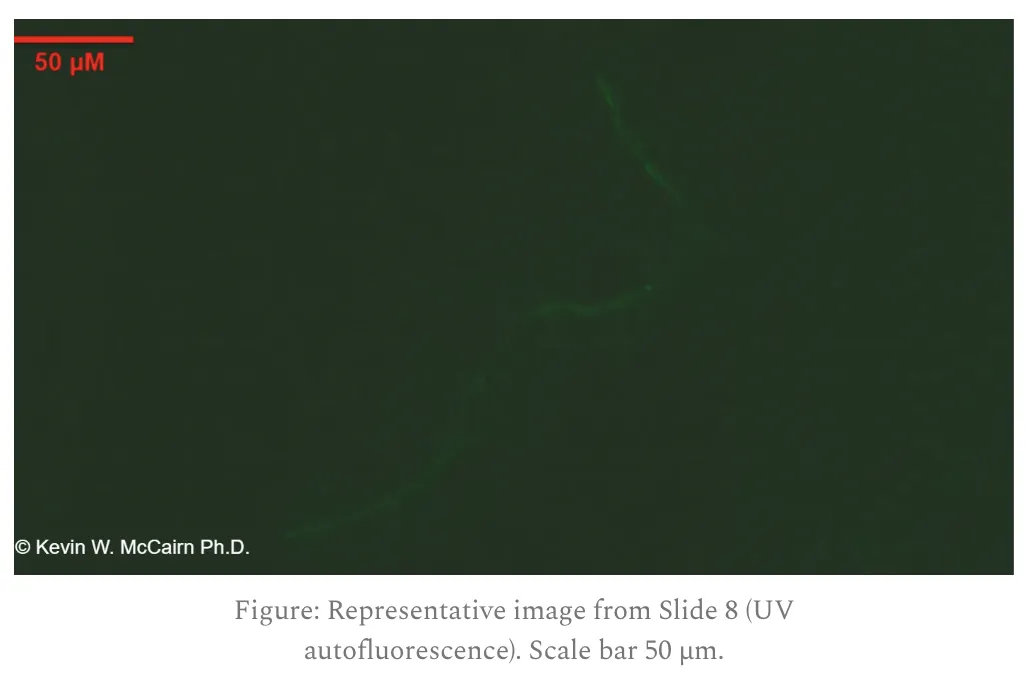
When McCairn asks his followers to send samples of blood to him on a slide in the mail, he supposedly finds fibrin clots with a diameter of about 10-30 µm in a large fraction of the samples. So if the density of clots per ml in his samples is representative of the overall density of the clots per ml in the bloodstream, then are there thousands of clots freely circulating in the bloodstream? Once the clots reach the arterial capillaries, they pass through the capillary bed to the veins, go back to the heart, and go back to the arteries again? And if the clots are somehow induced by vaccination, then how do the clots remain in circulation even years after vaccination?
ChatGPT said that a clot with a diameter of 20 µm wouldn't pass through the capillaries, which have a diameter of only about 5-10 µm: [https://
No - a fibrin clot of the size you described (20 µm in diameter × 1 mm in length) could not "loop" repeatedly through the circulation. Here's why:
1. Size relative to vessels
Capillaries: ~5-10 µm in diameter.
Your clot: 20 µm in diameter, twice as wide as the largest capillaries.
Red blood cells deform to pass; fibrin clots cannot.
Thus, such a structure cannot traverse capillaries.
2. Artery-to-vein transfer
For blood to move from the arterial side to the venous side, it must pass through the capillary bed.
Since the clot is wider than capillaries, it would become trapped at the first capillary network it encounters.
It would not emerge on the venous side.
3. Circulatory "loops"
Only cells and small deformable particles (RBCs, WBCs, platelets) can continuously recirculate.
Solid emboli (clots, cholesterol crystals, etc.) either:
Lodge in a vessel (causing occlusion), or
Fragment into smaller pieces until they are small enough to pass further downstream.
The capillaries at the tip of a finger have a diameter of about 5-10 µm, so I was wondering if they wouldn't be too narrow for McCairn's fibers to pass through in order for the fibers to end up in a finger prick sample: [https://

McCairn instructs his followers to do the finger prick samples using a small instrument that is known as a lancet, which creates a puncture in the fingertip. However actually the lancet might reach deep enough to penetrate the arterioles and not only the capillaries, because ChatGPT said:
Capillaries in the fingertip are far smaller than a 20 µm clot:
Typical capillary lumen diameter: ~5-10 µm, often just wide enough for a single red blood cell (≈7-8 µm) to deform and pass through.
Precapillary arterioles / postcapillary venules: somewhat larger (≈10-30 µm), but true capillaries in the papillary dermis are in the 5-8 µm range.
Because of this:
A 20 µm fibrin clot would not be able to traverse capillaries; it is roughly 3-4× larger than the lumen.
However, if such a microclot were already present in a postcapillary venule or small arteriole in the dermal plexus (where diameters can be >20 µm), it could potentially be carried into the superficial circulation and then extravasated through a lancet puncture.
ChatGPT said that the arterioles start at a depth of about 0.3-0.6 mm beneath the surface of the fingertips:
In the fingertip, the vascular network is stratified. Based on microanatomical and histological studies of digital pulp and nail-bed skin:
Capillary loops: extend into dermal papillae immediately beneath the epidermis, beginning at ~50-150 µm below the skin surface.
Superficial dermal plexus: composed of arterioles and venules, located in the upper dermis at a depth of roughly 0.3-0.6 mm beneath the surface.
Deeper dermal/subpapillary arterioles (arising from the deep plexus): usually found at ~1-2 mm depth at the dermal-subcutaneous junction.
So, arterioles that feed the capillary loops near the fingertip start around 0.3-0.6 mm beneath the epidermis, while larger supply arterioles run deeper, closer to 1-2 mm.
And a standard finger prick lancet typically reaches a depth of about 1.5-2.0 mm. So I guess feasibly a blood clot might get stuck in arterioles because it can't pass through the arterial capillaries, and then it might get released if you do a finger prick that reaches the arterioles. So it wouldn't necessarily be anomalous if a clot is too big to pass through the capillaries, if in fact the clot was not circulating freely in blood, but the clot was stuck before the arterial capillaries in the fingertip.
But regardless, I consider it unlikely that the fibers McCairn finds in blood samples are blood clots, and so far McCairn has not even been able to show that his fibers are made of fibrin.
McCairn now also posted the image below, and he wrote: "I've found a more clear image of the linear clot, but it's at a lower 4000X, the 5000x are all noisy. The reason for looking at high mag is to dispel the notion that it's cotton which shows pronounced linear striations. It's clear in this sample that the surface is dimpled, non-striated, and has nodules consistent with other amyloidogenic clots." [https://

The 4000x image shows a part near the end of the fiber towards the right side of the image (which was demonstrated by a second image in McCairn's tweet, but I didn't manage to save the second image before his tweet was marked as age-restricted content, and I don't have a phone so I'm not able to verify my age).
The new image shows a part close to the end that is about 9 µm wide, but the earlier 200x image showed a part closer to the middle that was about 13 µm wide.
ChatGPT said: "Cotton fibers from Gossypium appear flattened and twisted along their length because the central lumen collapses as the fiber matures and dries, giving the middle portion a ribbon-like, C-shaped cross-section. However, at the fiber ends, the lumen is less collapsed and the structure remains more rounded, so the ends typically appear smoother and more cylindrical under the microscope."
The earlier 200x image clearly showed a more flat and twisted shape: [https://
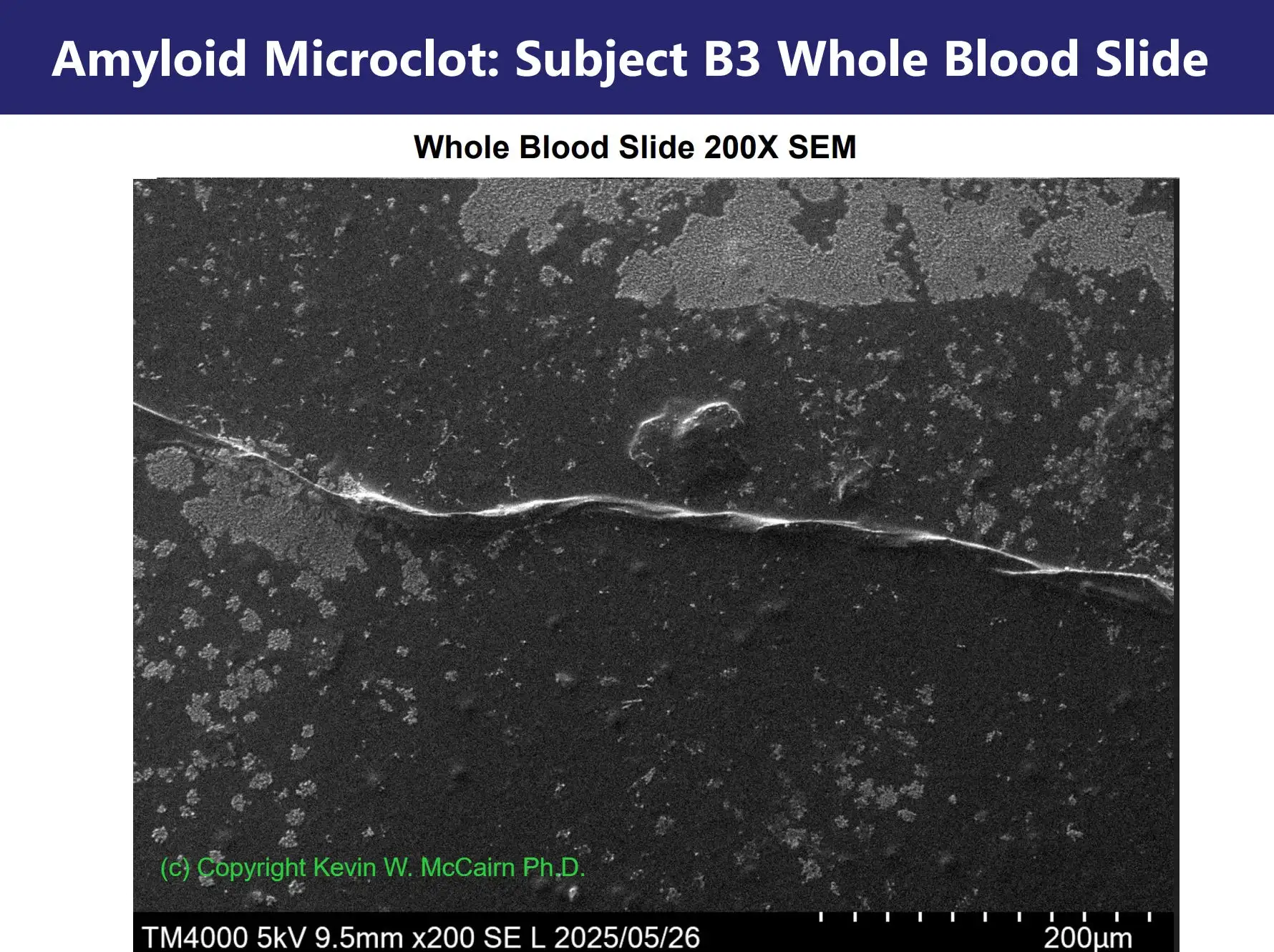
I told McCairn that his new image was so blurry that subtle striations might be hard to see. But then McCairn pointed out that the fiber also had "protruding nodule/nucleation sites", which I think meant the small ball-like specks that were attached to the fiber:

Then I posted a microscope image of fibers in dust with specks attached to them, and I asked McCairn if his "nodules" or "nulecation sites" were just specks of dust. But he said it was unlikely because his fiber had been soaked in buffer and dye:

I pointed out it would be easy to do an experiment where you took a sample of dust that contained fibers with specks attached, you soaked the sample in buffer and ThT, and you checked if the specks remain adhered to the fibers. And I posted this response from ChatGPT:
Yes, dust specks could remain adhered to a microscopic fiber even if the fiber has been soaked in buffer and ThT, but the likelihood depends on several factors:
Nature of the Fiber Surface
- If the fiber is hydrophilic (e.g., cellulose or proteinaceous material), buffer and ThT will wet it well, which can loosen loosely attached dust particles.
- If it is hydrophobic (e.g., certain synthetic polymers), surface tension effects may cause dust specks to stay trapped.
Dust Particle Properties
- Dust is heterogeneous: it can include inorganic particles, organic matter, fibers, salts, and lipids. Some of these bind electrostatically or hydrophobically to surfaces and are not easily washed off.
- Small particles (<1 µm) may adhere strongly through van der Waals forces.
Buffer and ThT Effects
- Aqueous buffer itself usually does not solubilize dust (unless the dust contains salts).
- Thioflavin T (ThT) is a small, charged, aromatic dye. At the concentrations typically used, it does not act as a detergent, so it won't remove particles strongly bound to the fiber.
- ThT may even interact with hydrophobic dust or fibrous debris, leading to retention rather than removal.
Mechanical Handling
- Passive soaking is often insufficient to dislodge strongly adhered dust.
- Agitation, sonication, or filtration would be more effective.
McCairn told me I should get my own lab equipment to do the experiment. And in fact I have thought of buying some basic equipment so I could do experiments like this myself. But McCairn should be interested in performing the experiment himself, in case he relies on the specks attached to his fiber as evidence that the fiber is not made of cotton.
McCairn did a 3-minute video where he instructed his followers on they can take a sample of blood from their finger and mail him the sample on a glass slide. At the end of the video, he smears the blood so it's spread out over the glass, but the blood is left exposed to open air, and he says "let these dry overnight in a dust-free environment": [https://
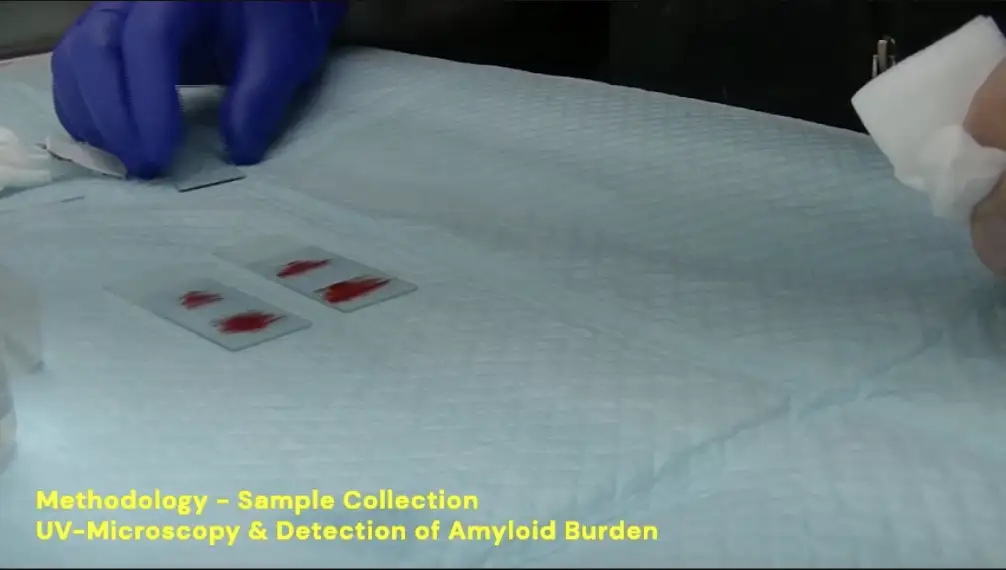
But how many of his followers actually had a perfectly dust-free environment at their home? He didn't instruct his followers to put any cover over the slides so dust wouldn't fall on the slides. And he didn't instruct his followers to check afterwards that no fibers of dust had landed on the blood while it was drying.
Ian Musgrave is a molecular pharmacologist who has experience doing electron microscopy of amyloids, but he said that McCairn's amyloid fibril was a cellulose fiber: [https://
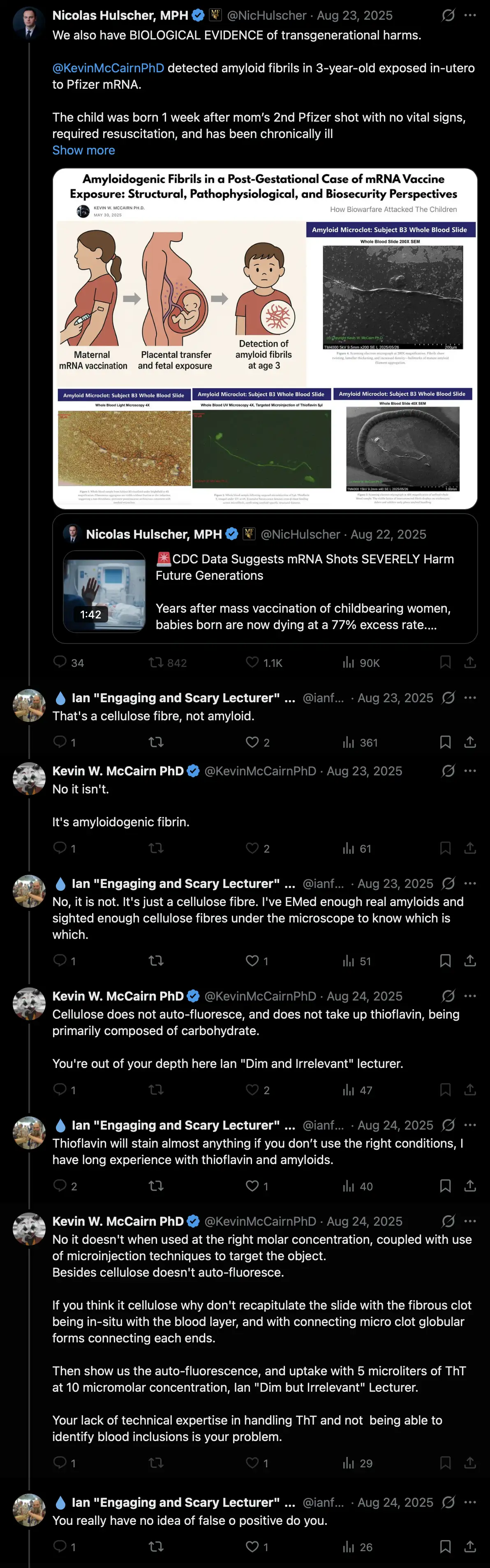
When McCairn said that cellulose doesn't autofluoresce, he forgot to mention that cellulose fibers can be strongly autofluorescent if they have been treated with optical brightening agents, like the vast majority of white clothes and white paper.
The Died Suddenly movie was produced by Lauren Witzke, who was Stew's producer until 2024. In April 2024 Stew Peters tweeted: "The @DiedSuddenly_ account has been hijacked by @LaurenWitzkeDE et al and is currently not being run by the Stew Peters Network." [https://
In May 2025 the Died Suddenly crew announced that they were raising funds for a new film called "Died Suddenly 2: Nano Sapiens", which was going to be directed by Matthew Skow, who directed the original Died Suddenly film together with Nicholas Stumphauzer. [https://
Jikkyleaks said that the cast of the film was full of "glowies", but Kevin McCairn replied "LMFAO at the list of cretins in that list": [https://

One of the people featured in the film was Maria Zeee, but a few weeks earlier, McCairn went on Maria Zeee's show together with Richard Hirschman, who was the main star of the original Died Suddenly film:

Several other people in the Nano Sapiens film are also connected to the clots: [https://
Ana Maria Mihalcea: When she looked at Hirschman's coffee ground clots under a microscope, and she presented a video of blinking lights as evidence that the clots contained quantum dot micro robots, Hirschman told her: "You got some pretty daggum solid proof behind you when you're showing the actual images, you're showing the blinking lights". [https://
La Quinta Columna: I have found no reference to a new type of white fibrous clots before January 2022 when Jane Ruby first broke the news about the clots. But Jane Ruby also says that she broke La Quinta Columna's story about graphene oxide. [https://
Youngmi Lee and Daniel Broudy: They were guests on the podcast of the people who made the Died Suddenly movie. [https://
David Nixon: He is a member of NZDSOS, which promoted An Unholy Triad, and which was co-founded by Matt Shelton who was credited in An Unholy Triad. [https://
Steven Quay: Greg Harrison did a video where he claimed that Quay's paper explained why the spike protein caused calamari clots to form. [https://
In June 2025 Nicolas Hulscher posted a tweet where he promoted McCairn's Substack post about the 3-year-old's fiber. Hulscher said the fiber was an "amyloid fibril", even though the diameter of the fiber was 3 orders of magnitude bigger than the diameter of an amyloid fibril: [https://

Nicolas Hulscher is the "foundation administrator" of the McCullough Foundation, and he runs the Twitter account of McCullough Foundation. Peter McCullough is the Chief Scientific Officer of The Wellness Company.
In May 2025 McCairn and Hirschman went on Maria Zeee's show, which is now part of Vigilant News Network which was founded by TWC's co-founder Foster Coulson:
TWC's "chief marketing officer" used to be Christopher Alexander, whose work experience includes having "successfully secured over 300 million dollars in contracts for Information Operations, PSYOP, and intelligence support" and being "recognized as a leader in disinformation, misinformation, and counter-propaganda campaigns". [https://
Accounts related to TWC seem to be artificially amplified by bots on Twitter. In 2024 I scraped the reposts of about 80 accounts that I suspected to be bots that promoted content about COVID from the controlled alternative media. When I sorted accounts by the number of reposts by the suspected bots divided by the number of followers, and I excluded accounts that were not related to COVID and accounts that had a low number of followers, McCullough Foundation ranked 2nd highest. [bot2.
Makis promotes ivermectin and fenbendazole as miracle cures for turbo cancer, but before COVID both of them were presented as cures for Morgellons disease: [https://

A forum post from 2016 said: "I've also read that a lot of people who are suffering with morgellons have had some huge success with fenbendazole." [https://
In 2024 Hulscher and McCullough coauthored a paper with Raphael Stricker, who was possibly the main person responsible for producing fake science to prop up the hoax about Morgellons disease. Stricker also coauthored a paper in 2021 with McCullough and Harvey Risch, who are both members of the "Chief Medical Board" of TWC: [https://

In 2019 the California Medical Board issued a complaint against Stricker because he prescribed ivermectin as a treatment for Morgellons disease without obtaining informed consent. [https://
The term Morgellons disease was coined by Mary Leitao. The earliest paper about Morgellons disease that is structured like a scholarly paper is probably a paper from 2006 that was coauthored by Virginia Savely, Mary Leitao, and Raphael Stricker. [https://

Mary Leitao also claimed that Morgellons filaments were autofluorescent: [https://
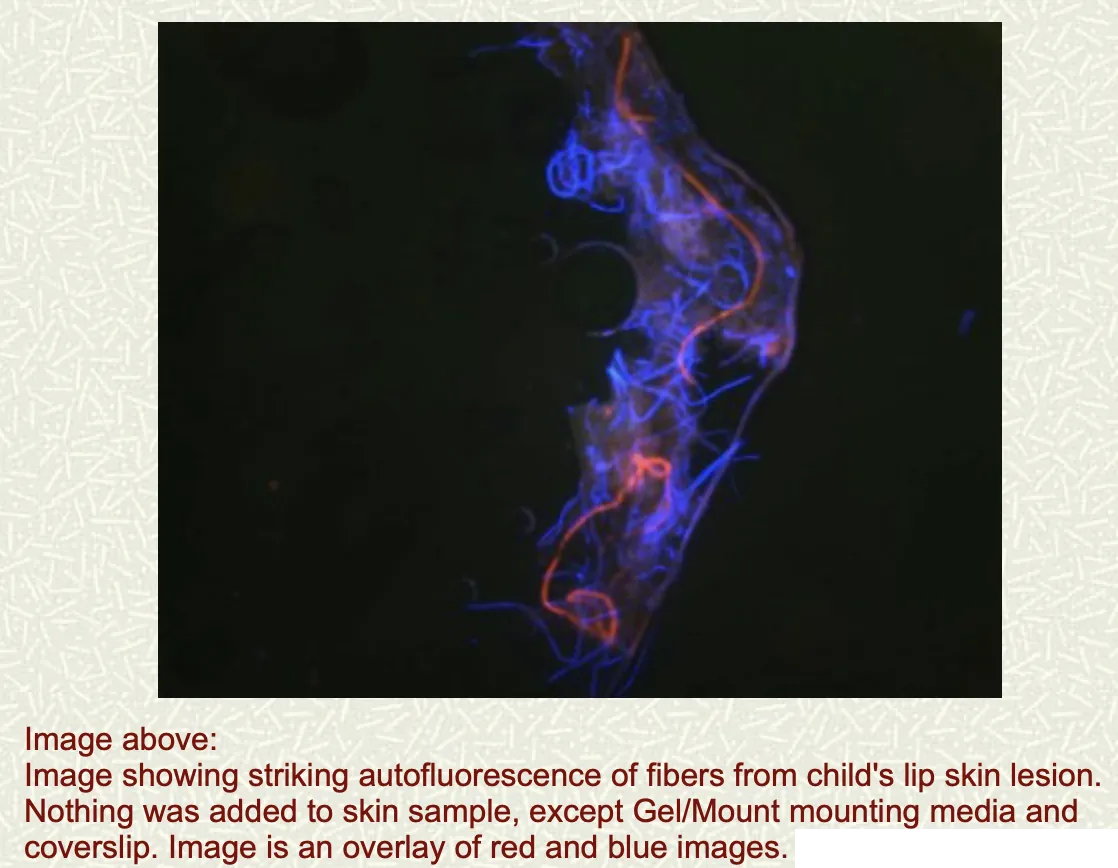
In a video that Ana Mihalcea did with Hirschman, she said that calamari clots are "made from these filaments that Clifford Carnicom calls cross-domain bacteria or Morgellons filaments", and she showed these images of Morgellons filaments that she found in Hirschman's clots: [https://

Then Hirschman told Mihalcea "I had a live blood analysis of my own blood and my blood had some of those filaments in it too" (even though it's not clear if by the filaments he meant Morgellons filaments or some other type of filaments). [55:26] As evidence that Hirschman's clots contained quantum dot microrobots, Mihalcea showed a microscope video of blinking lights, but Hirschman told her "you got some pretty daggum solid proof behind you, when you're showing the actual images, you're showing the blinking lights". [1:00:57]
The only scientific paper about calamari clots I have found was published in the journal IJVTPR (if I employ a very loose definition of a scientific paper that includes pseudo-scientific papers masquerading as scientific papers). One of the people on the editorial board of the journal is Shimon Yanowitz. [https://

The term "turbo cancer" was first introduced in September 2021 in Arne Burkhardt's pathology conference. [turbo.
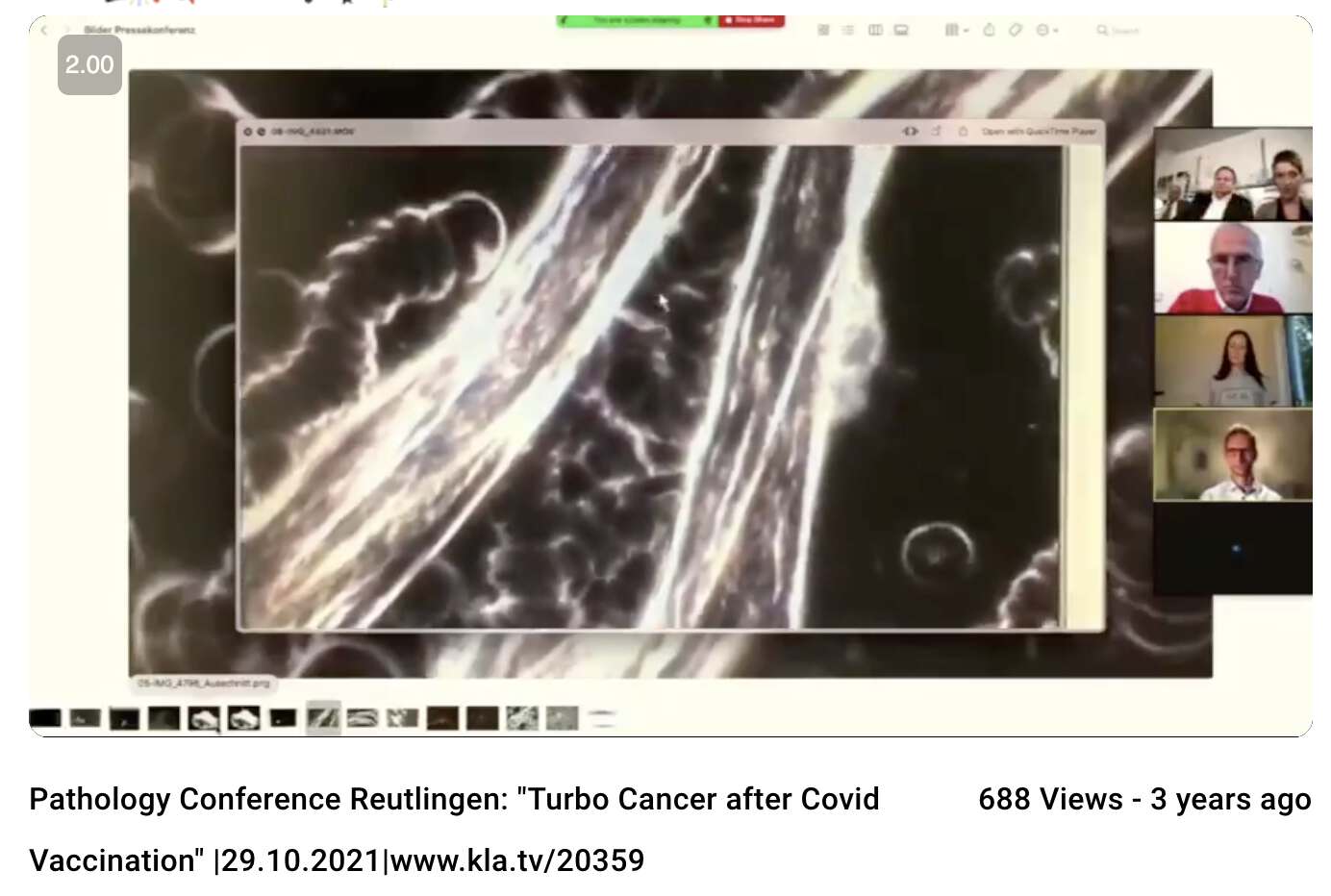
In reality the fibers in the image above have several characteristics of cotton, because they are about 2 to 3 blood cells wide, they have a flat body with a cupped C-like shape, and they have the kind of helical twists that are called convolutions in cotton.
One of the people in McCairn's circle is Johanna Deinert, who said that she advised Arne Burkhardt on immunohistochemistry, and I believe she even helped run his website, which is rather suspicious considering how Burkhardt appears to have been controlled opposition. [https://
Adam Finnegan promoted this video McCairn did with Nicolas Hulscher, where McCairn presented his neo-Morgellons theory about how vaccinated people have developed a scary new pathology which causes their body to grow fibers that look like textile fibers: [https://
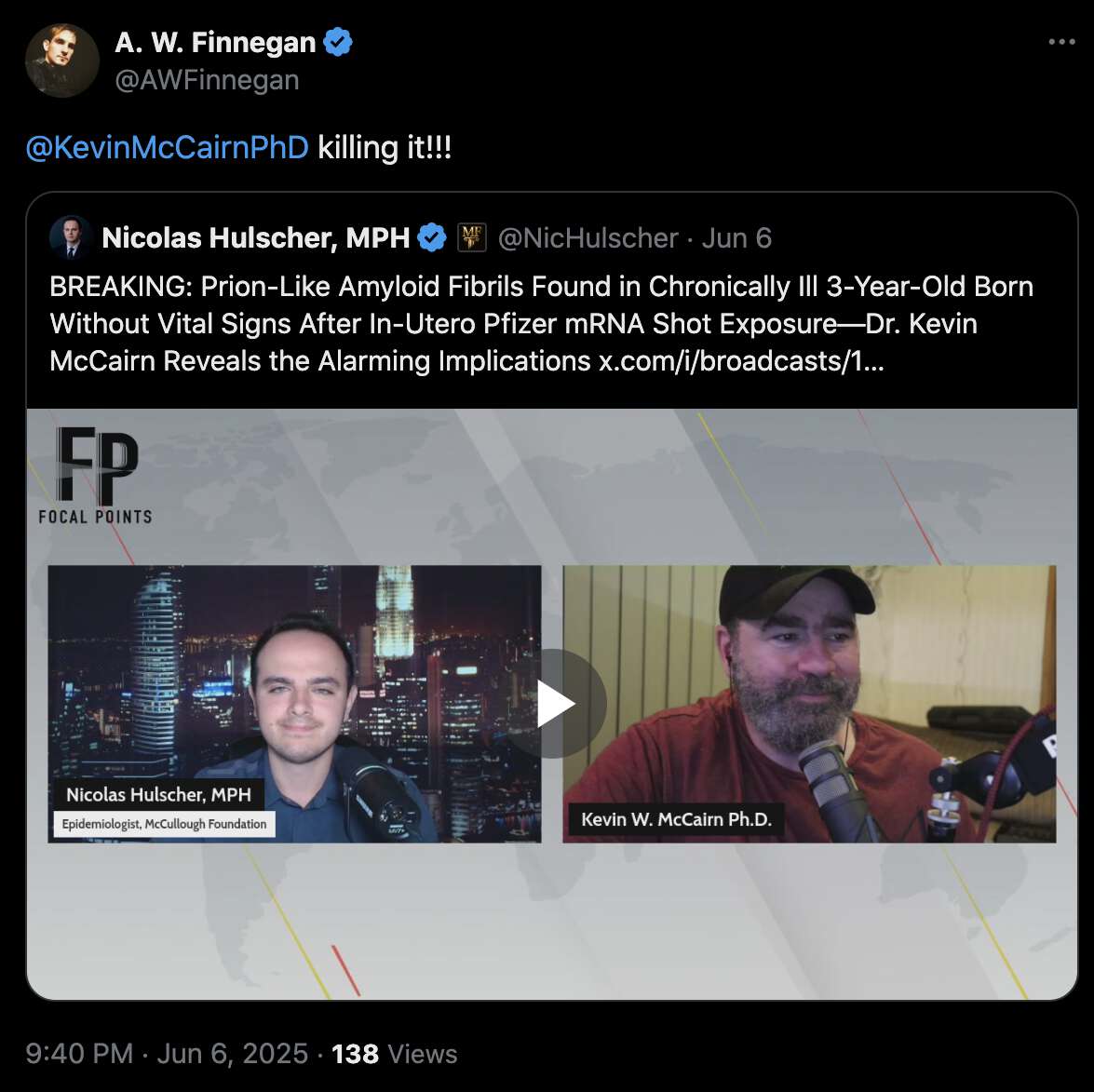
Kevin McCairn has done multiple videos with Adam Finnegan, and Finnegan is on McCairn's Discord and he is promoted by many people in McCairn's circle.
In 2021 Finnegan wrote an article about Morgellons disease, where he claimed that he had witnessed Morgellons disease in his extended family members, he characterized the Carnicom Institute as a credible source, and he suggested that the presence of microplastics in rain might mean that Morgellons is spread through chemtrails. He wrote that Morgellons disease was the result of "adverse events in nanotechnological failure", and he compared Morgellons filaments to nanowires produced by genetically modified viruses (even though the fibers that are said to be Morgellons filaments are visible with an optical microscope, but nanowires are not). [https://
Finnegan also showed a photo of plastic fibers in rainwater, and he compared it to Mary Leitao's photo of Morgellons filaments: [https://
Finnegan is a regular guest on the channel of the son of a high-level FBI agent, who also recorded an audio narration of Finnegan's book, and who appears to be Finnegan's biggest advocate in alt media. The son of the FBI agent launched his YouTube channel together with a Jew who said that he had homies at French Mossad, and that he worked with Dutch intelligence in New York: [https://

Edited in 2026: The rest of this section has been split off into a dedicated article about Finnegan and John Loftus: lyme.
A Twitter user called Tom Czerniawski said that prions from vaccines will kill so many people that all human life on earth will end, and he said it was not hyperbole or exaggeration. Kevin McCairn replied to him suggesting that the prions will result in an evolutionary bottleneck event: [https://
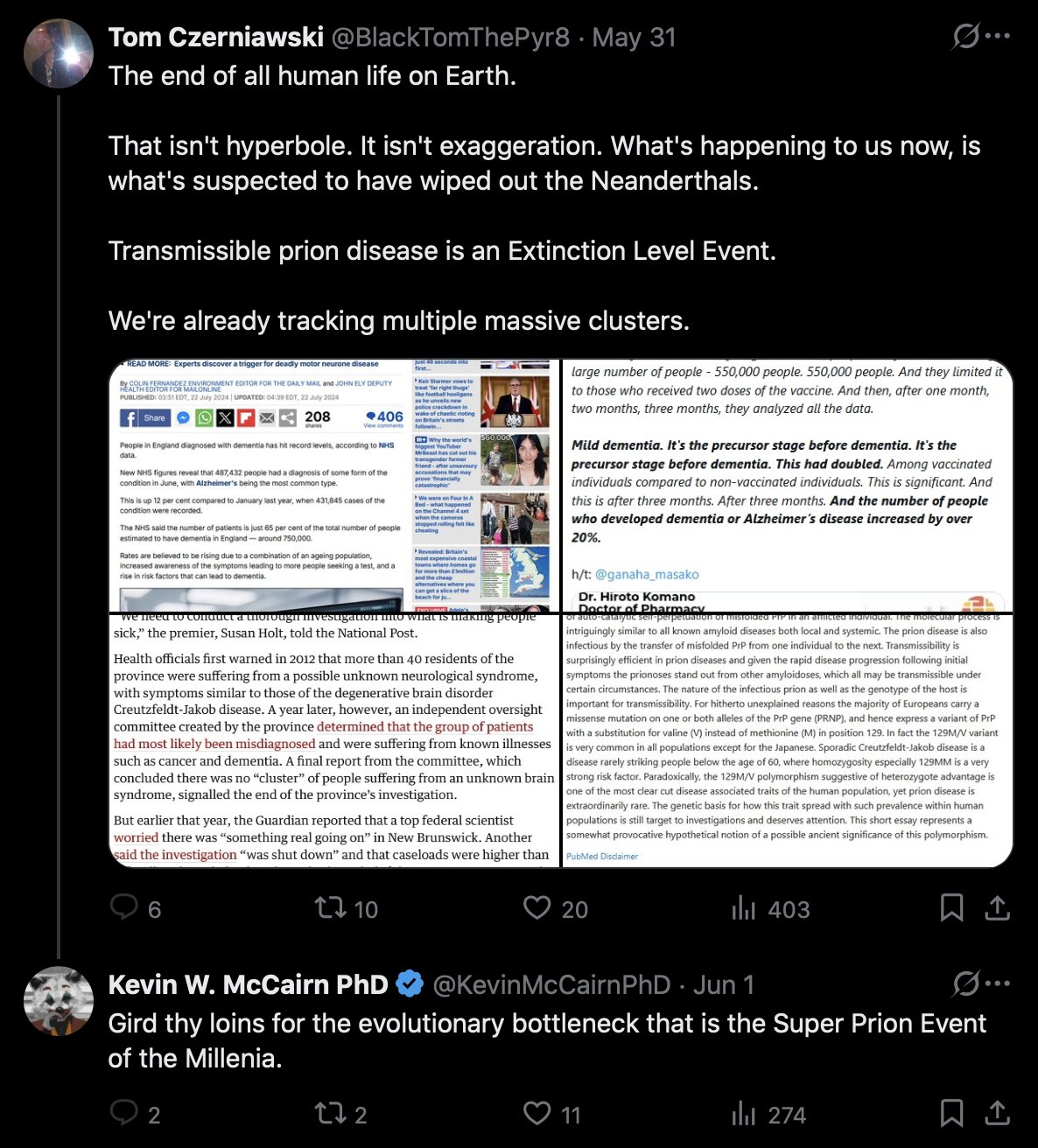
Earlier Tom Czerniawski was going around asking billionaires to donate money to McCairn, because he said that if McCairn receives a few hundred thousand USD in donations, he could "SAVE EVERYONE FROM DYING HORRIBLY": [https://
Here Tom said that the clots will cause a cataclysmic pole shift to arrive more quickly, and Ethical Skeptic agreed with him: [https://

One time when I told McCairn that his followers have the same kind of cult mentality as no-virus people, he said "no they don't" and "it's not like that at all". [https://
Added later: As further evidence that McCairn's followers are members of an apocalyptic cult, the pinned tweet of one of his fans says that the spike protein has a prion epitope that is creating an extinction-level super prion event (which somehow only McCairn has been able to reveal through his scientific genius): [https://
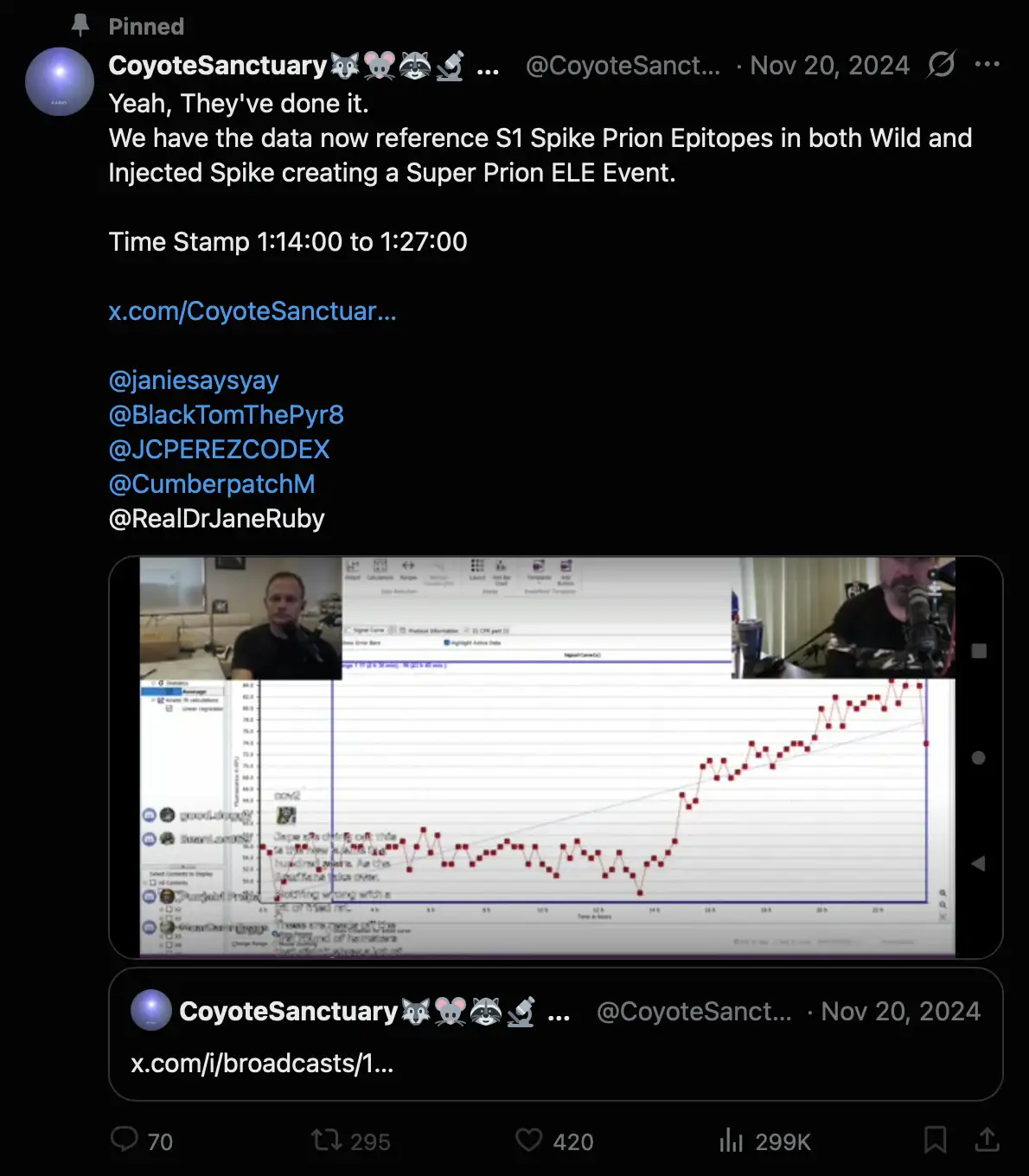
Added in 2026: Now Tom suggested that McCairn was an angel of salvation, who was sent to earth by divine providence to save humanity: [https://
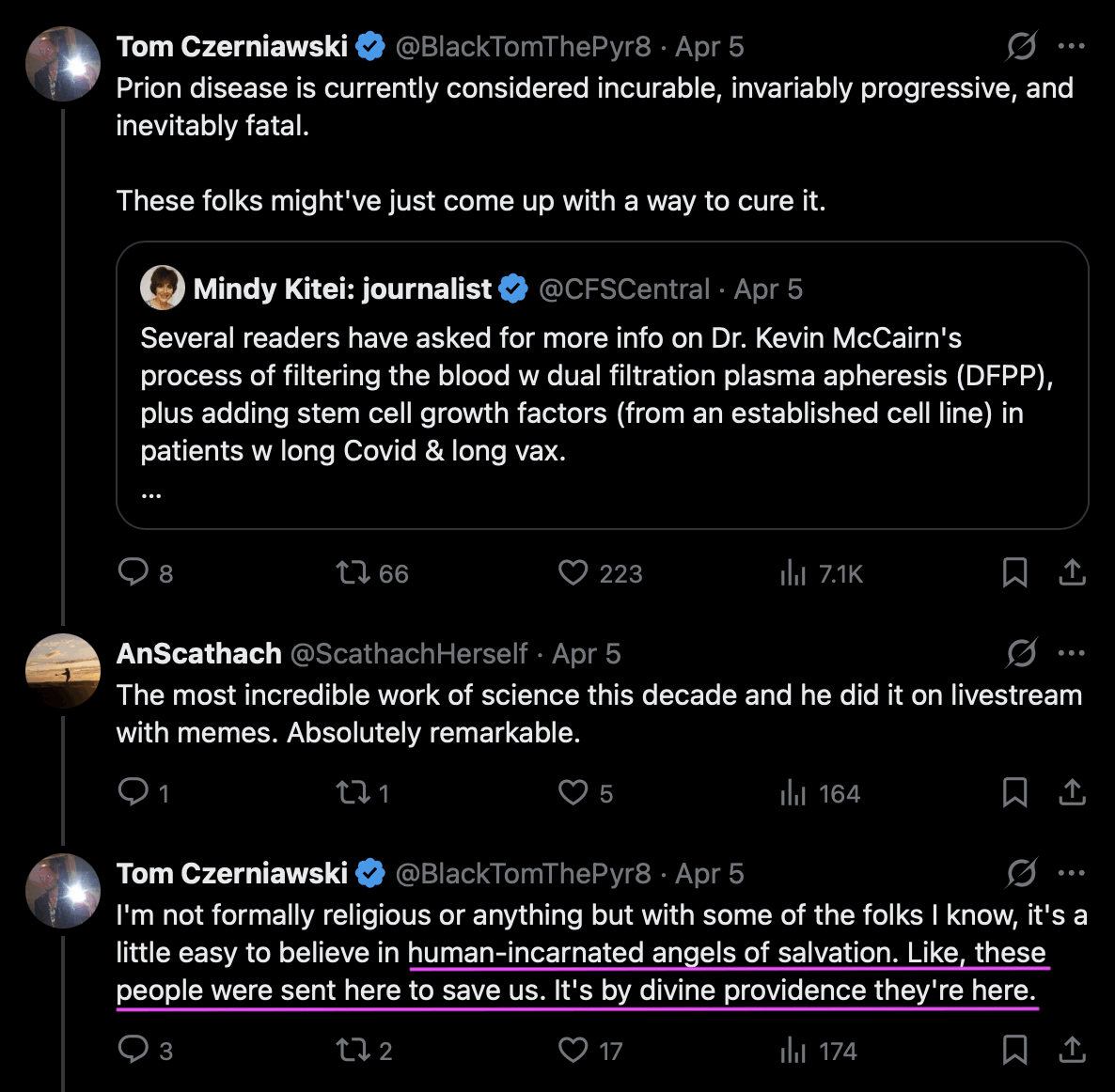
Here Tom seems to have implied that people like McCairn are the best humans on the earth: [https://

Black Tom also said that Jikkyleaks has saved countless millions of lives, or potentially billions down the road: [https://
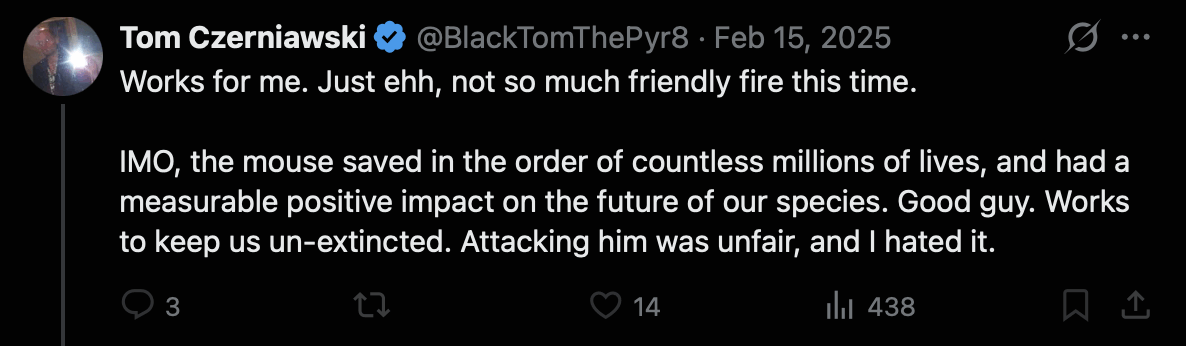
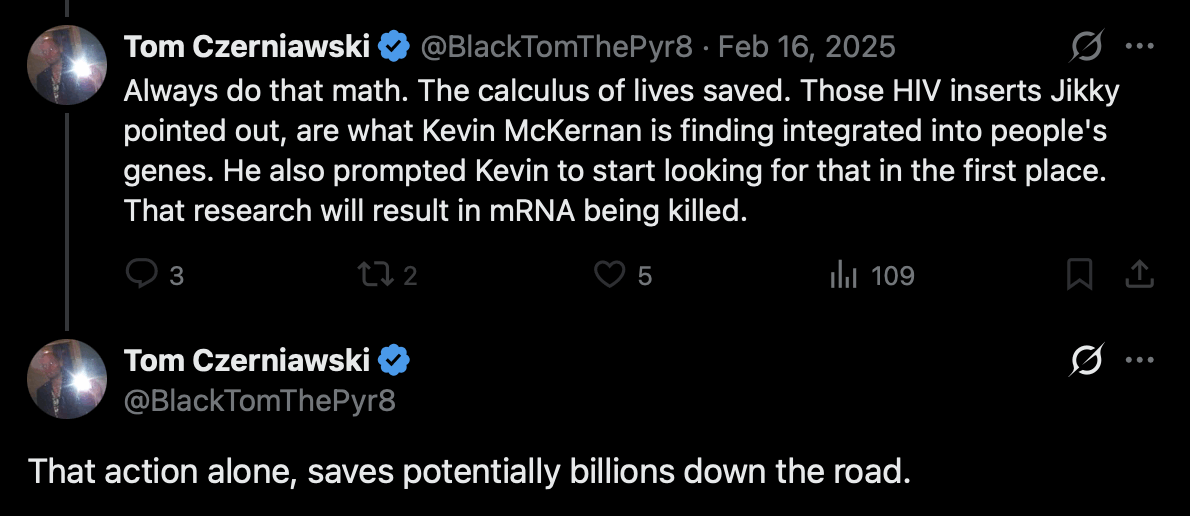
In May 2025, Kevin McCairn published a Substack post about how he supposedly found an amyloid fibril in the blood of a 3-year-old boy. His story went viral after Nicolas Hulscher published a Substack post about the story. Hulscher's post was then copied by Frank Bergman, who is the most prolific author on the fake news site Slay News. Bergman's article was promoted by the Died Suddenly account on Twitter, which posted a screenshot of Bergman's article copied to another fake news site called TRUTH11.COM:

A few days later, a paper about how vaccinated people were magnetic was published in the Indian predatory journal IJIRMS, which has also published papers by Hulscher and McCullough. At first the paper didn't get too much attention, but a few days later it went viral after Hulscher wrote a Substack post about the paper, and then Hulscher's article was again copied by Frank Bergman, and Bergman's article was promoted by Died Suddenly:

Nic Hulscher also posted similar AI-generated infographics promoting both stories: [https://
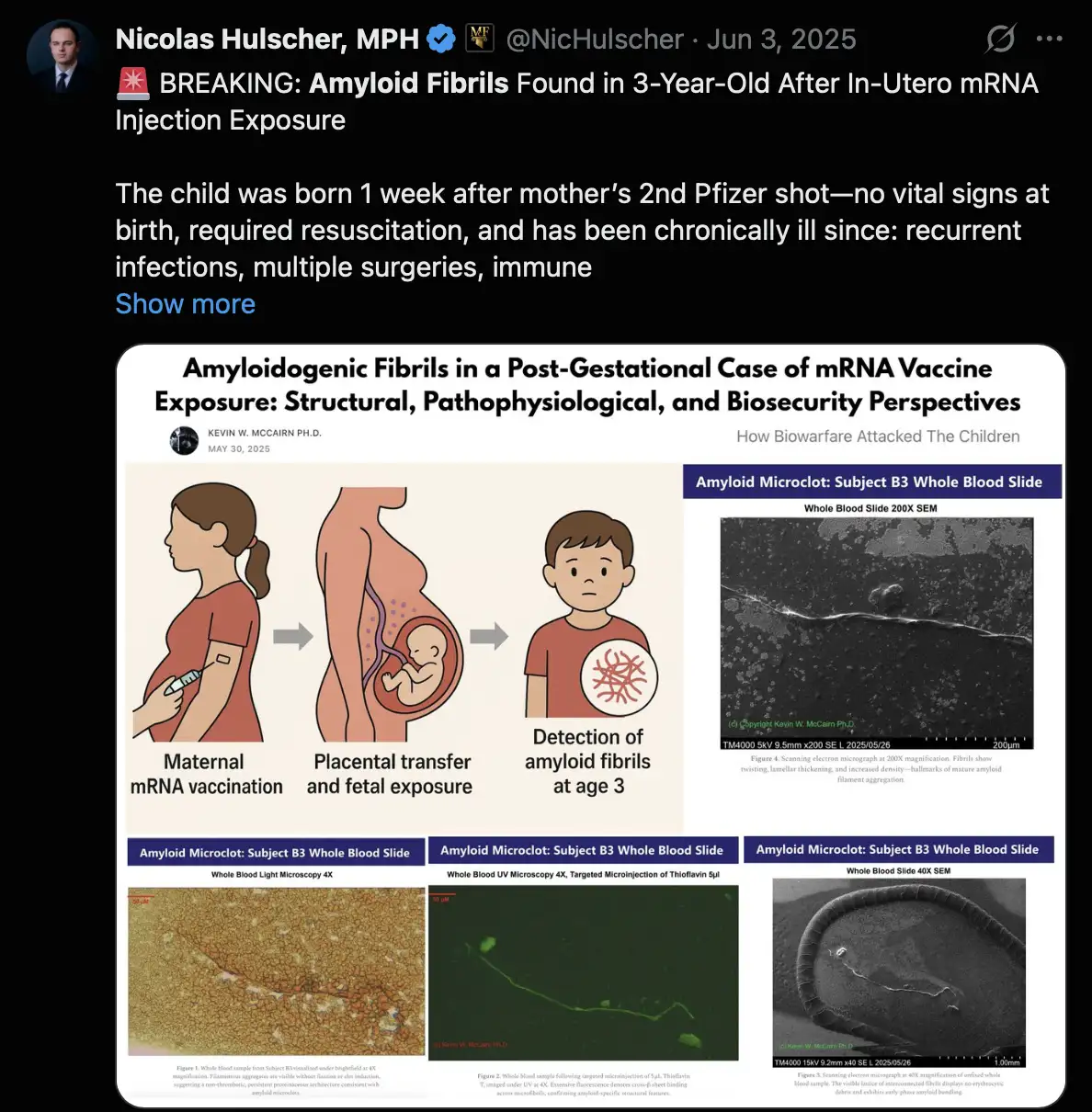
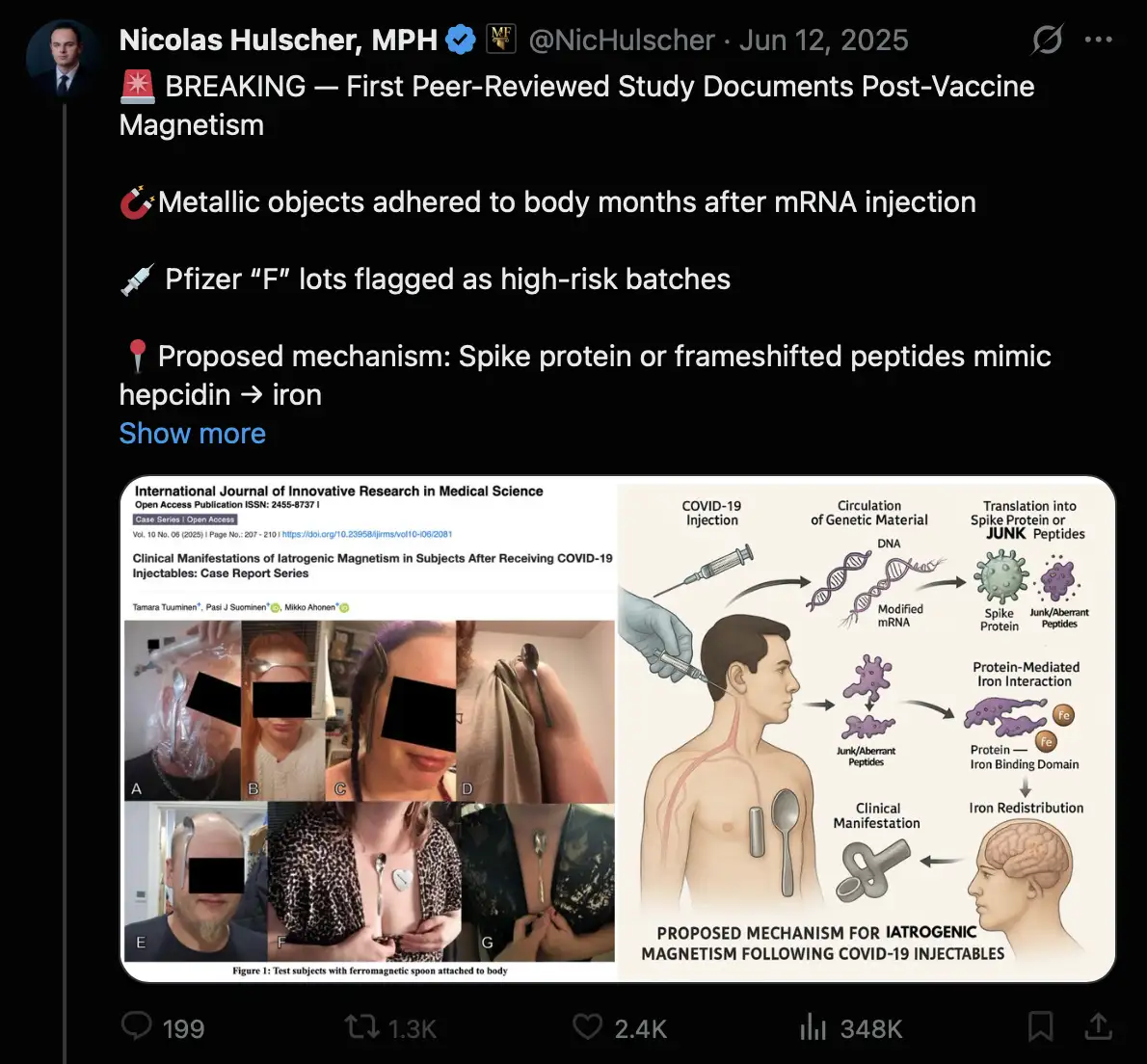
Frank Bergman is likely a fake person, and his portrait picture appears to have been generated by thispersondoesnotexist.com or by some other interface to StyleGAN: [https://

Slay News is run by British people from a company called Evil Corp Ltd. They also run another fake news site called News Addicts, where the most prolific author is Hunter Fielding who has an AI-generated portrait picture. Articles by Hunter Fielding are also published on Expose News, which is another British fake news site.
One author of the magnetism paper was Pasi Suominen, who is a member of Jikky's mouse army, so Jikky said that if the paper "got through peer review then it's got merit" (even though the paper was published in an Indian predatory journal): [https://
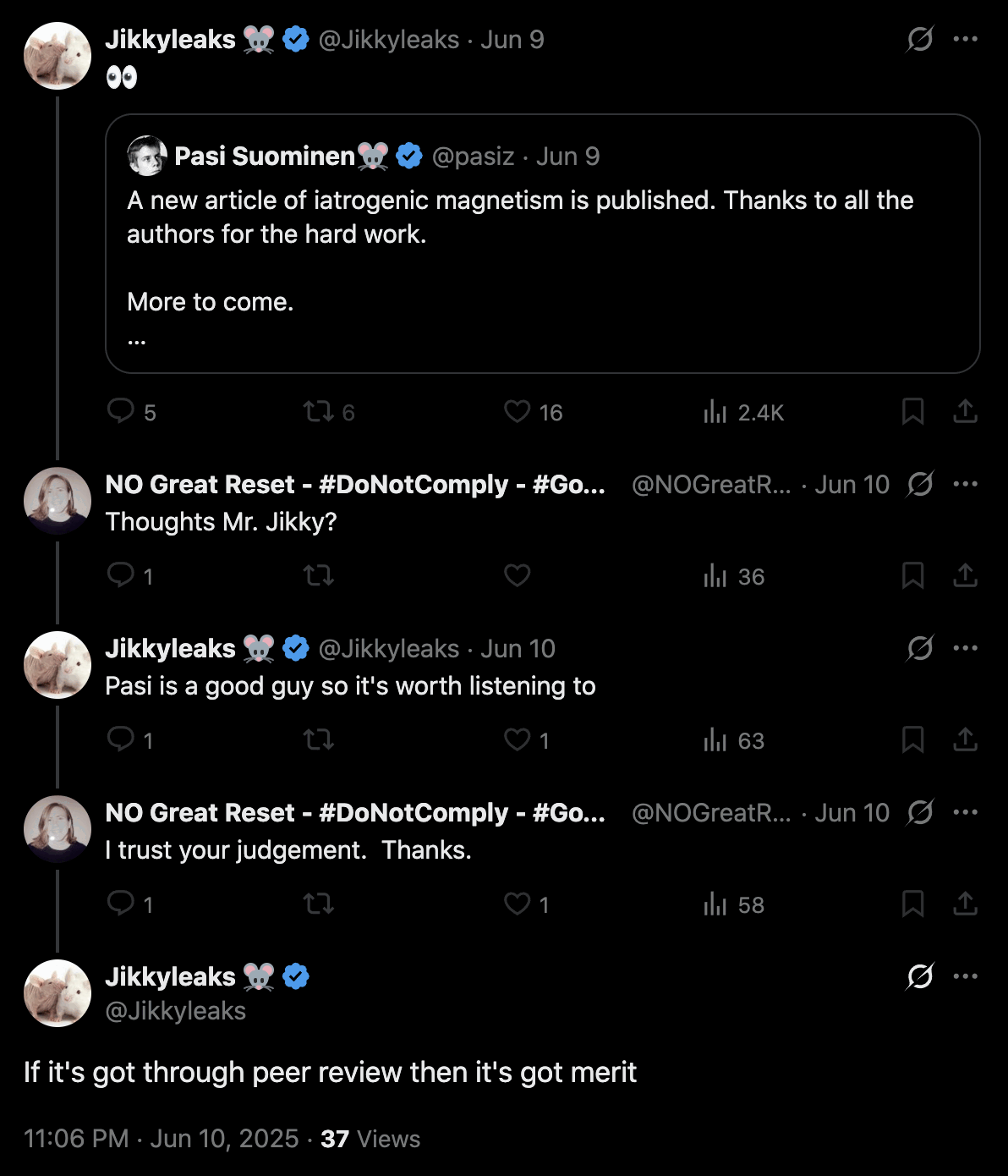
I'm calling Pasi Suominen's group the Finno Columna, because the story that graphene oxide made vaccinated people magnetic was originated by La Quinta Columna. La Quinta Columna came up with #MagnetGate and #BluetoothGate before Jikky came up with his first gate: [https://
A Twitter user called Jesus4AllAlways posted the images below and wrote: [https://
My family of 5 are unlucky patients who took pFIZER Feb 2021 double jab In Rockaway NJ.
Using an Olympus CX 43 lab microscope from January 3, 2024 regular for some reason in November 2024 I observed the fiber looking structures in my blood. I began to research what they were.
Suspicious of the PJab in January to May 2025, I checked my wife and children. Bad news.
I observed the same strange structures in each of them.Pic 1 shows my May 25 observation of myself
Pic 2 is 22 year old child
Pic 3 is wife
Pic 4 is 20 year old
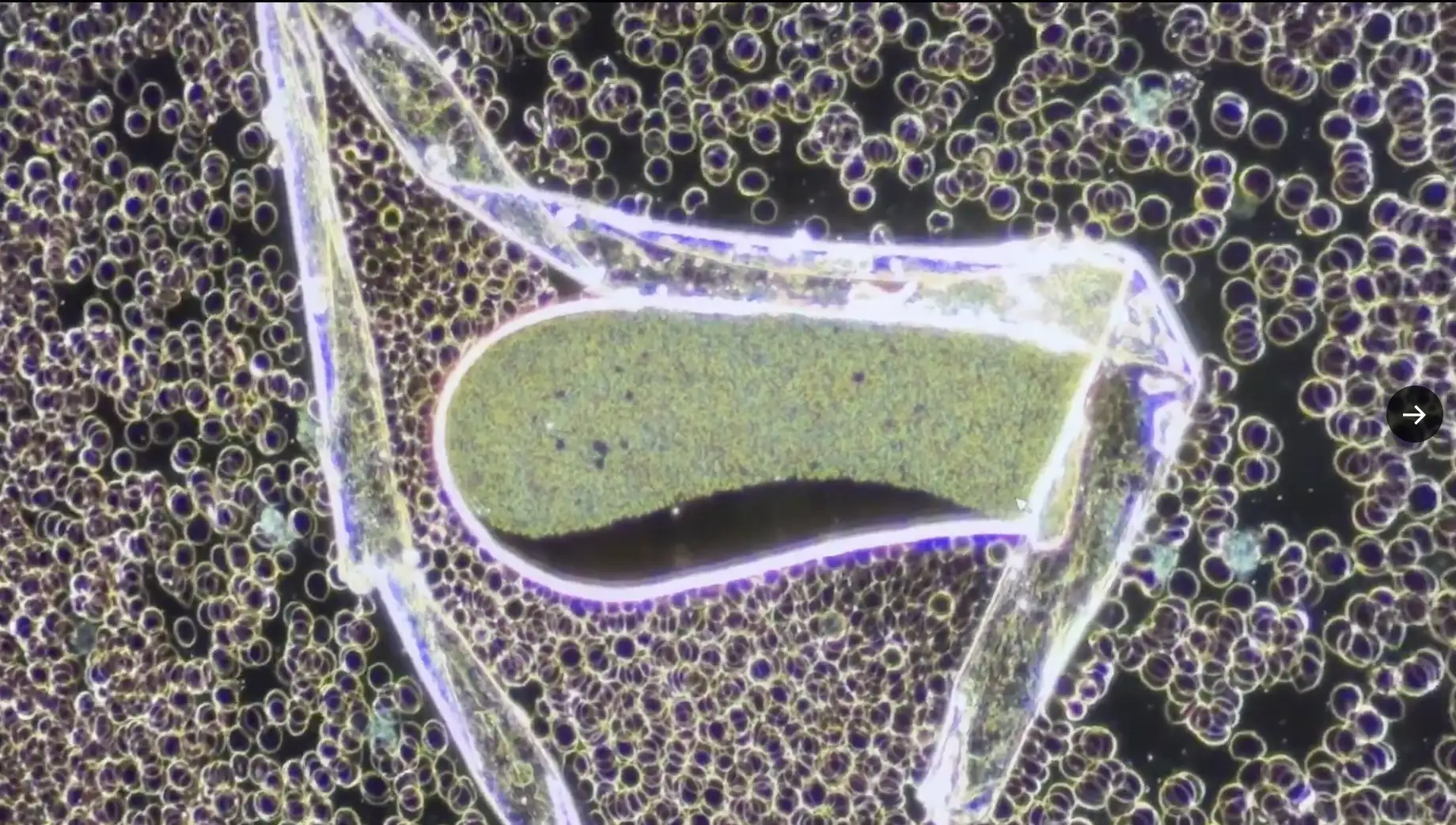
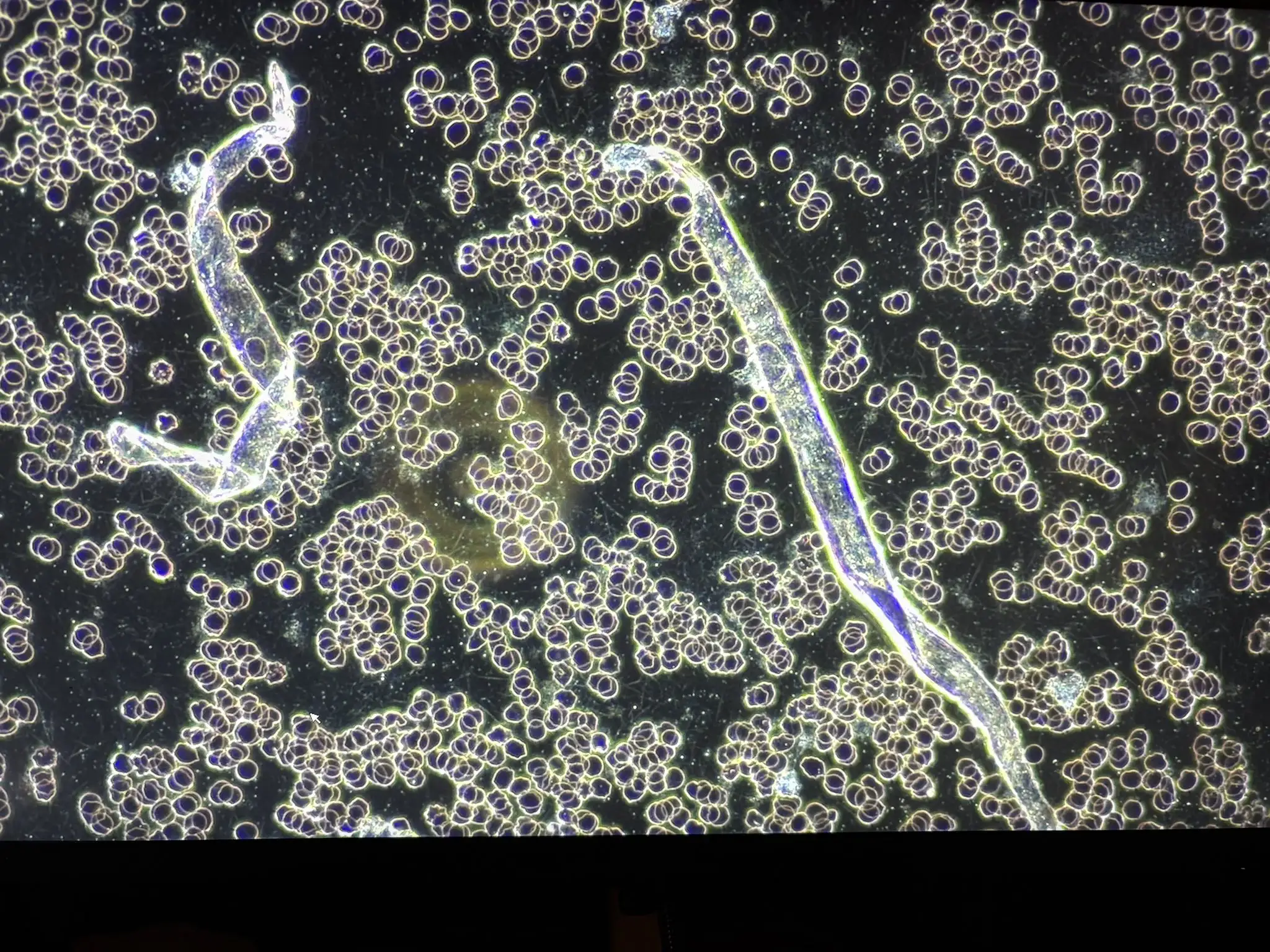
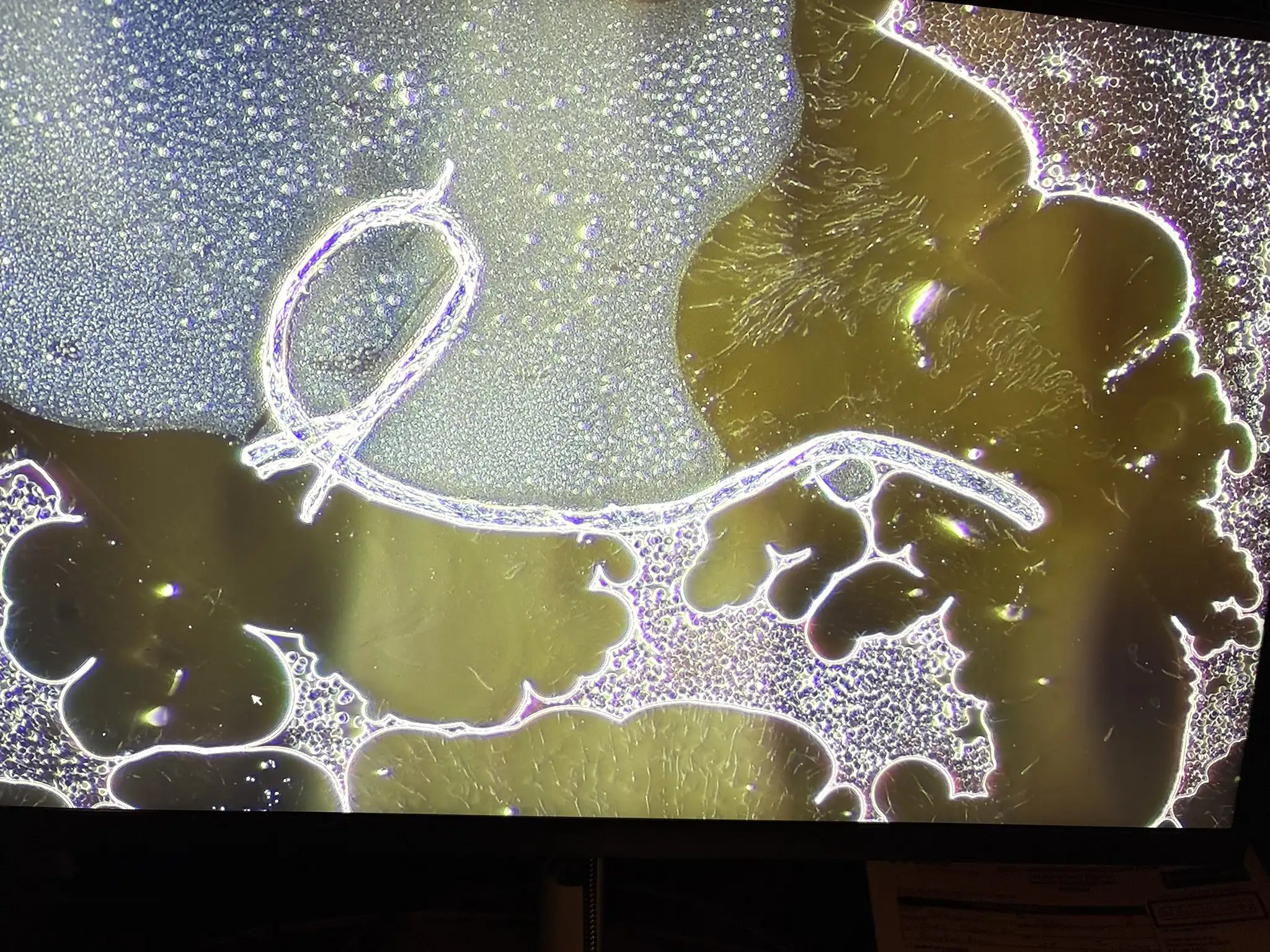
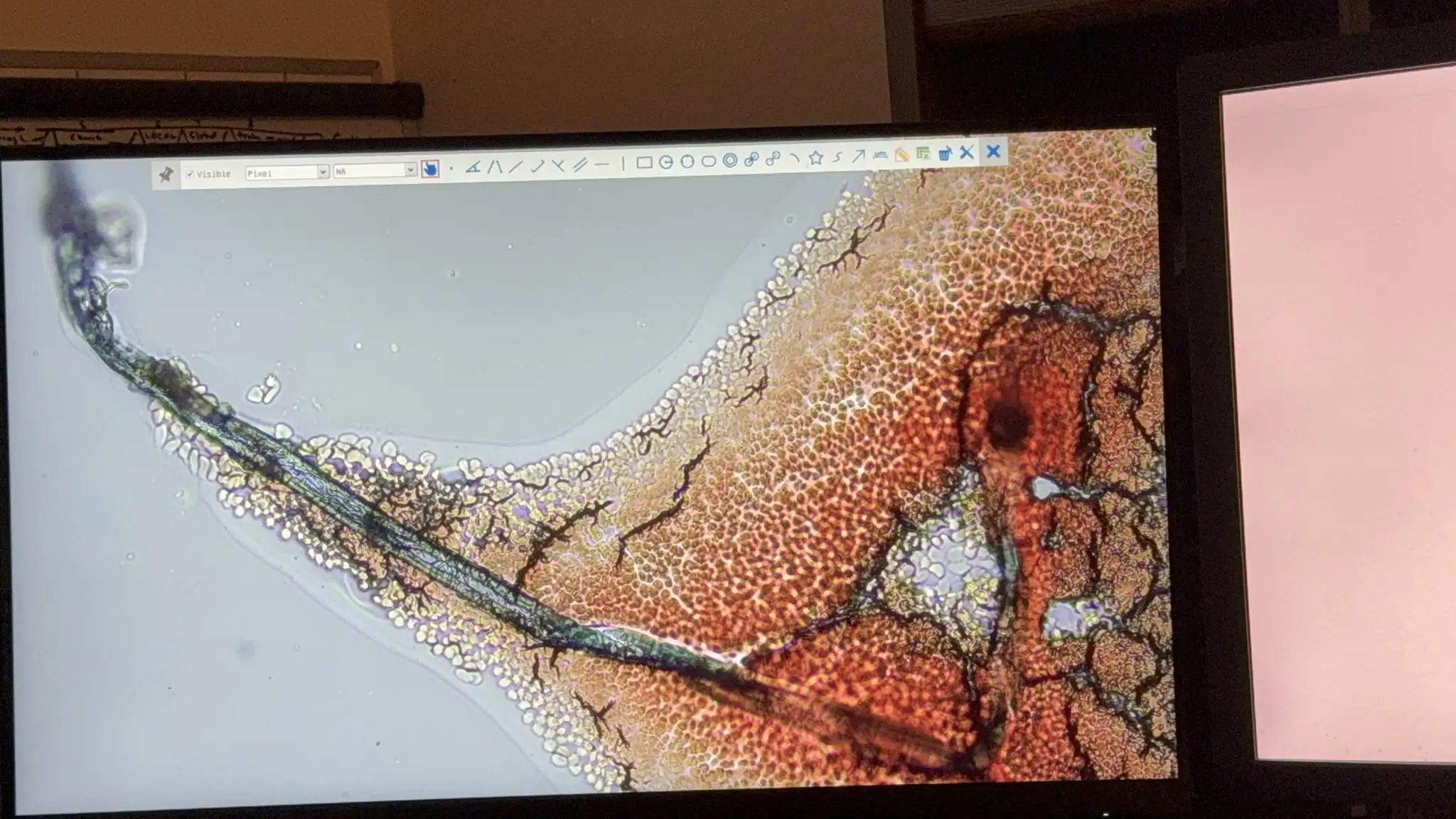
(The first image was actually a video clip, but I included a screenshot of the video above. In the video Jesus4AllAlways said that the cells were white blood cells, even though they're actually red blood cells.)
In a reply to Jesus4AllAlways, McCairn suggested that one or more of the structures in the images were "amyloidogenic fibrin": [https://
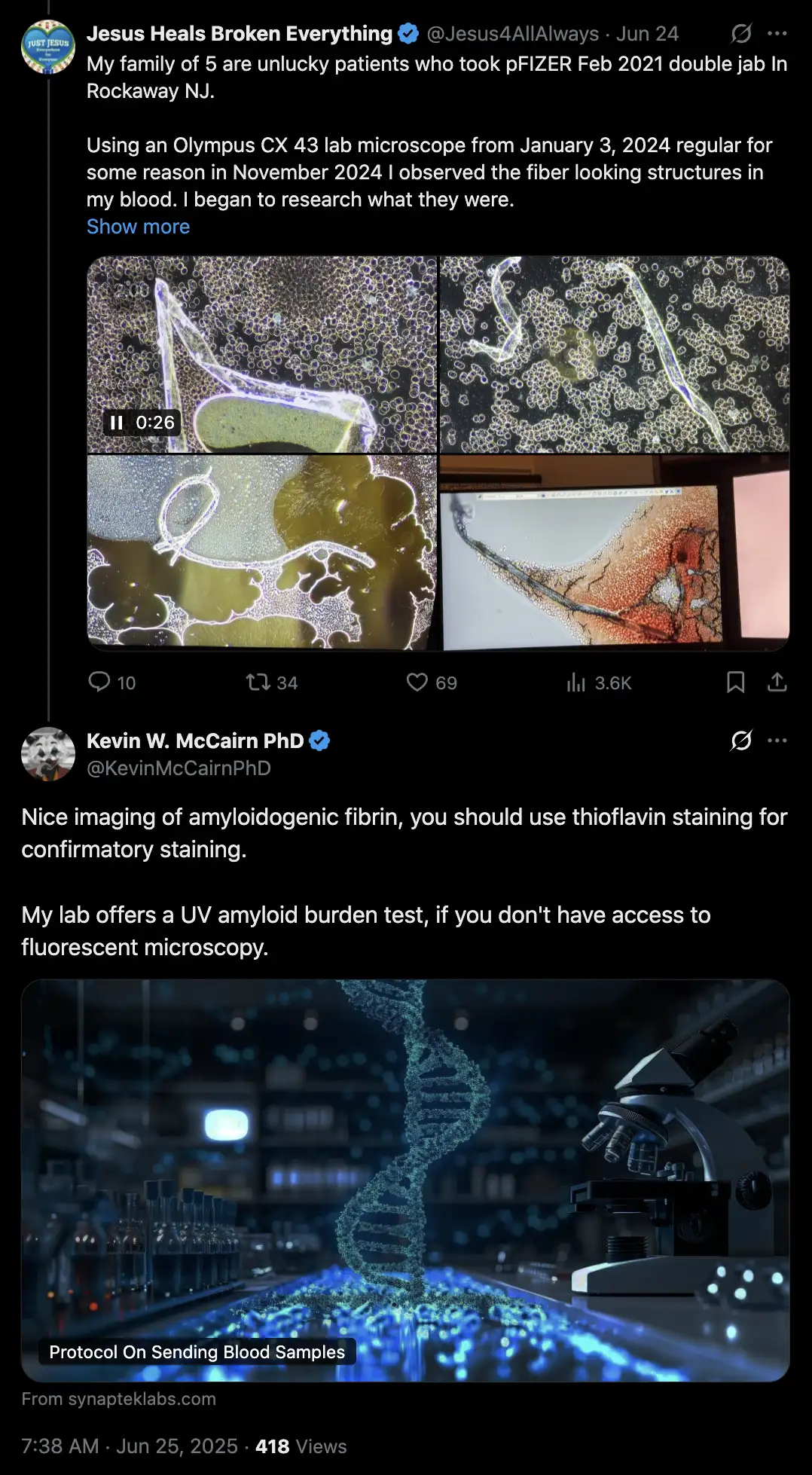
The structures in the first two images are about 3-4 times wider than the red blood cells, but red blood cells have a diameter of about 6-8 µm, so the diameter of the structures is roughly consistent with the fibers McCairn has found in blood samples, which have had a diameter of about 10-30 µm.
Some of McCairn's fibers have been flat like the structures in the first two images, but his other fibers haven't looked similarly flat. But even one of McCairn's flat fibers had a lengthwise fold running along the middle, which was missing from the structures in the images by Jesus4AllAlways. And the fibers in McCairn's microscope images haven't looked as translucent as the structures in the first two images. And McCairn's fibers haven't usually had the kind of folds of about 90 degrees as in the first two images, where you can see different parts of the folded structure overlapping each other. And Jesus4AllAlways didn't even do UV microscopy or ThT staining.
So then why was McCairn ready to declare that the structures in the images were "amyloidogenic fibrin"?
In 2022 when Shimon Yanowitz was on Maria Zeee's show, he showed an image of the structure below, which has similar folds as the ribbons in the blood of Jesus4AllAlways. Yanowitz said the structure was a killer tube which could be programmed to kill the host, and he said: "There are now billions of people walking around with some structures inside of them that could be commanded to open up and release the payload upon external command at will." [https://

This is what ChatGPT said about Shimon's killer tube:
This image shows a ribbon-like structure under a microscope, viewed with polarized light or differential interference contrast (DIC), based on the high-contrast, crystalline-like edges. The object in question is highly consistent with a synthetic microplastic fiber, most likely polyester, nylon, or another textile-derived filament.
Characteristics Supporting This:
Flat, crumpled ribbon appearance typical of synthetic fibers.
High birefringence (bright glow under polarized light), which is characteristic of plastics.
No internal biological structure (e.g., no nuclei, organelles, or cellular components).
The irregular folding and twisting are typical of how synthetic fibers behave when dried or compressed.
Ana Mihalcea said that similar translucent ribbons with folds were "hydrogel filaments": [https://

ChatGPT said that Mihalcea's hydrogel filaments were likely to be synthetic fibers:
Left Image:
The background consists of what look like red blood cells (RBCs) - biconcave discs, tightly packed.
The ribbon runs diagonally and has a smooth, semi-transparent appearance with light-scattering properties, suggesting it is not biological tissue.
The ribbon's uniform thickness and reflective surface suggest it could be a polymer fiber, perhaps from clothing or lab materials (e.g., polyester or nylon).
Right Image:
A similar structure is seen again, this time bent at an angle.
The bright refraction and internal stress patterns visible under polarized or brightfield illumination are typical of synthetic materials, not biological ones.
The presence of RBCs again near the ribbon supports that this is a foreign object in a biological sample.
Conclusion:
The ribbon in both images is most likely a synthetic fiber accidentally introduced into the sample - possibly from clothing, gloves, wipes, or sample coverslips. It is not a biological structure.
Similarly when I asked what the ribbon in the video by Jesus4AllAlways was, ChatGPT answered: "The structure has sharp folds and flat surfaces, consistent with plastic sheeting or synthetic ribbon fibers, not biological tissue."
Added later: I asked McCairn if he still stuck to his claim that the images by Jesus4AllAlways showed "amyloidogenic fibrin", and if by "amyloidogenic fibrin" he referred to the flat ribbons with folds. He indicated that he did refer to the flat ribbons with folds, and he said: "I would say from that image of that the ribbon like structure is consistent with the morphology of amyloid fibrillar forms seen in long covid and vax injured." [https://
However I again uploaded Mihalcea's images of hydrogel filaments to ChatGPT, and I asked if the folds and flat shape were consistent with a fibrin clot. But ChatGPT said:
No - sharp folds like the ones in your image (especially the ~90° bend in the right-hand picture) are not characteristic of natural fibrin clots.
Here's why:
Fibrin mechanics: Natural fibrin fibers are semi-flexible biopolymers. When bent, they curve smoothly because the protofibril bundles resist sharp angles - you get arcs, not crisp corners.
Amyloid fibrin: Even when fibrin is converted into amyloid-like β-sheet-rich forms, it becomes stiffer and more brittle, but it still tends to fracture or kink irregularly rather than form a neat, flat, ribbon-like corner.
Your sample: The flat cross-section, uniform thickness, and clean angular bend are far more consistent with synthetic fibers (e.g., textile microfibers), which can hold a crease from manufacturing or folding.
In short, a true natural fibrin clot won't spontaneously develop a paper-fold-style corner under physiological conditions or during slide prep - unless it's being mechanically crushed between coverslip and slide, in which case it fractures rather than bends smoothly at 90°.
In July 2021 Philippe van Welbergen presented the microscope images of vaccinated blood below, and he suggested that the translucent ribbon with folds was made of graphene oxide. The ribbon is about 3-4 red blood cells wide, so it has a similar diameter as the ribbons shown by Jesus4AllAlways and Mihalcea: [https://
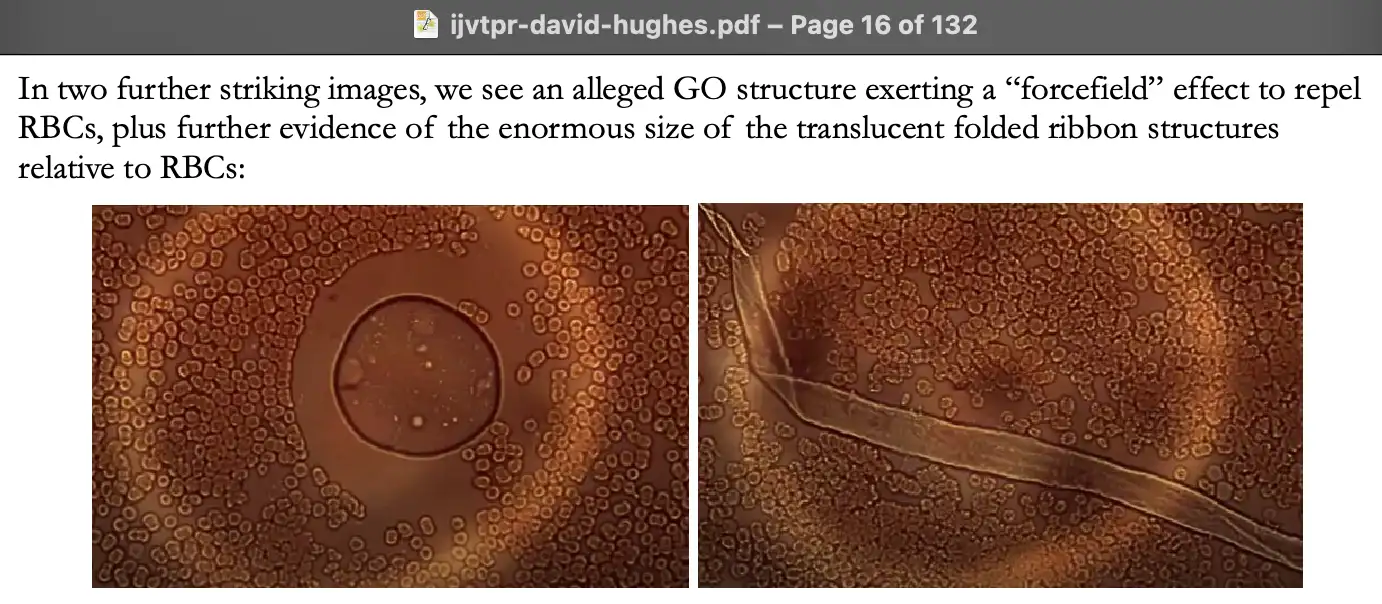
Just like McCairn, van Welbergen also suggested that the presence of ribbons was somehow a characteristic of unhealthy vaccinated blood:
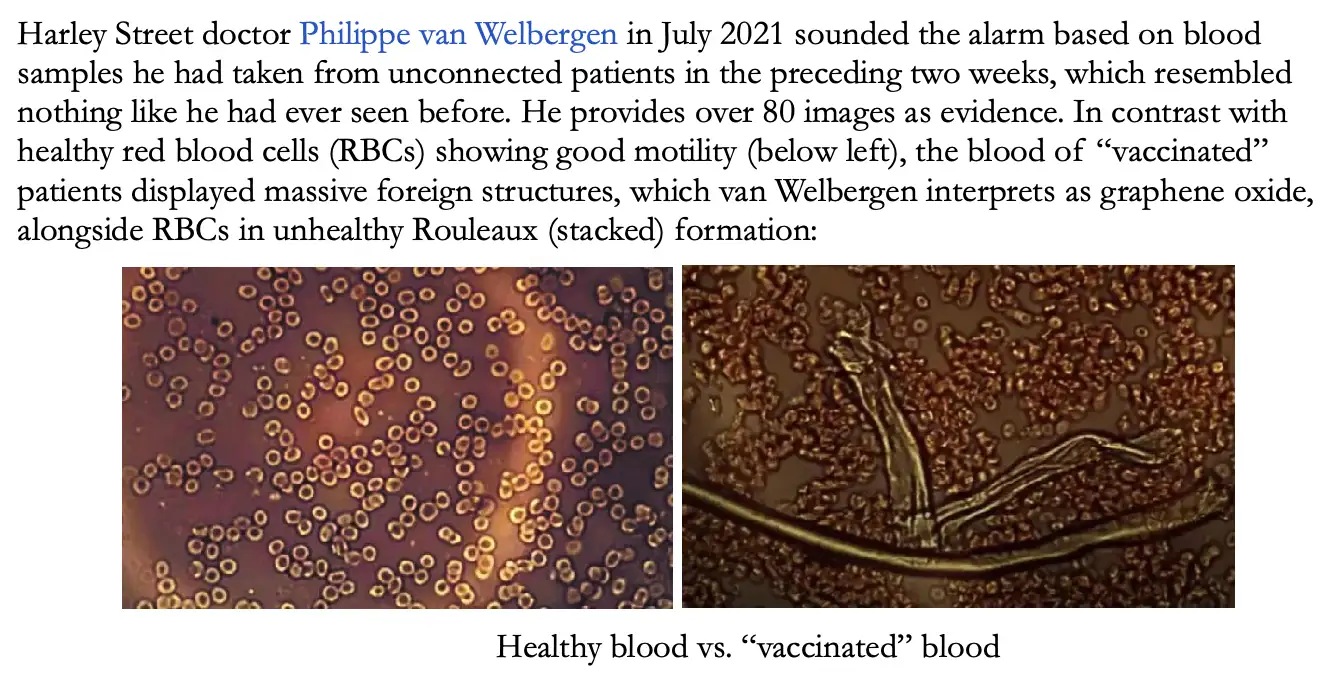
In 2021 Jane Ruby did a video where she showed the photos below, and she said: "Dr. Welbergen calls those gold structures tubes, when he magnified them even further on a regular microscope. They are actually in a tube form, and you can see the opening on either end of those. Remember, this looks strikingly like the graphene oxide that we saw under the regular microscope, from the Spanish researchers like the Quinta Columna, where you saw that folded over protein that looked like it was like a piece of Kleenex under a pane. And that's what this is." [https://
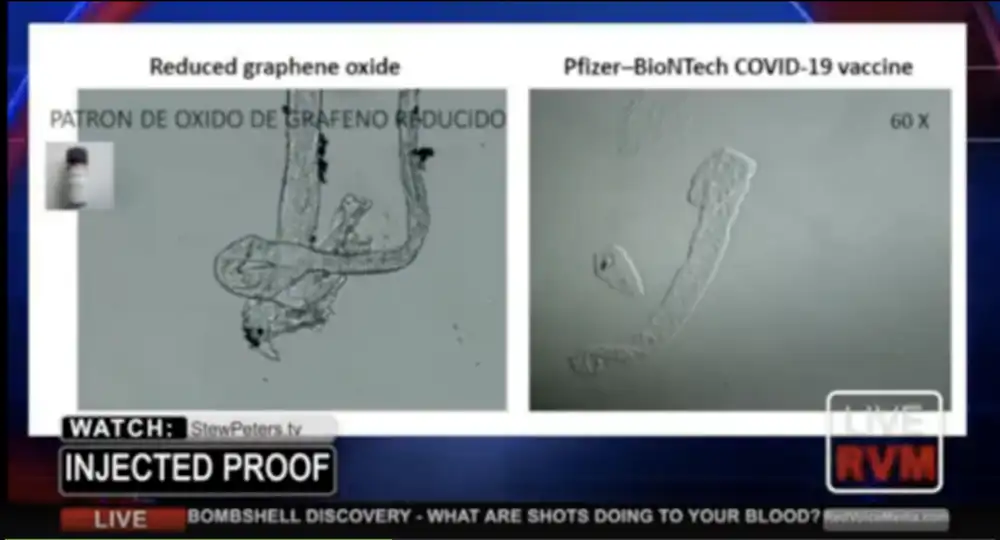
Kevin McCairn told me that the calamari clots are "very clearly blood vessel occlusions, composed of amyloidogenic protein, that have the same properties as amyloidogenic micro clots, that have been proven human tissue through genomic testing". [https://
However I told him: "A clump of fibrin is not tissue. If you dipped some rubber in blood and tested it genetically, you would find human DNA from the blood, but that doesn't mean the rubber would be human tissue. It's possible the clots have a human origin, but I think it has not yet been proven." And I showed him this response from ChatGPT:
Calling such clots "human tissue" would be misleading. Here is why:
Blood clot composition: A fibrin-rich clot with little entrapped blood cells is still just a coagulum of protein (fibrin) rather than a structured tissue. It lacks organized cells, extracellular matrix, vasculature, or architecture typical of tissue.
Definition of tissue (in biology/medicine): Tissue is a collection of cells (of one or more types) and their extracellular products, organized to perform a function. Examples: epithelial tissue, muscle tissue, connective tissue.
Clot vs. tissue: A clot is an acellular polymer network (fibrin mesh) that sometimes traps platelets, leukocytes, and red blood cells. While it originates from blood (a fluid connective tissue), a fibrin clot by itself is not equivalent to "human tissue."
Terminology in practice: Pathologists or hematologists would usually describe this as "fibrin clot," "fibrinous exudate," or "thrombus" (if formed in vivo), but not "tissue."
McCairn posted an AI response which said that the clots are not human tissue, but the clots can be still viewed as a "quasi-tissue scaffold", or the clots can be considered to "function as novel pathological pseudo-tissue": [https://

But I told him that those were bad copes, and that he is a quasi-scientist and he functions as a pseudo-scientist. He cannot even tell protein apart from tissue, or a peptide apart from a protein, or a micrometer apart from a micromolar, or a dust fiber apart from an amyloid fibril.
I told McCairn I hadn't found evidence that string-like fibrin clots with a diameter of about 10 to 30 µm would be circulating freely in human blood. He responded by showing the images below from a paper where the senior author was Resia Pretorius, and he wrote: "Row B is a string like microclot that would be well over 100 micrometers, as it fills the whole micrograph, from whole blood, and stained with ThT." [https://

I pointed out that the string-like segments on row B had a diameter of only about 1 µm. They also seem to be part of a web-like structure and not lone isolated fibers.
Then I asked ChatGPT to list the diameters of different types of fibers that appear as contaminants on microscope slides. Most types of fibers it listed have a diameter around the range of 10 to 50 µm, which matches the diameter of the fibers that McCairn has found in blood samples:
Synthetic Fibers
- Nylon: ~10-50 µm
- Polyester (PET): ~10-30 µm
- Acrylic: ~10-25 µm
- Polypropylene: ~20-50 µm
- Rayon (regenerated cellulose): ~12-20 µm
Natural Fibers
- Cotton: ~10-40 µm (flat, twisted ribbon-like appearance)
- Wool: ~15-40 µm (scaly surface)
- Silk: ~10-15 µm (smooth, uniform diameter, triangular cross-section)
- Linen (flax): ~12-16 µm
Mineral and Glass Fibers
- Asbestos: ~0.02-3 µm (often below light microscopy resolution, needle-like)
- Glass fibers: ~1-20 µm (uniform, cylindrical)
- Rock wool / slag wool: ~2-10 µm
Other Microscopic Fibers
- Cellulose fibers (paper fragments, wood pulp): ~10-50 µm
- Carbon fibers: ~5-10 µm
For example these cotton fibers are about 20 µm wide at the widest point: [https://

In this image, the cotton and linen fibers both have a diameter of about 20 µm: [https://
The next photo supposedly shows hydrogel filaments that Mihalcea found in the blood of a corpse embalmed by Hirschman. The filaments are about 2 to 3 red blood cells wide, which is about 15 to 20 µm, because red blood cells typically have a diameter of about 6 to 8 µm: [https://

The fiber below also had a diameter of about 2 to 3 red blood cells, even though Mihalcea claimed the fiber was a carbon nanotube, and carbon nanotubes have nano-scale or pico-scale diameters: [https://
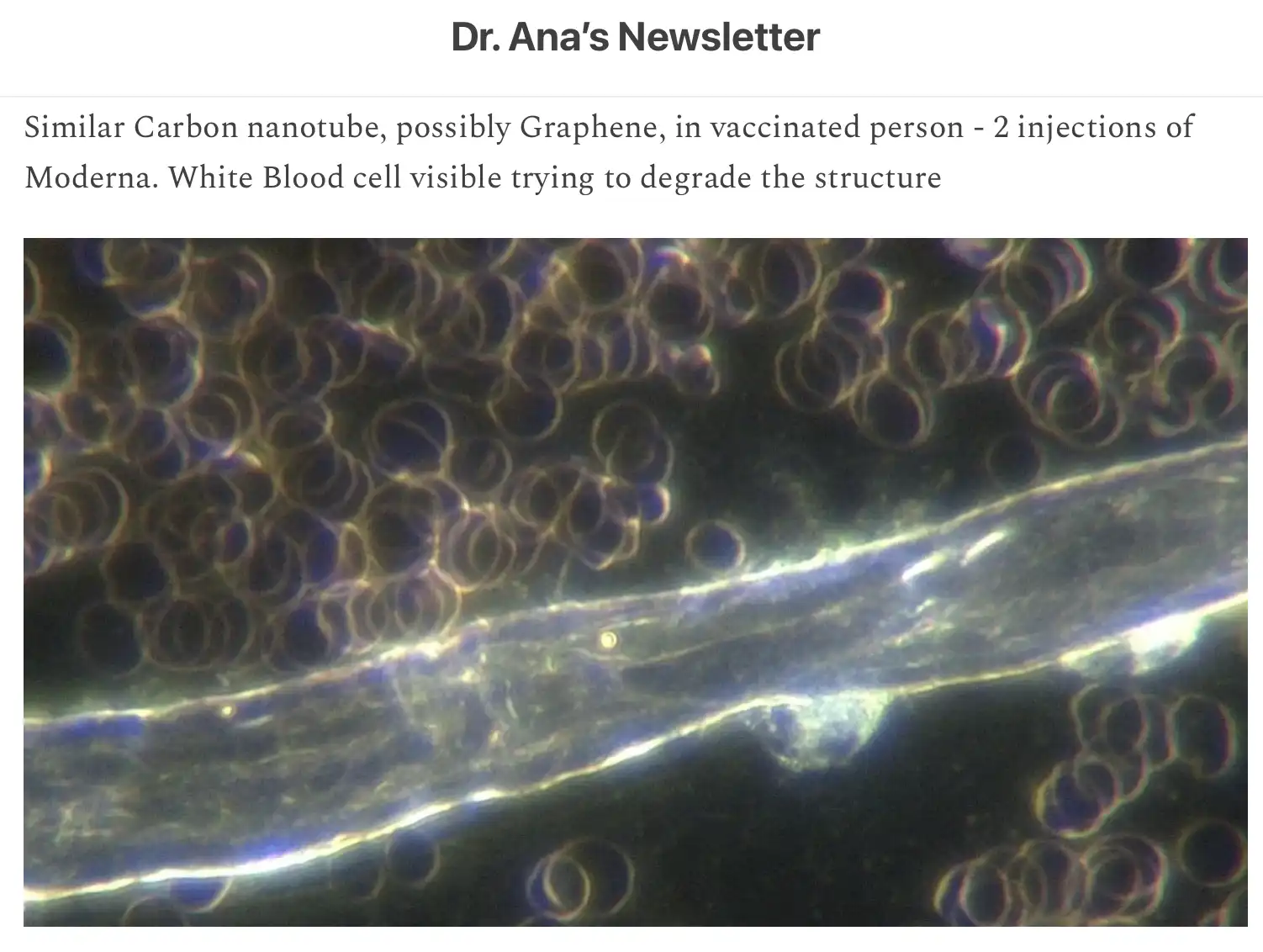
These fibers in the blood of the son of Jesus4AllAlways were also about 2 to 3 red blood cells wide: [https://
McCairn said that the fiber below was a "fibrillar form clot" that he found in his own blood. The fiber is about 3 to 4 red blood cells wide at the widest point. McCairn said the scale bar was wrong and it was supposed to be 50 µm wide, but based on the size of the red blood cells, the scale bar might be closer to about 100 µm wide: [https://
McCairn supposedly found the fiber below in the blood of Lyndsey House in 2024. If the scale bar is accurate, then the fiber is about 15 µm wide: [https://
Robert Young also found a scary fiber with a diameter of about 3 red blood cells in vaccinated blood: [https://
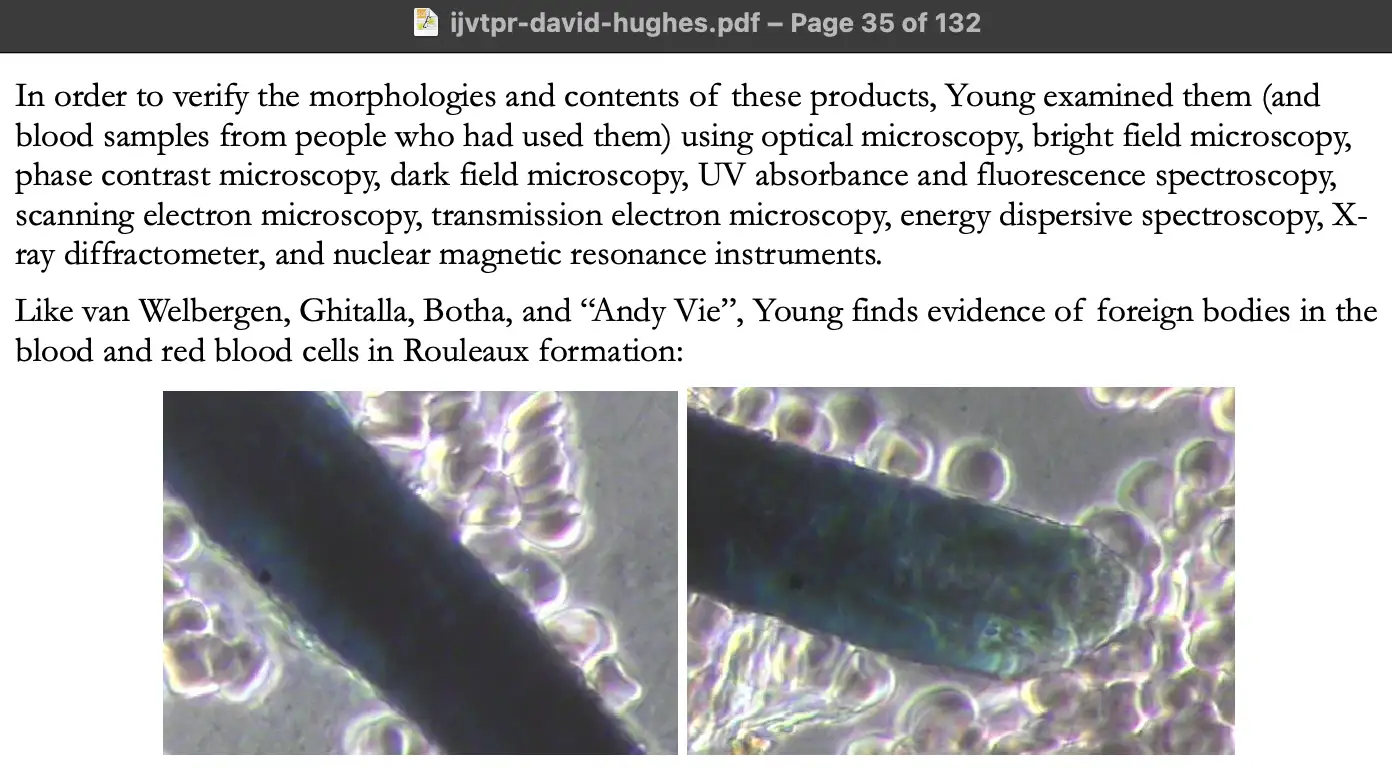
Clifford Carnicom's website has an archive of articles going back to 1999. His early articles focused on topics like chemtrails and HAARP, but his first article about Morgellons disease is from 2006. [https://

However Carnicom failed to mention that both the diameter and the twisted shape were characteristic of a fiber of cotton. He also posted these images of fibers in the sample, which look like cotton because they have a flat cupped shape, and they have the kind of twists that are called "convolutions" in cotton:


In Carnicom's second post about Morgellons disease, he wrote about a sample he is supposed to have received from another Morgellons patient. He posted this close-up photo of one of the fibers in the sample, where you can now see the flat cupped shape even more clearly: [https://

Carnicom wrote that the diameter of the fiber was approximately 40 µm, which would be about 3-4 times wider than his earlier fiber that he said was about 10-12 µm wide. Fibers of cotton typically have a diameter of about 10-40 µm, or sometimes a narrower range of variation is given as 12-25 µm. However Carnicom's estimates of the diameter might have a fairly wide margin of error, because in another post he estimated that a structure in his image had a diameter between 3 and 10 µm, so his maximum estimate was more than 3 times higher than his minimum estimate. [https://
Carnicom said that his Morgellons filaments were composed of multiple "sub-micron filaments" which were packed together within a "bounding filament". By the "sub-micron filaments", he might have referred to segments of the fiber that were separated by the lengthwise striations which are characteristic of cotton. In one post he wrote: "The diameter of the bounding filament generally ranges from 20-40 microns in thickness." [https://
In June 2025 McCairn did an experiment where he mixed fibrinogen with ThT, heated it up to 42 degrees, and shook the mixture, and as a result he claimed he was able to create the fluorescent fibers below. He said that "using heat and shaking, we've managed to make the fibrinogen aggregate into an amyloidogenic form". [1:39:39] And he said: "In this instance I've been able to make fibrillar forms twisted reactive profile that looks very similar to what we're seeing in the blood. And again, what's the critical factor here? Is it the temperature? Is the Thioflavin intrinsically causing a reaction to the fibrinogen? Is the concentration of fibrinogen too high?" [1:29:43] He was surprised to find fiber-like structures that looked similar to the so-called "amyloid fibrin aggregates" he found in blood samples, even though his experiment was supposed to be the control run where he just looked at regular fibrinogen and he didn't apply any special procedure to form amyloid fibrin, like mixing in LPS or spike protein peptides with the fibrin. But he didn't rule out the possibility that the fibers were not made of fibrin, but they were just contaminants on his slide: [https://
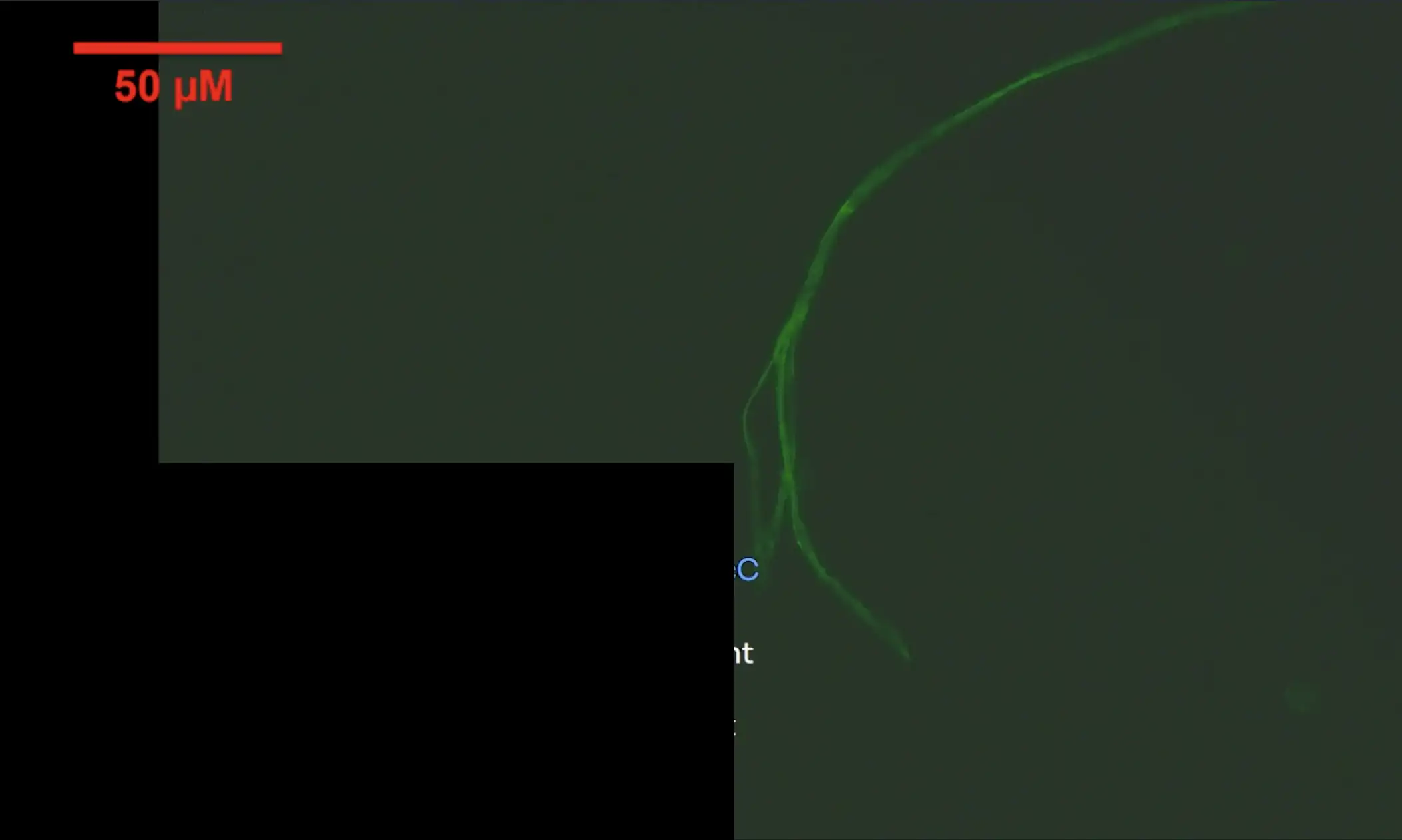
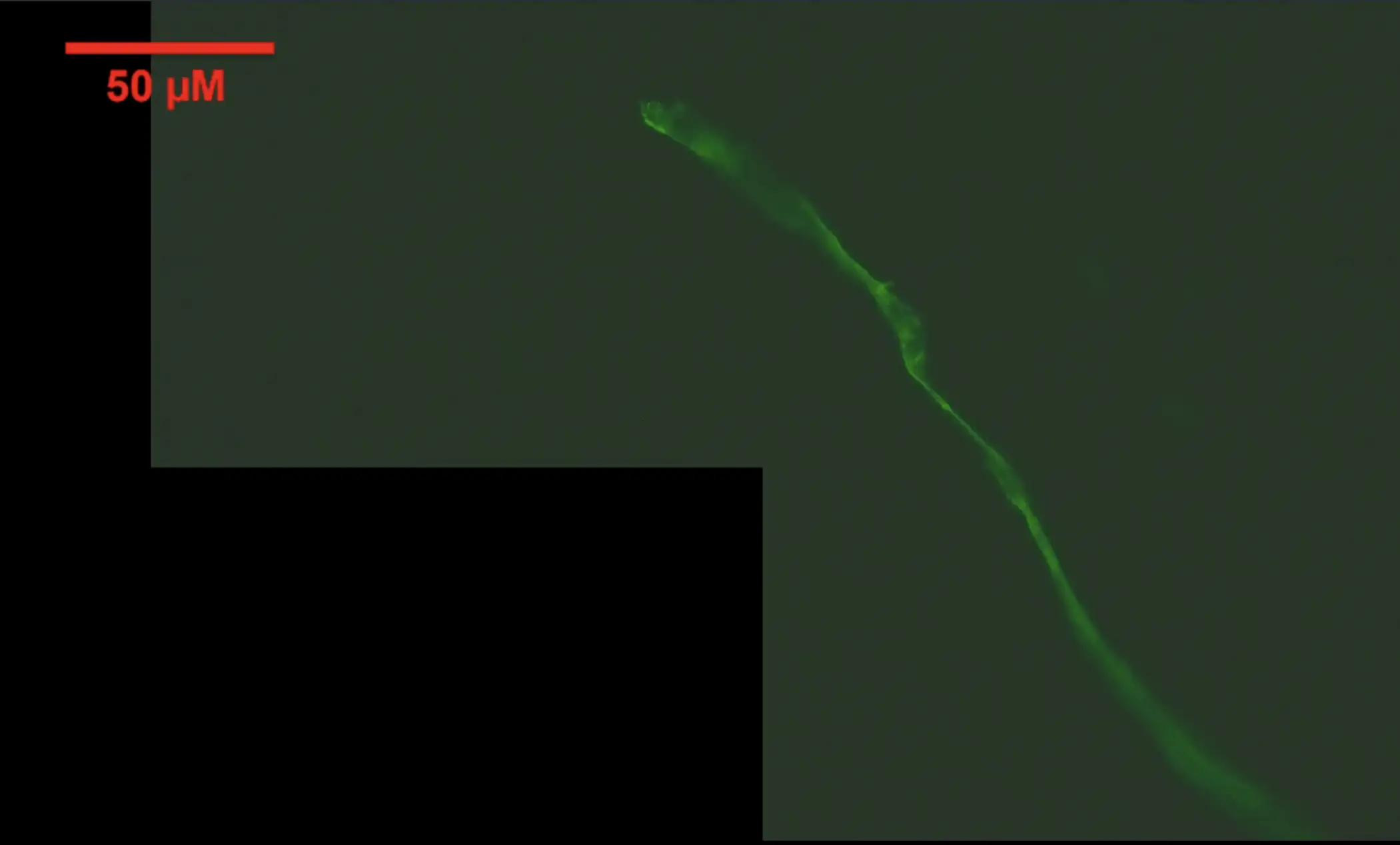
At time 1:18:12 he said "What I've done to try to remove confounders that - fibers, dust, et cetera that could get to our preparation - so every sample that we're using here, has been passed and filtered through a - basically anything larger than a 100 micrometers would not pass the filter". But he didn't mention that dust fibers narrower than 100 µm might still pass through the filter.
He should've also repeated the experiment without the Thioflavin, so he could've seen if he found similar fibers that were autofluorescent without Thioflavin.
When I asked McCairn why the fiber in KenCaptn's blood had a flat shape, McCairn said it was because blood vessels are flat. But the fiber in the second image above also has a flat shape, even though the fiber didn't form inside a blood vessel.
In 2025 when Ian Musgrave said that the fiber in the 3-year-old's blood was cellulose and McCairn got a false positive with ThT, McCairn said that in order to eliminate false positives, "I run antibodies, use SEM/EDX, and Raman on samples". [https://
In 2012 the CDC published a study where they analyzed fibers that were said to be Morgellons filaments, but the fibers were found to be textile fibers or cellulose. For example the IR spectroscopy results of the fiber below were consistent with cellulose: [https://
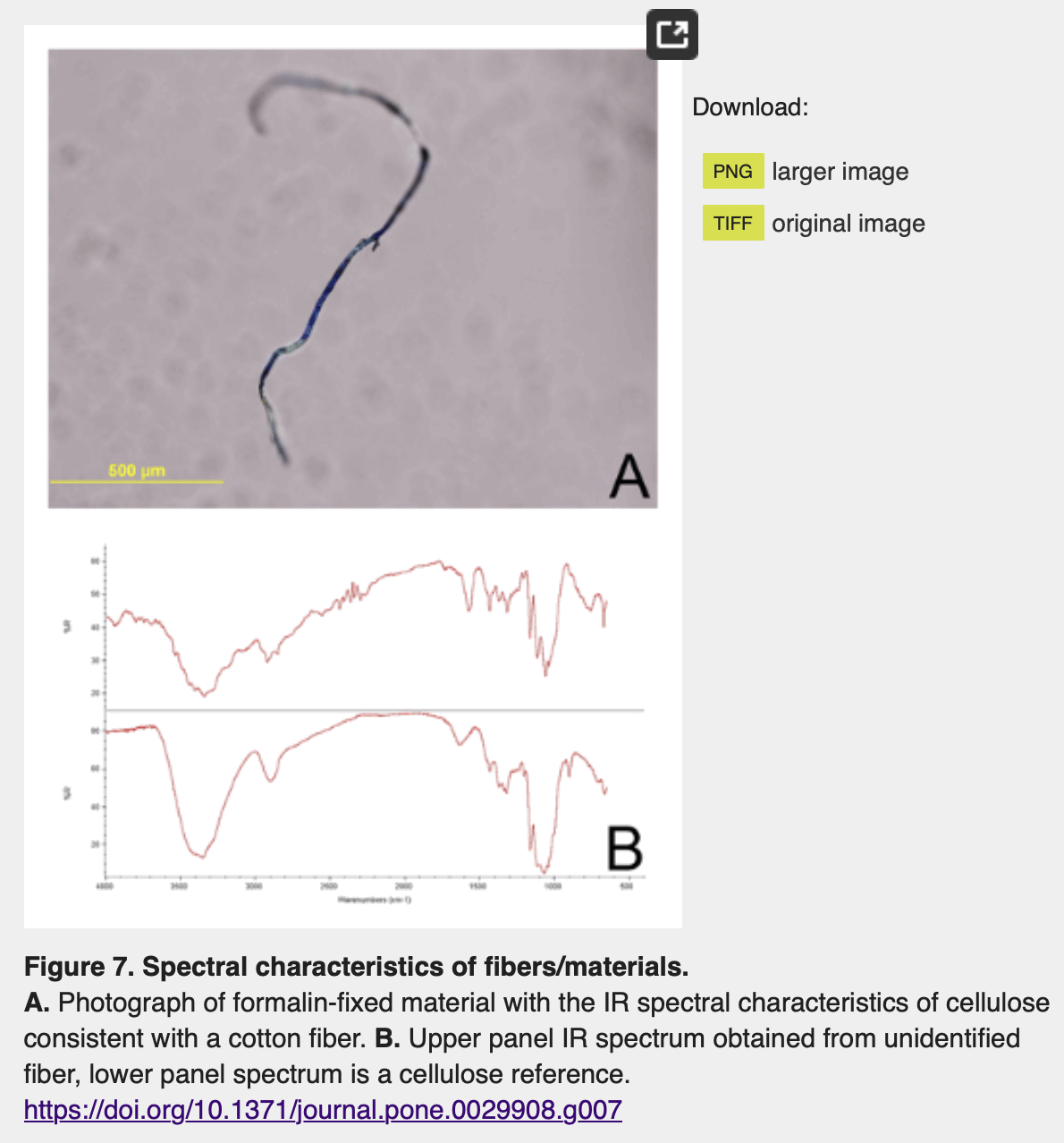
I have never seen McCairn publish similar spectroscopy results of his supposed fibrin clots.
I have told McCairn that the fibers he claims are microclots are morphologically consistent with textile fibers, and I have asked him if he knows of any studies that have described fibrin clots having similar morphology as textile fibers.
McCairn now showed me the image below from a paper by Pretorius and Kell, where the bottom right panel appears to show a segment of an elongated clot with a diameter of about 10 µm. But it's not clear how long the structure is or if it has uniform width throughout its length, even though the width of the structure does seem to taper off suddenly towards the right side of the image. The structure doesn't look flat, but it's not clear if other parts of the structure would look more flat. The structure is also not uniformly fluorescent like some of McCairn's fibers have been: [https://
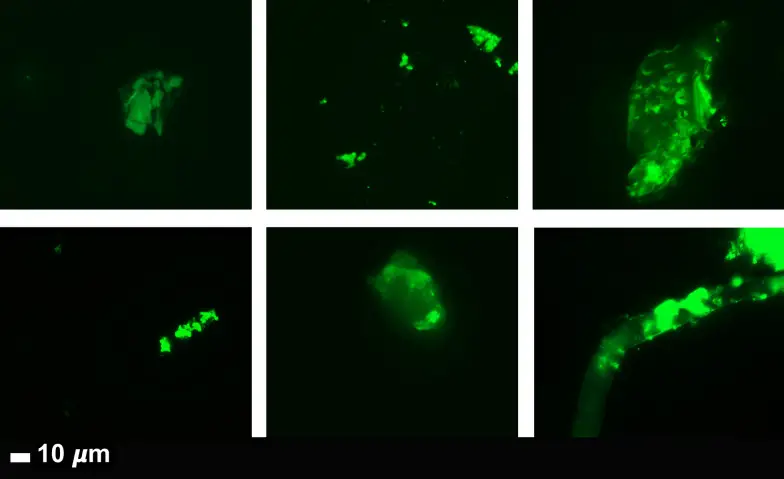
McCairn also found an Indian paper that included the images below, which feature a few structures with a string-like shape that the authors described as microclots: [https://
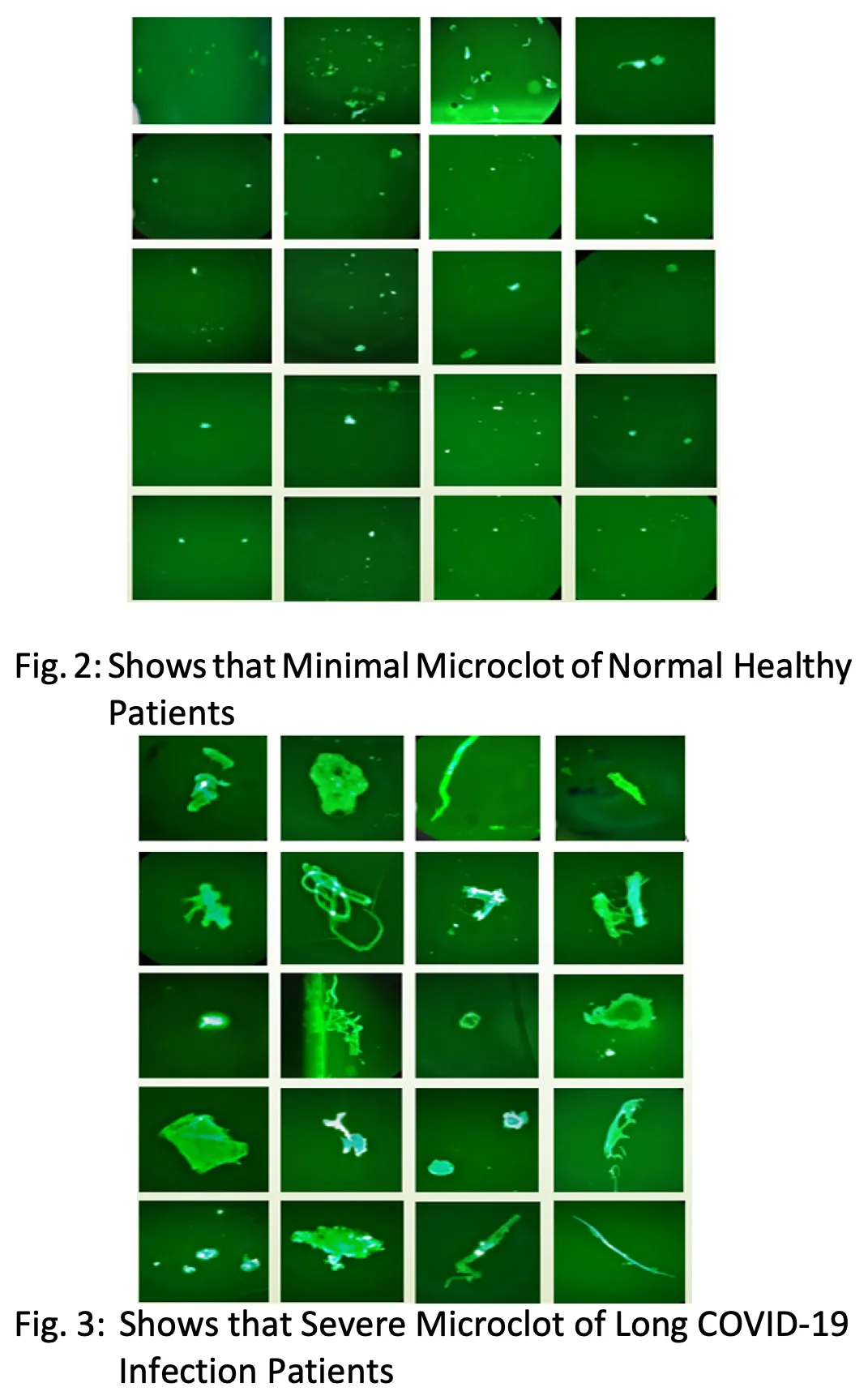
However the images in the Indian paper don't even have scale bars, so it's difficult to tell if the diameter of the string-like structures is consistent with textile fibers or not. And the elongated structures seem to have a more variable diameter than the fibers in McCairn's images, and they have a somewhat gel-like appearance, and they don't seem to be flat. The authors didn't describe analyzing the composition of the structures in order to determine if the structures were even clots made of fibrin. And the paper doesn't seem very credible, because it was written in broken English, and the paper was published in a predatory journal about tropical medicine even though the paper was not about tropical medicine.
McCairn also found a paper from 2025 that described a method for quantifying the number of microclots associated with long COVID in a blood sample. The paper included the figure below, where the top left panel shows an elongated structure with a diameter of about 20 µm: [https://
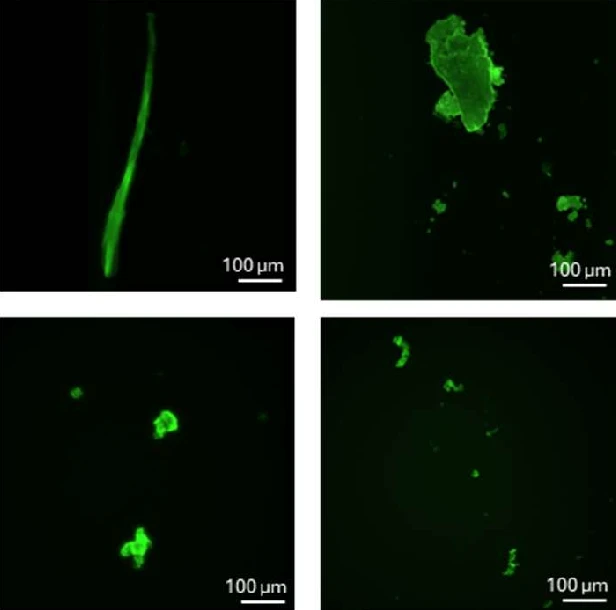
However the elongated structure above looks more cylindrical than flat, and it doesn't have any sharp corners similar to the folds I have described as "paper fold"-style corners. The structure doesn't seem to have the kind of helical twists that are called convolutions in cotton, even though the image has such low quality that the shape of the clot is difficult to discern. The structure also appears to have a fairly high degree of variability in diameter, so that the diameter is tapered off towards the top of the image. The structure also seems too wide to even pass through the capillaries. And the authors of the study did not describe determining if the structures in the images were even made of fibrin, or doing any kind of filtering to remove non-fibrin structures from the blood.
Next McCairn found the figure below from a paper where the authors quantified the amount of fibrin microclots in 84 children and young adults. But like in the case of the other papers, the authors didn't describe determining the composition of the structures to verify if they were actually clots made of fibrin. But even if the structure on the right is actually a clot made of fibrin, it doesn't look flat, it has quite a bit of variability in diameter along its length, it doesn't have sharp "paper fold"-style corners, and it doesn't have the kind of lengthwise fold running along the middle as the fiber McCairn found from Lyndsey's blood. And the structure has a diameter around 20 to 30 µm, which is too wide to even pass through a capillary: [https://
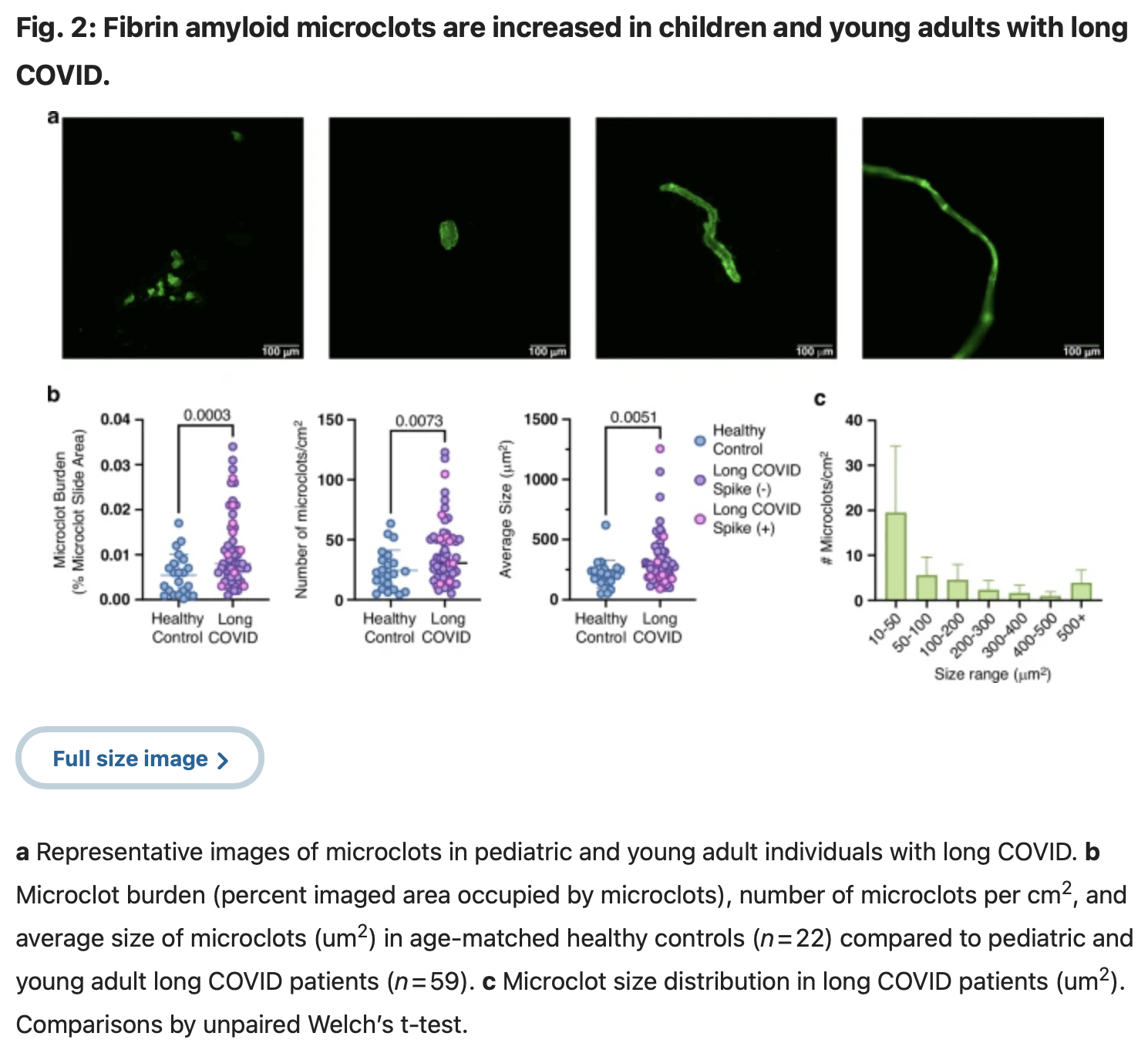
In 2024 The People's Voice quoted McCairn claiming that vaccines were responsible for the sudden deaths of athletes and for turbo CJD: [https://

In 2026 Steve Kirsch wrote a Substack post where he estimated COVID vaccines killed about one in a thousand people, and he listed 12 points of evidence in support of his estimate, where 8 points consisted of anecdotes from various sources, and one point was a survey he conducted on Twitter. I have been telling Kirsch that in the hierarchy of evidence pyramid, there should be a special place 20 levels underground for Steve Kirsch surveys.
But some of his anecdotes are possibly even dumber than his surveys. He might have just made up some of the anecdotes, because one of his sources was supposedly the coach of a soccer team, who said two players of the team had died of prion disease since the vaccines were rolled out. Kirsch wrote: [https://
I spoke today to the 10 year coach of a men's soccer team. She mentioned that before the COVID shots, they never had a death on the 80 person team (ages 26-33 all men).
They had 3 deaths since the shots rolled out: 2022, 2023, and 2025. Two were prion disease and one was cardiac.
80 vaccinated, 3 unexpected deaths. That's more than 1 per 1,000 for sure; it's like 1 in 27.
ChatGPT said that most deaths from prion disease in the United States are from Creutzfeld-Jakob disease, and the CDC's website says that about 500 to 600 cases of CJD are reported per year. [https://
On NVSS there have been about 500 deaths per year with CJD listed as the underlying cause, and there hasn't been any clear increase above the pre-COVID trend since 2021, and there were only 4 deaths in ages below 34 with CJD listed as the underlying cause in 2021-2024:
v=fread(" curl -Ls sars2. net/ f/ vital. csv. xz| xz -dc") s=v[ year> =2010& cause==" A810"] s[,.( all=sum( ucd), under34=sum( ucd[ age< 34])), year] # year all under34 #2010 356 0 #2011 383 2 #2012 338 0 #2013 428 3 #2014 402 2 #2015 450 0 #2016 459 1 #2017 458 2 #2018 440 1 #2019 518 4 #2020 476 1 #2021 509 0 #2022 514 0 #2023 492 3 #2024 566 1
But I guess there just isn't an ICD code yet for vaccine-induced turbo prion disease. Or CDC is evil so you can't trust their data or something.

